



Manas Dasgupta
NEW DELHI, Nov 3: An article by the Congress leader and former union minister Shashi Tharoor has provided timely leverage to the BJP to attack the opposition “Mahagathbandhan” in the Bihar elections allegedly for promoting nepotism and dynastic politics.
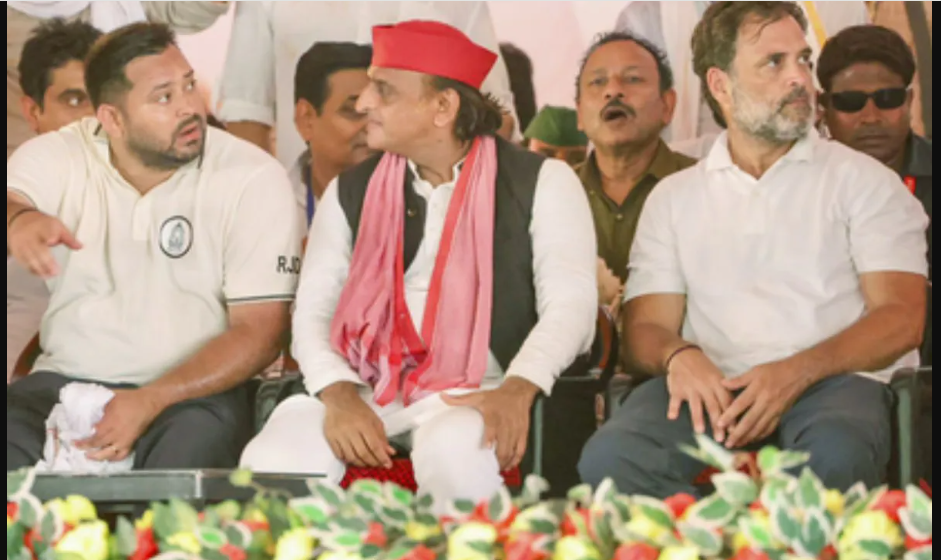
“It is a direct attack on India’s nepo kid Rahul Gandhi and Chhota nepo kid Tejashwi Yadav,” the BJP said on Mr Tharoor’s article titled ‘Indian Politics Are a Family Business,” written for the international media organisation Project Syndicate and published on October 31.
Even though Mr Tharoor’s criticism of dynastic politics was not limited to the Congress and gave examples of several other parties some of which are current or former members of the NDA, the BJP used it to attack the Leader of the Opposition in the Lok Sabha Rahul Gandhi and the “Mahagathbandhan” chief ministerial candidate in Bihar Tejashwi Yadav, the son of the Rashtriya Janata Dal (RJD) supremo Lalu Prasad Yadav in view of the current elections to the Bihar Assembly.
The promise of democracy – government of the people, by the people, for the people – cannot be fully realised as long as Indian politics continue to remain a family enterprise, Mr Tharoor, who contested unsuccessfully for the Congress party chief’s post, said in the article. He also said it was about time that India traded dynasty for meritocracy, and called for fundamental reforms.
“It is high time India traded dynasty for meritocracy. This would require fundamental reforms, from imposing legally mandated term limits to requiring meaningful internal party elections, together with a concerted effort to educate and empower the electorate to choose leaders based on merit,” Tharoor said.
The Thirvanathapuram MP, who served as a minister under the UPA government, said dynastic politics across the political spectrum poses a “grave threat” to Indian democracy. “When political power is determined by lineage rather than ability, commitment or grassroots engagement, the quality of governance suffers. Drawing from a smaller talent pool is never advantageous, but it is especially problematic when candidates’ main qualification is their surname,” he said.
Pointing out that while the Nehru-Gandhi family was associated with the Congress, dynastic succession prevails across the political spectrum in India. In Odisha, after the passing of Biju Patnaik, his son, Naveen, won his father’s seat in the Lok Sabha, Tharoor said. The Maharashtra-based Shiv Sena’s founder Bal Thackeray passed the baton to his son Uddhav, whose own son Aditya is waiting in the wings, he said.
“The same goes for Samajwadi Party founder Mulayam Singh Yadav, a former chief minister of Uttar Pradesh, whose son Akhilesh Yadav later served in the same post; Akhilesh is now an MP and the president of the party. In Bihar state, the leader of the Lok Janshakti Party, Ram Vilas Paswan, was succeeded by his son Chirag Paswan,” Tharoor said, citing more examples of political dynasties.
He then cited examples from Punjab, Telangana and Tamil Nadu. “In Punjab, the Shiromani Akali Dal, long commanded by Parkash Singh Badal, has been taken over by his son Sukhbir. Telangana is currently witnessing a battle for succession between the son and the daughter of the Bharat Rashtra Samithi’s founder, K Chandrasekhara Rao. In Tamil Nadu, the late M Karunanidhi’s family controls the ruling Dravida Munnetra Kazhagam party, with his son M K Stalin now serving as chief minister and his grandson anointed as heir apparent,” he said in his article.
Away from the Indian “heartland”, Jammu and Kashmir has been led by three generations of Abdullahs, with the principal opposition party dominated by two generations of Muftis, Tharoor said. This phenomenon, Tharoor argued, was not limited to a handful of prominent families but was rather woven deeply into the fabric of Indian governance, from village councils to the highest echelons of parliament. He then cited examples from the Indian subcontinent.
“To be fair, such dynastic politics are practised across the Indian subcontinent,” he said, citing examples of the Bhuttos and Sharifs in Pakistan, the Sheikh and Zia families in Bangladesh, and the Bandaranaikes and the Rajapaksas in Sri Lanka.
“But they appear particularly incongruous with India’s vibrant democracy. Why then has India embraced the dynastic model so fully? One reason might be that a family can serve effectively as a brand: candidates with built-in name recognition do not have to work as hard to attract voters’ attention or build their trust. If voters accepted a candidate’s father, aunt or sibling, they would probably accept the candidate — no credibility-building required,” Mr Tharoor said.
Members of political dynasties are likely to be insulated from the challenges faced by ordinary people, they are often particularly ill-equipped to respond effectively to their constituents’ needs, he argued in the article.