


Virendra Pandit
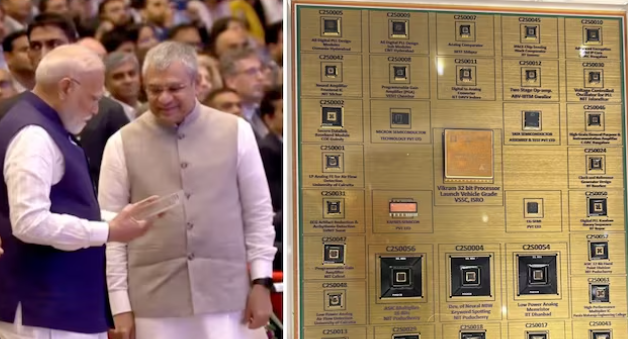
New Delhi: In a significant achievement in the field of high technology, Union Minister for Railways and Electronics & Information Technology Ashwini Vaishnaw on Tuesday presented the first Made-in-India, Vikram 32-bit processor chip to Prime Minister Narendra Modi, saying the country is a lighthouse of stability in the current turbulent world.
The chip presentation marked a significant milestone in India’s semiconductor journey and highlighted the government’s efforts under the India Semiconductor Mission (ISM), the media reported.
Addressing the inaugural session of Semicon India 2025 at Yashobhoomi in the national capital, PM Modi said the government is currently working on the next phase of the ISM and Design-Linked Incentive (DLI) Scheme to make the country self-reliant in these areas.
The three-day event is focussing on advancing a robust, resilient, and sustainable semiconductor ecosystem in India.
The PM said the base of digital infrastructure being critical minerals, India is also working on the Critical Minerals Mission and is committed to meeting the growing demand for rare earth minerals.
The smallest chip being Made in India will start driving the biggest change in the world, he asserted.
Developed by the Indian Space Research Organisation (ISRO)’s Semiconductor Laboratory (SCL), the Vikram chip is India’s first fully-indigenous 32-bit microprocessor specifically designed and qualified for the punishing conditions onboard space launch vehicles.
The initial lot of Vikram 3201 device was successfully validated in space during the PSLV-C60 mission, demonstrating its reliability for future space missions.
After the launch of the ISM in 2021, the Vikram chip was first introduced in March and showcased rapid advances in India’s chip-making capabilities. Within three and a half years, India transitioned from being a major consumer to emerging as a creator of advanced chips, driven by government-backed R&D, stable policies, and robust economic growth. Vikram’s fabrication and packaging took place at SCL’s 180nm CMOS facility in Mohali, Punjab.
The Vikram-32 is a computer chip that can handle different tasks. It works with numbers that have decimals (like 3.14) and is built using a 32-bit design, which means it processes data in chunks of 32 bits at a time, and is designed to withstand extreme temperatures and environments found in spaceflight.
According to ISRO, it can handle substantial memory and execute complex instructions needed for launching satellites and space vehicles, the media reported.
Its robust reliability and versatility also signal its potential for defence, aerospace, automotive, and energy sectors, making it instrumental in strategic applications.
Vaishnaw said the government has approved investments of over Rs 1.60 lakh crore in this sector across six states. With more than 23 design startups supported under the DLI scheme, the event illustrated India’s emergence as a bright spot in the global semiconductor value chain and a “beacon of stability and growth”.
Presenting Vikram-32 to PM Modi was both a technological and symbolic milestone, heralding India’s new era of indigenous semiconductor innovation and global competitiveness, he said.
Vaishnaw said that global policy turmoil has created huge uncertainties. In these turbulent times, India stands as a lighthouse of stability and growth. “You should come to India because our policies are stable,” he told the gathering.
He highlighted the rapid progress being made in the sector. “Today, construction work at five semiconductor units is going on at a rapid pace. Pilot line of one unit is completed, and we just presented the first Made-in-India chip to the PM. Two more units will start production in a few months. The design of five additional units is progressing very well. Ecosystem partners for chip manufacturing are all present here,” he said.
Driven by the PM’s far-sighted vision, he said, ISM was launched. “We collected together a team of globally-renowned industry leaders, and started the new journey with a laser-sharp focus on execution. And here we are today—in a short span of three and a half years, we have the world looking at India with confidence.”
Inviting global investors to participate in India’s semiconductor growth story, Vaishnaw pointed to the country’s rising demand. “Friends, you should also come to India because demand is strong. Our electronics production has grown six times in the last decade, and electronics exports have grown eight times. Demand for semiconductors is increasing every quarter as the Make-in-India program propels new plants in every sector. So, this is the time for you to be in India.”
The minister also shared the stability and professionalism of India’s policy framework. “We have managed the ISM in a transparent and professional way. We have attempted to cover all the important manufacturing sectors, from power electronics to consumer electronics to automobiles to defence and strategic sectors. Our decisions are backed by rigorous analysis done by professionals from the semiconductor industry.”