TDB Adopts Resolution Opposing SC Verdict of 2018 Allowing Women to Enter Sabarimala Temple







Manas Dasgupta
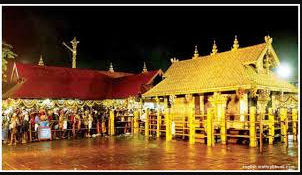
NEW DELHI, Mar 2: The Travancore Devaswom Board (TDB), which runs the famous Sabarimala Temple in Kerala, on Monday passed a landmark resolution opposing Supreme Court verdict of September, 2018 permitting women of all ages, including those in the menstruating age to enter and worship at the temple.
The TDB resolution has immense political ramifications, given the long-standing demand of the electorally significant Hindu social organisations, chiefly the Nair Service Society (NSS), and belatedly the Sree Narayana Dharma Paripalana Yogam (SNDP), that the government uphold Sabarimala custom and tradition, including the bar on women of childbearing age (10 to 50 years) entering the temple.
TDB president K. Jayakumar told a press conference that the resolution would serve as the basis for the affidavit the Board would file with the Supreme Court when the justices meet to review the 2019 order from April 7.
Mr Jayakumar said the TDB’s position was not anything new. “The Board was constituted (in 1949 under the Covenant for the Formation of the United States of Travancore and Cochin) to protect temple traditions (under the provisions of the Travancore-Cochin Hindu Religious Institutions Act XV of 1950).”
Mr Jayakumar said various earlier Board leaderships had opposed women’s entry in principle, but never adopted it as a resolution. “It’s the TDB’s default legal position. Protecting temple traditions is core to the TDB’s constitution,” he said.
Mr Jayakumar said he could not comment on the Left Democratic Front (LDF) government’s position, given that such matters were the Cabinet’s preserve. “When the Supreme Court reviews the subject, the TDB would submit its official position,” he said.
Minutes later, Devaswom Board president V.N. Vasavan told reporters that the Cabinet would revisit the subject. Last week, Communist Party of India (Marxist) [CPI(M)] State Secretary M.V. Govindan hinted that the LDF government would protect the “belief of devotees,” signalling a marked shift from its 2019 position, which upheld the Supreme Court verdict.
Mr Govindan had also drawn a line between left ideology and governance, ostensibly on the issue of women’s entry, by stating that the administration need not always tow the party line on executive matters in a parliamentary democracy. Notably, the NSS general secretary, Sukumaran Nair, had criticised the BJP for failing to pass a central law that would future-proof Sabarimala’s religious practices and customs against legal challenges.
He had accused the BJP of reneging on its promise to the NSS. He slammed Congress for “mouthing” the cause of Ayyappa devotees for political purposes without pursuing any meaningful measures to protect their interests. He had also lauded the government for withdrawing cases slapped against peaceful protestors during the 2019 Save Sabarimala Campaign, which rocked the first Pinarayi Vijayan government.
On February 16, the Supreme Court had scheduled for hearing from April 7 before a nine-judge Constitution Bench a series of review and writ petitions concerning the 2018 judgement of allowing women of menstruating age to enter the Sabarimala temple. A Bench headed by Chief Justice of India Surya Kant said the maintainability of the review petitions had already been decided by an earlier nine-judge Bench constituted in 2019 by then Chief Justice of India Sharad A. Bobde. The hearings before the Bench had to be aborted abruptly due to the onset of the COVID pandemic.
The Sabarimala case has come up for the first time after a gap of nearly five years and post the pandemic. Chief Justice Kant is the only remaining serving judge of that original nine-judge Bench.
The Supreme Court gave a brief timeline for the hearing of the case in April 2026. The nine-judge Bench would hear the review petitioners challenging the 2018 judgment from April 7 to April 9. Those opposing them would be heard from April 14-16. The rejoinder submissions would be heard on April 21, followed by the concluding submissions from the amicus curiae on April 22. Parties have to adhere to the timeline, the court stressed.
In November 2019, a majority judgment by a five-judge Constitution Bench led by then Chief Justice of India Ranjan Gogoi had referred the Sabarimala review and writ petitions to a seven-judge Bench. Over 60 review and writ petitions had challenged the Sabarimala judgment of 2018. The 2019 judgment had not expressly stayed the September 2018 verdict.
The 2019 majority judgment had also clubbed similar petitions concerning essentiality of religious practices pending in the Supreme Court, including the right of Muslim women to enter mosques, Parsi women who have married out of their faith to enter their religious place of worship and the issue of female genital mutilation practised by the Dawoodi Bohra community, with the Sabarimala case.
The judgment in 2019 had framed legal questions in the case, including whether practices considered essential should be given constitutional protection and the extent to which the judiciary could intervene in an essential religious practice.
The nine-judge Bench was constituted as it had to necessarily delve into a 1954 judgment by a seven-judge Bench in the Shirur Mutt case which had for the first time gone into what constituted “essential religious practices.” In the 1954 judgment, the apex court had held that “what constitutes the essential part of a religion is primarily to be ascertained with reference to the doctrines of that religion itself.”
The September, 2018 judgment was delivered by five-member bench with 4-1 verdict throwing open the doors of the Sabarimala temple to women of all ages. While the majority agreed that women of all ages should be allowed to freely access the Sabarimala temple, each of the court’s judgments, including Justice Indu Malhotra’s dissenting opinion, spoke to a different, and constitutionally plausible, vision.
The respondents in the case including a clutch of intervenors, justified the ban on entry of women chiefly at two levels. First, the temple, they argued, enjoyed denominational status under Article 26 of the Constitution, which allowed it to determine for itself the manner in which it managed its religious affairs.
Second, prohibiting women of menstruating age from entering Sabarimala, they contended, was supported by the temple’s long-honoured custom: since Lord Ayyappa is a “Naishtika Brahmachari”, allowing women aged between 10 and 50 years to enter the temple, it was claimed, would affect the deity’s “celibacy.”
What’s more, this custom, the Travancore Devaswom Board, which administers the temple, further asserted, was supported by Rule 3(b) of the Kerala Hindu Places of Public Worship (Authorisation of Entry) Rules, 1965, which states, “Women who are not by custom and usage allowed to enter a place of public worship shall not be entitled to enter or offer worship in any place of public worship.”