Shahabuddin Accuses Yunus of Attempting to Destabilise Bangladesh, Create Constitutional Crisis




Manas Dasgupta
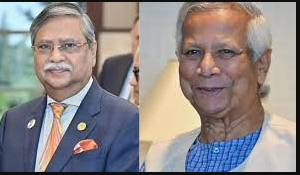
NEW DELHI, Feb 23: Nobel Laureate Mohammad Yunus, who as the chief administrator of Bangladesh after the ouster of the Sheikh Hasina government managed to spoil his country’s relations with India, has been accused of “destroying the law and order situation in the country and create a constitutional crisis” during his 18 months tenure before Tarique Rahman-led Bangladesh Nationalist Party (BNP) took charge of the country last week.
The accusation has come no less than a person of the stature of the President of Bangladesh. In an interview, Mr Mohammed Shahabuddin said the former chief advisor had “conspired” to remove him from the office in an unconstitutional manner and had also attempted to destabilise Bangladesh and create a constitutional vacuum. Mr Shahabuddin recalled the 18 months of the Yunus administration and said there were attempts to “destroy the law and order situation in the country and create a constitutional crisis.”
“During those one and a half years, I have not been part of any discussion, yet various conspiracies are being hatched against me. There have been many attempts to permanently destroy the peace and order of the country and create a constitutional vacuum,” he said in the interview given at Bangabhaban, the President’s official residence in Dhaka.
The President former chief adviser Yunus did not maintain constitutionally required communication with him during the interim government period, saying he was neither informed about foreign visits nor briefed on state matters, which he described as a “constitutional obligation.” The President said the Yunus administration did not consult him while issuing orders. “The constitution says that the chief advisor has to brief me after every foreign trip. But Dr Yunus did not update me. The chief advisor has to inform me in writing about the talks and discussions that happen overseas. He went abroad some 14 or 15 times, but he never met me after those trips,” he said.
“The chief adviser did not follow any provision of the constitution. Whenever he went abroad, he was supposed to meet the president after returning and inform me in writing about the outcomes. He travelled abroad 14 to 15 times, but not once did he inform me. He never came to see me,” the president said. Shahabuddin alleged that he was made a palace prisoner in the past one and a half years, and two of his planned foreign visits — to Kosovo and Qatar — were blocked by the Yunus administration
Responding to a question on whether the former chief advisor coordinated with the President on state decisions, including the issuance of 133 ordinances, Shahabuddin said that although some ordinances may have been necessitated by the circumstances, there was no justification for issuing such a large number. On being asked whether he had been aware of the last agreement concluded with the United States by the interim government ahead of the elections, the President said he had no knowledge of it, and such developments should have been formally communicated to him.
“No, I do not know anything. Such a state agreement should have been informed to me. Be it small or big, of course, the previous heads of government informed the President. And this is a constitutional obligation. But he did not do it. He did not inform me verbally nor in writing. He didn’t come. And he was supposed to come anyway!” the President said.
Mr Shahabuddin said “at one point, even a conspiracy was made to bring a former chief justice and seat him in my place through unconstitutional means.” But he added that a judge refused the proposal, citing constitutional constraints. He also described the October 22, 2024, protests outside Bangabhaban as a “terrifying night,” saying mobs were mobilised, and there were attempts to loot the presidential residence, which were eventually brought under control with military deployment.
He said he never got a call from Mr Yunus after the protests. “He never had any stance for or against me. And I never reached out to him for any support,” he said. Mr Shahabuddin said the Bangladeshi Army and the BNP leadership helped him in maintaining constitutional continuity. He said the chiefs of the three services told him clearly, “You are the supreme commander of the armed forces. Your defeat means the defeat of the entire armed forces. We will prevent that at any cost.”
On August 8, 2024, Mr Shahabuddin administered Mr Yunus, a Nobel laureate, the oath of office as the interim government’s chief advisor. The President said he had played a key role in making Mr Yunus the chief advisor after the fall of the Hasina government. “I took the initiative to form the interim government. But there was no coordination from the chief advisor’s side after that. He never came to meet me, and kept me in the dark,” he said.
The President also alleged that Yunus administration deliberately kept him on the sidelines and stopped him from travelling abroad on two occasions. Referring to an invitation from Qatar, he said that the Bangladesh Foreign Ministry wrote a letter without consulting him. “The letter said that the ‘President is busy with national duty and will not be able to travel to Qatar’. I was asked to sign that letter,” he said.
Mr Shahabuddin said the interim administration did not want him in the limelight and prevented him from attending events within Bangladesh too, even university convocations typically attended by the President. Citing an attempt to denigrate the President’s office, he said that the Yunus administration removed portraits of the President from consulates and high commissions of Bangladesh across the world. “The President represents the country and it is a custom to display his portrait. The administration ended decades-long customs in one night,” he said.
Meanwhile, within days after Mr Tarique Rahman taking over as the Prime Minister, the government effected a reshuffle at the top level of the Bangladesh Army on Sunday. It appointed a new Chief of General Staff (CGS) and recalled the defence advisor in India. Lieutenant General M. Mainur Rahman, who previously served as the chief or General Officer Commanding of Army Training and Doctrine Command, was appointed the CGS.
The defence advisor at the Bangladesh High Commission in India, Brigadier General Md. Hafizur Rahman, was called back to take charge as the General Officer GOC of an infantry division in the promoted rank of a Major General. The reshuffle will affect key strategic commands and the country’s military intelligence agency.
The principal staff officer, Lieutenant General S. M. Kamrul Hasan, was replaced by the just-promoted Lieutenant General Mir Mushfiqur Rahman. Lt. Gen. Hasan has been attached to the Foreign Ministry to be appointed as an ambassador abroad.
Major General Kaiser Rashid Chowdhury has been appointed the Directorate General of Forces Intelligence, the report said. A Brigadier General at the Bangladesh Army Headquarters, he will take charge of the post upon his promotion to Major General.