






Manas Dasgupta
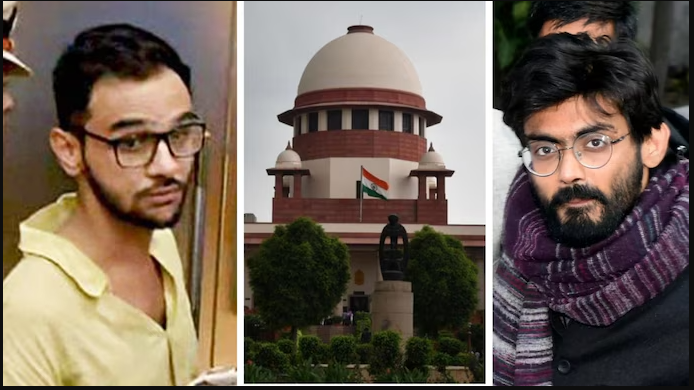
NEW DELHI, Jan 5: The Supreme Court on Monday declined to grant bail to activists Umar Khalid and Sharjeel Imam in the February, 2020, Delhi riots “larger conspiracy case” registered under the Unlawful Activities (Prevention) Act (UAPA) citing the gravity of the allegations and the “central” role attributed to them by the prosecution.
A Bench comprising Justices Aravind Kumar and N.V. Anjaria, however, granted conditional bail to five other co-accused after drawing a clear distinction between their alleged roles and those ascribed to Mr Khalid and Mr Imam. The Court held that the allegations against Gulfisha Fatima, Meeran Haider, Shifa-ur-Rehman, Mohd. Saleem Khan and Shadab Ahmed were limited and ancillary in nature, thereby warranting differential treatment.
Only last week, eight US lawmakers and the newly-sworn-in mayor of New York Zohran Mamdani had written a letter to the Indian authorities requesting for bail and “fair trial” for Khalid and Sharjeel pointing out that they had remained behind the bar for over five years without any trial.
Shortly after the SC door was also closed on him even after spending five years in jail, activist and former JNU student Umar Khalid remarked that remained imprisoned was his life now. He at least was happy that five of his co-accused had been granted bail by the apex court and would be able to walk out of the jail now.
While refusing bail to Khalid and Sharjeel, the Supreme Court interpreted that an ‘act of terror’ under the UAPA was not limited to the final flourish of violence but the build-up to it too. The bench referred to Section 15(1)(a) of the 1967 Act to note the residuary phrase of “by another means” while defining acts of terror using “bombs, dynamite or other explosive substances or inflammable substances or firearms or other lethal weapons or poisonous or noxious gases or other chemicals or by any other substances (whether biological radioactive, nuclear or otherwise) of a hazardous nature…”The statutory intent, the court said, was not to limit the definition of terror to the use of weapons.
The bench stated that was satisfied there was enough material to indicate their involvement in the criminal conspiracy. “Confining Section 15 [terrorist act] to only conventional modes of violence will be to unduly narrow its ambit contrary to plain language,” Justice Kumar said.
One of the arguments raised by the petitioners in the riots case was that they did not participate in the actual acts of violence in February 2020. The Delhi Police had argued that they had conspired for a “regime change” through an armed rebellion and disruption of supply of essential commodities, amounting to ‘terrorist act’ under the UAPA.
The court said a ‘terrorist act’ under the UAPA extended to disruption of essential supplies leading to economic insecurity and destabilisation of civic life even if violence was not committed in the process. The offences covered under the UAPA go beyond the ordinary offences and affect the security and integrity of the nation, Justice Kumar said. A terrorist act was not an isolated, solitary and final act; it was the culmination of “organised, sustained and conspiratorial activities unfolding over time.”
The court reasoned that getting bail under Section 43D(5) of the UAPA was more stringent than in any other ordinary criminal laws solely due to the distinctive nature of the offences under the Act. The usual presumptions (of innocence) in favour of the accused had been curtailed.
The top court reasoned that Mr Khalid and Mr Imam stood “qualitatively on a different footing” from the remaining accused. It noted that the material placed on record prima facie indicated their involvement in a “formative” role in the execution of the alleged offence. “…Umar Khalid and Sharjeel Imam stand on a qualitatively different footing from the remaining accused, both in the prosecution narrative and in the evidentiary basis relied upon. This structural distinction cannot be ignored and must inform any judicial determination relating to culpability, parity, or the applicability of penal provisions requiring a heightened threshold of intent and participation,” Justice Kumar said, reading from the operative portion of the judgment.
Addressing the defence’s principal contention that bail ought to be granted on account of prolonged incarceration without trial for over five years, the Bench underscored that delay, by itself, cannot operate as a “trump card” to override the statutory constraints governing cases under the UAPA.
The appeals before the top court arose from a September 2 judgment of the Delhi High Court refusing bail to the accused. The High Court had characterised the roles attributed to Mr Khalid and Mr Imam as “grave” and held that the evidence on record prima facie disclosed a coordinated plan underlying the riots, which left 53 people dead and hundreds injured in the national capital.
The Delhi Police, represented by Solicitor General Tushar Mehta and Additional Solicitor-General S.V. Raju, had earlier characterised the two accused as the “intellectual architects” of the alleged conspiracy. The prosecution had argued that the scale of the violence, the degree of preparation involved, and the intent underlying it left “no doubt” that the conspiracy extended far beyond civil demonstrations against the Citizenship (Amendment) Act (CAA), 2019.
Concurring with this contention, the Bench held that Mr Khalid and Mr Imam were not entitled to claim parity with the other accused. It, however, granted them liberty to revive their pleas for bail after the examination of protected witnesses or upon the completion of one year from the date of the ruling, whichever occurs earlier.
On the applicability of Section 15 of the UAPA, which defines a “terrorist act,” the Court rejected the defence’s contention that the provision must be narrowly confined to cases involving explosives or immediate physical violence. Senior advocate Siddharth Dave, appearing for Mr Imam, had argued that the delivery of an “unpalatable” speech, by itself, could not attract the rigours of the UAPA in the absence of demonstrable consequences.
The Court, however, clarified that Section 15 cannot be so narrowly construed. It held that acts resulting in the disruption of essential supplies, or those intended to destabilise public order or economic security, could also fall within its ambit, and that “immediate physical harm” was not a prerequisite for its invocation.
The High Court, while rejecting the bail pleas, had observed that both Mr Khalid and Mr Imam were among the earliest to mobilise protests against the CAA in December 2019 through speeches, pamphlets, and WhatsApp groups. According to the prosecution, these activities subsequently crystallised into a wider conspiracy culminating in violence.
However, the accused had maintained that they were exercising their constitutional right to protest and had no role in inciting violence. They had also sought parity with fellow activists Natasha Narwal, Devangana Kalita, and Asif Iqbal Tanha, who were granted bail in 2021.
Soon after the apex court order refusing them bail was issued, Mr Khalid’s partner Banojyotsna Lahiri posted on X that when she spoke to Khalid after the court verdict, she told him she would go to meet him at the Tihar Jail, where he was being held, on Tuesday. “Good, aa jaana. Ab yahi zindagi hai (Good, come. This is my life now),” he responded. Lahiri also recalled that Khalid expressed joy that the others had got bail. “I am really happy for the others, who got bail! So relieved,” she quoted him as saying.
Imam was arrested on January 28, 2020, for speeches made during the anti-CAA protests and charged in the conspiracy case in August that year. Khalid was arrested on September 13, 2020. They were both charged under the stringent Unlawful Activities (Prevention) Act or UAPA.
The riots had broken out in northeast Delhi on February 24, 2020, during protests against the Citizenship (Amendment) Act (CAA) and the National Register of Citizens (NRC), leaving more than 50 people dead. They had coincided with the visit of US President Donald Trump to India.
While the Delhi Police has said Khalid and Imam launched a well-orchestrated “pan-India” conspiracy aiming at “regime change,” Khalid had told a court last year that he had spent five years in custody based on a “joke of an FIR.” “You first decide ‘isko pakadna hai’ (this person has to be caught)… then reverse engineering takes place… There are no linkages (with the actual offences) and we are far away from recovery,” his lawyer had said.
Last week, a group of 8 American lawmakers had written to Indian Ambassador Vinay Kwatra and raised concern about Khalid’s detention. “With respect for India’s democratic institutions and its role as a key partner of the US, we request that your Government share the steps being taken to ensure that the judicial proceedings against Khalid and those of his co-accused who remain in detention comport with international standards,” the lawmakers, including US Representatives Jim McGovern and Jamie Ruskin, said in the letter. Rights groups like Amnesty International have also criticised the prolonged incarceration of the activists.