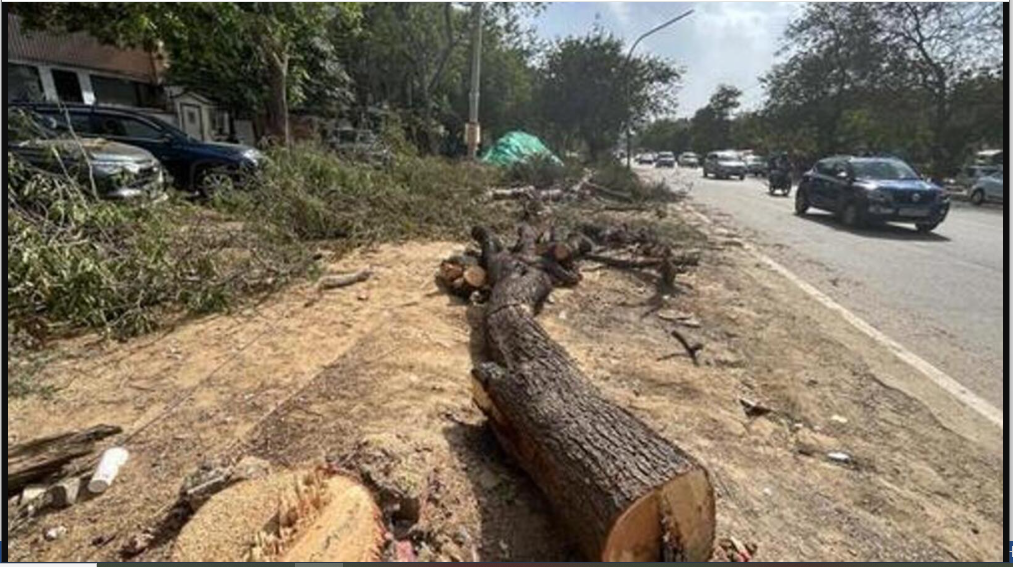









NEW DELHI, Jan 5: The Supreme Court on Monday pulled up the Delhi Development Authority (DDA), which sought permission to cut 473 trees in the Delhi Ridge area to complete a road leading to the Central Armed Police Forces Institute of Medical Sciences (CAPFIMS).
A bench comprising Chief Justice of India Surya Kant and Justice Joymalya Bagchi questioned how many of the 1.65 lakh trees cut last time have been replaced. “We Don’t Want AI-Generated Forests,” the bench said, demanding concrete proof of compliance of its earlier order.
Raising serious concerns over environmental compliance against the past tree felling carried out in the region, the Chief Justice said: “You are seeking permission to cut another 473 trees. How many were cut earlier? We won’t permit anything unless we are satisfied about compliance. What about compliance concerning the earlier felling of 1.65 lakh trees across 18 pockets?”
Responding to the court, Solicitor General Tushar Mehta said a compliance affidavit has been filed. The Chief Justice, however, sought concrete proof of action on the ground and directed the authorities to place photos on record. The counsel appearing for the DDA submitted details of the steps taken so far. “Progress after six months has been placed on record covering 18 sites over 185 acres,” he said.
The court then specifically asked about the actual plantation work, observing, “Out of the 185 acres identified, how many saplings have actually been planted?” In response, the counsel said more time had been granted for completing the work. “Time has been granted till March 31, boundary work is in progress,” he said.
But the Chief Justice persisted. “If you are planting larger trees, deeper pits are required. What type of soil is being used?” he asked. Expressing dissatisfaction over the pace of plantation, he then cautioned the authorities, saying: “Unless actual plantation is carried out in these pockets,” and hard evidence submitted, further permissions would not be considered.
The Solicitor General pointed out a practical difficulty linked to the road construction, saying, “The existing saplings will have to be relocated, otherwise, the road construction cannot proceed.” At this stage, Advocate Gopal S, appearing as Amicus Curiae, explained the background of the plantation issue and submitted that the saplings were planted only after the Supreme Court’s earlier directions, following tree cutting by the DDA without prior permission.
The matter will be heard next on January 19.
(Manas Dasgupta)