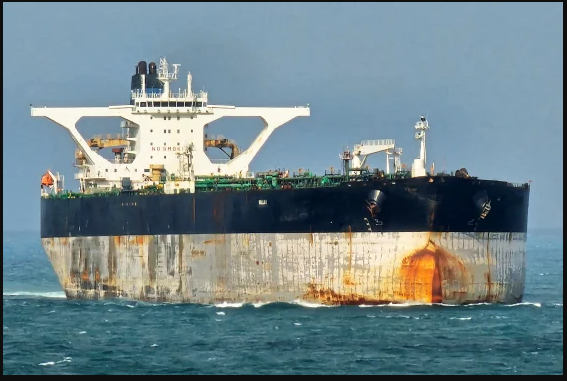
Russian-Flagged Oil Tanker Seized by US Forces in North Atlantic








NEW DELHI, Jan 7: The United States military on Wednesday announced the seizure of a Russian-flagged oil tanker, originally known as the Bella-1, in the North Atlantic for sanctions violations, bringing an end to a multi-week pursuit by American forces.
The seizure of the ship, which evaded being boarded near Venezuela, was a joint operation between the Department of Homeland Security and U.S. military personnel, the U.S. European Command, which is responsible for the region, said in a post on X.
The military command went on to say that the seizure supported President Donald Trump’s proclamation on targeting sanctioned vessels that “threaten the security and stability of the Western Hemisphere.” The ship was sanctioned by the U.S. in 2024 for allegedly smuggling cargo for a company linked to the Lebanese militant group Hezbollah. The U.S. Coast Guard attempted to board it in the Caribbean in December as it headed for Venezuela. The ship refused boarding and headed across the Atlantic.
Officials added that Russian military vessels were in the general vicinity of the operation, including a Russian submarine. It was unclear how close the vessels were to the operation, which was taking place close to Iceland. Britain provided support to the United States in its operation to seize the Russian-flagged oil tanker, the Ministry of Defence said.
The U.S. Coast Guard first attempted to intercept the vessel last month, but it refused to be boarded. Since then, it has registered under a Russian flag. The tanker, now known as the Marinera, is the latest tanker targeted by the U.S. Coast Guard since the start of U.S. President Donald Trump’s pressure campaign against Venezuela.
Separately, the U.S. Coast Guard has also intercepted another Venezuela-linked tanker in Latin American waters, U.S. officials said as the U.S. continues enforcing a maritime “blockade” of sanctioned vessels from Venezuela.
The oil tanker Marinera, which was formerly called Bella 1, had been trying to avoid US sanctions targeting oil shipments linked to Venezuela, Iran and Russia. This is believed to be the first time in recent years that the United States has seized a Russian-flagged vessel.
The tanker began its journey in Iran and departed the Gulf of Oman in November. It passed through the Suez Canal and the Strait of Gibraltar before crossing the Atlantic in early December. The ship was believed to be heading to Venezuela to collect oil at a time when Washington was tightening its enforcement of sanctions on Venezuelan energy exports.
On December 21, the US Coast Guard stopped the vessel in the Caribbean Sea. At that point, the tanker was still operating under the name Bella 1. US authorities said they had a seizure warrant because the ship was not flying a valid national flag. However, the crew refused to allow the Coast Guard to board. Instead, the vessel broke away and sailed into the Atlantic, with US forces continuing to track it.
As the pursuit continued, the crew took steps to shield the ship from US seizure. A Russian flag was painted onto the hull, as international law treats ships as being under the protection of the country whose flag they fly. But US officials said this effort failed because the vessel had not been flying a valid national flag when it was first approached by the Coast Guard.
Soon after, the ship changed its identity. Bella 1 was reborn as Marinera and added to Russia’s official shipping registry, with Sochi on the Black Sea listed as its home port. Russia then made a formal diplomatic request asking the United States to halt its pursuit of the tanker. According to media reports, the request was delivered to the US State Department late on New Year’s Eve. Despite this, the chase continued. US authorities maintained that the tanker was accused of violating sanctions and of transporting Iranian oil.
As US pressure on Venezuela intensified, the vessel abruptly changed its route. On December 15, it stopped near the Caribbean and reversed direction, heading back towards Europe. This came after Donald Trump announced a “complete blockade” of Venezuelan oil tankers.
According to reports, Russia went further to protect the ship. The media report said the Russian navy deployed a submarine to escort the tanker. In the 24 hours before the operation, multiple Western surveillance flights were seen over the vessel. These included aircraft from US bases in Iceland and RAF Rivet Joint and P-8 Poseidon planes from the UK, which are capable of detecting submarines.
On Wednesday, the US Coast Guard finally boarded and seized the vessel in the North Atlantic. The US military confirmed the action on X, saying the tanker had been taken for breaching sanctions. US Defence Secretary Pete Hegseth wrote, “The blockade of sanctioned and illicit Venezuelan oil remains in FULL EFFECT – anywhere in the world.”
Russia’s Ministry of Transport said in accordance with the 1982 UN Convention on the Law of the Sea, “no state has the right to use force against vessels duly registered in the jurisdictions of other states.” It is important to note that the US has not ratified the convention but generally recognises its provisions as customary law.
The tanker is believed to be part of the so-called “shadow fleet” used to move oil for Russia, Iran and Venezuela. It was sanctioned by the United States in 2024 over allegations that it carried illicit cargo for a Hezbollah-owned company. It was owned by Louis Marine Shipholding Enterprises SA, a Turkey-based company accused of having links to Iran’s Islamic Revolutionary Guards Corps.
Although initial reports suggest the vessel was empty at the time of seizure, Moscow’s efforts to shield it have raised questions about why Russia was willing to risk a standoff with the United States at a time when the ties between the two nations are already strained because of the delay in the Ukraine ceasefire.
(Manas Dasgupta)