


Virendra Pandit
New Delhi: Some sections in the Indian economy are concerned with the 50 percent tariffs the mercurial US President Donald Trump has imposed on India, effective Wednesday, but these ‘sanctions’ may likely be diluted or phased out the way Washington did when it clamped sanctions against New Delhi after the 1998 nuclear tests at Pokhran, Rajasthan.
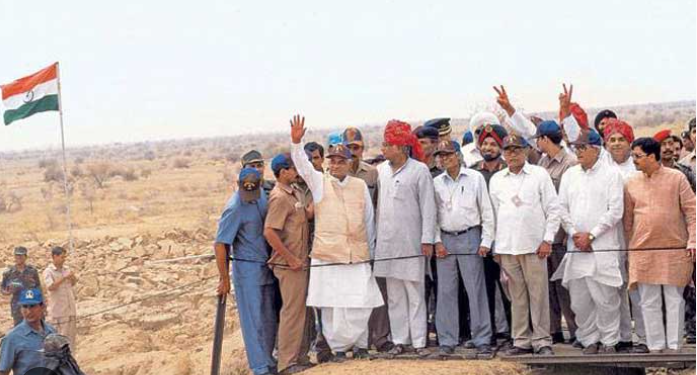
The Pokhran-II nuclear tests, conducted by the then Prime Minister Atal Bihari Vajpayee-led NDA government—helmed by Defence Minister George Fernandes, and Dr. APJ Abdul Kalam, who later became the President of India—made India a nuclear power. Even after the then US President Bill Clinton announced sanctions, however, New Delhi did not panic and calmly weathered the storm. Finding its measures did not affect India, the US subtly weakened the sanctions through what it called ‘exceptions’ made for India, and lifted the sanctions altogether within a year.
After the 1998 nuclear tests, the US (and Japan) had imposed economic and technical sanctions under Section 102 of the Arms Export Control Act (also known as the Glenn Amendments). The sanctions included terminating foreign assistance, denying loans and credit, and freezing grant and yen-loan aid. However, many of these sanctions, particularly those from the US, were lifted within months due to a presidential waiver authority granted by the US Congress.
Now that India needs no foreign assistance, loans, or credit, the Trump tariffs—which his White House Press Secretary Karoline Leavitt on August 19 claimed were ‘sanctions’—are unlikely to make any dent in the long term. Prime Minister Narendra Modi and Reserve Bank of India Governor Sanjay Malhotra have exuded confidence that India will successfully ride out this phase of the US-India bilateral relations. The government is expected to announce measures to absorb the tariff shocks soon. Besides, Japan’s likely announcement to invest USD 68 billion in India during Prime Minister Narendra Modi’s visit this week will absorb much of the shock soon.
The additional 25 percent tariff — notified on Monday by the US Department of Homeland Security to penalise New Delhi for buying Russian oil — may hit labour-intensive and export-centric sectors such as apparel and textiles, gems & jewellery, automobile parts, carpets, agrifood, shrimps, chemicals and machinery, in the short term.
Indian textiles and leather industries have already pushed some of their inventory to the US in recent weeks to avoid the additional 25 percent tariffs, but there are still tonnes of garments and leather goods lying in their warehouses. Their American customers are pressuring these companies to share the cost with 5 to 25 percent discounts on goods, the media reported.
According to reports, these textile exporters could suffer a collective loss of nearly Rs. 5,000 crores per month across India. India’s loss will be a gain for countries like Bangladesh, Pakistan, Vietnam, and Cambodia.
India’s annual exports to the US in 2024-25 were valued at USD 86.5 billion, including textiles exports worth USD 10.3 billion. With a 50 percent tariff now, India’s apparel industry could face huge losses in the short term.
To cushion the impact, exporters have urged the government to announce immediate support, on the lines of the one provided during the COVID-19 pandemic, to stop competitors from China, Vietnam, Bangladesh, Indonesia and the Philippines from completely taking over their market. Most of India’s Asian competitors face 19-20 percent tariffs in the US while China has been slapped with 30 percent.
The 50 percent US tariff is likely to hit India’s annual exports by USD 60 billion, which is 66 percent of India’s exports of the total exports in 2024-25, according to estimates made by trade research body Global Trade and Research Initiative (GTRI).
“The US tariffs are likely to slash India’s goods exports to USD 49.6 billion in FY26, down 43 percent from USD 86.5 billion. India’s non-US goods exports may grow 5 percent to USD 368.5 billion. The GDP growth could drop, from 6.5 percent to 5.6 percent, but 20 percent export-to-GDP ratio provides some cushion.”
Exporters from key labour-intensive sectors like gems & jewellery fear job cuts as they might lose their entire US markets. “We were already struggling with the 10 percent baseline duties imposed in April and had no idea how to cope with the 25 percent duties imposed on August 7 as orders were being cancelled. Now with the import duties doubling, exports will come to a standstill, manufacturing bases may shift and there will be huge employment loss,” warned Vipul Shah, former chairman of the Gems & Jewellery Export Promotion Council.
Job losses are also expected in the textiles and garments sector as exporters expect at least 50 percent of their orders in the US to be immediately put on hold or cancelled.
Exporters also seek help in market diversification. Handicraft exporters say that although a large part of their exports, about 40 percent, goes to the US, some part of it is then re-exported to the Latin American countries.
“The US being the largest consumer market, the tariffs will disrupt our production and employment generation. About 40 percent of handicrafts exports is to the US, but 30 per cent of that is re-exported to Latin America. It can now be directly exported to Latin America,” said Rakesh Shah, a handicraft exporter.