


Virendra Pandit
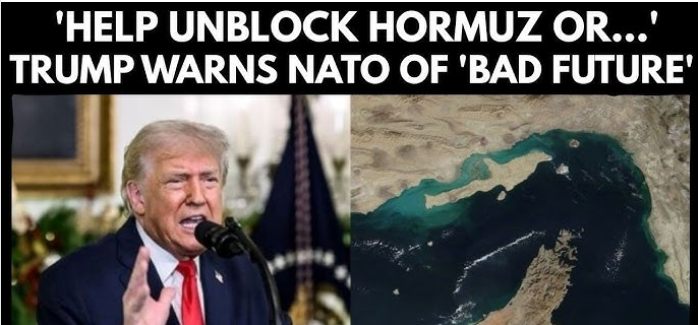
New Delhi: With even the US’ allies saying “No” to his calls to help protect the Strait of Hormuz from Iranian attacks, a frustrated President Donald Trump warned these countries of a “very bad” future if they do not help the USA reopen the narrow waterway linking the Gulf of Persia with that of Oman, and said he may also delay a planned summit with Chinese President Xi Jinping in March-end on the same issue.
The United Kingdom, Japan and Australia have joined the list of countries declining to send naval escorts to protect the Strait of Hormuz after Trump called on allies to secure shipping in the critical waterway, the media reported on Monday.
According to a Financial Times report on Sunday, Trump said: “I think China should help too because it gets 90 percent of its oil from the Straits,” adding he would prefer to know Beijing’s position before the planned visit. “We may delay,” he said of the trip.
US Treasury Secretary Scott Bessent and Chinese Vice Premier He Lifeng wrapped up the first of two days of talks in Paris on Sunday to iron out issues in their trade truce and clear a path for Trump’s trip to Beijing to meet with President Xi Jinping at the end of March.
The US President said countries that benefit from the shipping route should help secure it. “It’s only appropriate that people who are the beneficiaries of the Strait will help to make sure that nothing bad happens there,” he told the FT.
He had on Saturday called on nations to send warships to keep the narrow waterway open for shipping as Iranian forces continue attacks. He said he hoped countries including China, France, Japan, South Korea and Britain would send ships to the area.
When asked to specify the assistance he wanted, Trump said it could include minesweepers and other military assets to counter drones and naval mines.
“We’re hitting them very hard,” Trump said of Iranian forces. “They’ve got nothing left but to make a little trouble in the Strait … these people are beneficiaries and they ought to help us police it.”
Iran effectively shut the key Strait after the United States and Israel launched attacks against it more than two weeks ago, starting February 28. About a fifth of global oil and liquefied natural gas (LNG) normally passes through the Strait of Hormuz.
Trump also warned Washington could launch further strikes on Kharg Island, Iran’s main oil export hub, saying the US forces could target its oil infrastructure, if needed. “We can hit that in five minutes,” he said. “And there’s not a thing they can do about it.”
He also criticised Britain’s response after speaking with Prime Minister Keir Starmer. “The UK might be considered the number one ally… and when I asked for them to come, they didn’t want to come,” Trump lamented, adding that Britain only offered to send ships after the US had already reduced Iran’s military capabilities.
“Many countries, especially those that are affected by Iran’s attempted closure of the Hormuz Strait, will be sending warships, in conjunction with the United States of America, to keep the Strait open and safe,” Trump said in a post on his private social media outlet, Truth Social, on Sunday.
He also claimed that the Iranian military capabilities had been largely destroyed but warned that Tehran could still target vessels using drones, mines or short-range missiles along the strategic route.
“Hopefully, China, France, Japan, South Korea, the UK, and others, that are affected by this artificial constraint, will send ships to the area so that the Hormuz Strait will no longer be a threat from a nation that has been totally decapitated. In the meantime, the US will be bombing the hell out of the shoreline and continually shooting Iranian boats and ships out of the water. One way or the other, we will soon get the Hormuz Strait open, safe, and free!” he added.
Meanwhile, the European Union’s foreign policy chief is encouraging member states to redirect the bloc’s Red Sea naval mission to help restart oil and gas shipments in the Strait of Hormuz.
“If we want to have security in this region, it would be easiest to already use the operation we have in the region and maybe change a bit,” Kaja Kallas said on Monday, ahead of a meeting of EU foreign ministers.
The EU operation in question is Aspides, which was launched in 2024 after the Houthis attacked shipping vessels in the Red Sea. Officials are now discussing whether the bloc could turn that mission to the Strait of Hormuz, a key shipping route that has been effectively closed since the US and Israel attacked Iran.
Ministers will debate “whether it’s possible to really change the mandate of this mission,” Kallas said.
The blockade has sent energy prices soaring, leaving European officials anxious about inflation, economic slowdowns, and even food supply disruptions. Besides shifting the Aspides operation, these countries are also exploring a “coalition of the willing” operation, Kallas said.
“We also need to see what would be the fastest way to provide this opening of the Strait of Hormuz,” he said.
Trump is trying to pressure countries to help reopen the strait. On Sunday, he said he was “demanding” that others offer assistance.
“Why are we maintaining the Hormuz Strait when it’s really there for China and many other countries? Why aren’t they doing it?” Trump said.
NATO says NO
He also directly called out his North Atlantic Treaty Organization (NATO) allies, warning that the military alliance would have a “very bad future” if its members don’t aid the US in Iran. His renewed attacks on the transatlantic alliance received a tepid response from European officials on Monday.
On Trump’s demand, Japan’s Prime Minister Sanae Takaichi told Parliament that the country has no plan to dispatch naval vessels to escort ships to the region.
“We have not made any decisions whatsoever about dispatching escort ships. We are continuing to examine what Japan can do independently and what can be done within the legal framework,” she said.
Likewise, Australian cabinet member Catherine King said that while the government understands the significance of the issue, it will not send naval ships to assist in reopening the strait, reported ABC News.
The UK is, however, considering deploying aerial minesweepers to help remove mines from the passage in an effort to restore the flow of oil exports, reported The Guardian. PM Kier Starmer has refused to send naval ships as it could escalate tensions in the region.
Germany has also indicated that it won’t participate in the Strait of Hormuz mission now. “It is completely clear that Europe always gives constructive support when it comes to securing sea routes, but I see neither an immediate necessity nor, above all, Germany participating,” Foreign Minister Johann Wadephul said on ARD television.
Last week, French Defence Minister Catherine Vautrin stated that the country would not be sending warships to Hormuz.
Interestingly, even the US Navy, scared of Iranian attacks, is also not currently escorting vessels through the narrow shipping lane.
“NATO is there for the case where one of the members is attacked, and I want to remind that none of us has been directly attacked,” said Luxembourg’s Foreign Minister Xavier Bettel. “There are no grounds for now to invoke Article 5,” he added, referencing the alliance’s collective defence clause.
Lithuanian Foreign Minister Kestutis Budrys was more willing to engage. “We have to look into it and consider it,” he told Bloomberg TV. “I would look for the in-depth debate within Nato.”
In the UK, Work and Pensions Secretary Pat McFadden, speaking for the government, said Trump had spoken to PM Starmer on Sunday night. But he didn’t commit to offering any assistance.
“Of course, everyone is concerned about the situation in the Straits of Hormuz and the wider effect of this war on energy prices,” said McFadden, a close Starmer ally. “But it’s also important to remember that we have not sought to be a protagonist in this war.”
While the Aspides vessels are currently allowed to navigate in the Strait of Hormuz, their mandate doesn’t enable them do more than that. EU countries would have to unanimously agree to change those directives, which could be difficult.
But German Foreign Minister Johann Wadephul said he wasn’t keen about getting Aspides more directly involved in the Iran conflict.
He said he’s “very sceptical that expanding the Aspides mission in the Strait of Hormuz would lead to greater security” and that Germany “will not participate in this dispute.”
Italy is also currently not in favour of repurposing the Aspides mission to guard the Strait of Hormuz, accord. The country has one ship deployed in the mission.
Short of that, the EU is hoping member states could commit more assets to the either the existing Aspides mission or other regional efforts, an EU diplomat said. Already, France has sent two extra vessels to bolster Aspides.