


Virendra Pandit
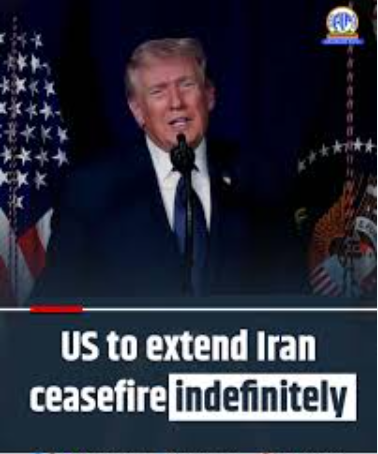
New Delhi: US President Donald Trump late on Tuesday extended the ceasefire with Iran indefinitely, while awaiting a “unified proposal” from Tehran, even as the US military maintains its blockade of Iranian ports, the media reported on Wednesday.
The move came as the White House put on hold Vice President JD Vance’s planned trip to Pakistan for a second round of truce talks with Iran, which has balked at further discussions.
Trump made the announcement as ceasefire talks looked increasingly uncertain as the two-week truce expired on Wednesday. Both countries said they were prepared to resume fighting if no deal is reached.
The US President said he would “extend the ceasefire until such time as their proposal is submitted, and discussions are concluded, one way or the other.”
Iran offered no formal acknowledgment of Trump’s ceasefire extension.
Iran’s response
Two ships came under attack Wednesday in the Strait of Hormuz, the British military said, complicating efforts to bring the United States and Iran together in Pakistan for a second round of talks to end the war.
On Wednesday morning, Iran’s paramilitary Islamic Revolutionary Guard Corp (IRGC) attacked a container ship, damaging it but causing no injuries. The British military’s United Kingdom Maritime Trade Operations centre did not immediately identify who shot at the second ship, but suspicion fell on Iran.
In the second attack, a cargo ship said it had been fired upon and was stopped in the water, but no damage to the vessel was reported.
The two attacks came days after the US seized an Iranian container ship after shooting it last weekend and boarded an oil tanker associated with Iran’s oil trade in the Indian Ocean.
Pakistan’s Prime Minister Shehbaz Sharif thanked Trump for agreeing to the extension, saying it would buy time for ongoing diplomatic efforts.
“With the trust and confidence reposed in us, Pakistan shall continue its earnest efforts for a negotiated settlement of the conflict,” he wrote on X.
Trump said the US would continue its blockade of Iranian ports, which Iran has called “unacceptable,” and indicated it was a reason it had not yet agreed to join talks again in Islamabad.
The IRGC vowed on Wednesday to “deliver crushing blows beyond the enemy’s imagination to its remaining assets in the region.”
The United Kingdom Maritime Trade Operations Centre, a monitoring agency run by the British military that first reported the earlier attack, said an IRGC gunboat did not hail the ship before firing.
Iran’s Nour News, however, reported that the IRGC only opened fire on the ship after it had “ignored the warnings of the Iranian armed forces.”
Iran’s semi-official Fars news agency described the attack as Iran “lawfully enforcing its control over the Strait of Hormuz.”
Iran seizes two ships
The IRGC Navy on Wednesday said it had seized two vessels in the Strait of Hormuz and redirected them toward Iran’s coast, warning that any attempt to “disrupt order and safety” in the strategic waterway would be treated as a red line.
The two vessels, MSC Francesca and Epaminondas, were seized, redirected, and sent towards Iranian ports, Iranian news agencies said, citing an official statement from the IRGC Navy.
The IRGC also reportedly targeted a third ship in the area. The IRGC-affiliated Fars news agency said a vessel identified as Euphoria was struck and is now grounded off Iran’s coast.
This ship had passed south of Iran’s Larak island before slowing to under one nautical mile per hour at around 3:00 pm IST, after making multiple turns in the strait. Its last transmitted position placed it roughly 40 nautical miles south of the other two ships, between Oman and Iran.
By contrast, tracking signals showed Francesca, a Panama-flagged cargo vessel, and Epaminondas, which sails under Liberia’s flag, were located less than 10 nautical miles off Iran’s coast after both had earlier gone off AIS tracking while approaching the strait from the Persian Gulf.
The data indicated that both these ships had been in the Gulf since at least April 18 before reappearing near Iranian waters.
Trump’s fresh claims
In a post on his private social media outlet Truth Social, Trump claimed that Iran is undergoing a severe financial crisis, asserting that the country is “collapsing financially” as tensions continue to simmer in the region.
Tehran is “starving for cash” and “losing 500 million dollars a day.” The Iranian leadership is under significant internal pressure, with the “Military and Police complaining that they are not getting paid.”
The US President’s remarks come amid an ongoing maritime standoff, with Trump claiming that the Iranian authorities “want the Strait of Hormuz opened immediately.” The strategic waterway has been a focal point of recent geopolitical friction, impacting global energy corridors and maritime trade.
Trump also highlighted the deteriorating domestic situation in Iran, describing the state of affairs as an “SOS!!!” scenario. These assertions appear to be part of the administration’s broader strategy to highlight the impact of the current economic and naval blockade on Tehran’s operational capabilities.
Iran’s outward hostility regarding the waterway is a performance intended for a political audience rather than a reflection of its financial reality, he claimed. “Iran doesn’t want the Strait of Hormuz closed; they want it open so they can make USD 500 million a day.
He dismissed Tehran’s threats to keep the passage shut, describing them as a defensive reaction to US military pressure. “They only say they want it closed because I have it totally BLOCKADED (CLOSED!), so they merely want to ‘save face,’” the President added.
He also revealed that backchannel communications have already begun. Intermediaries reached out recently to signal a shift in Tehran’s position. “People approached me four days ago, saying, ‘Sir, Iran wants to open up the Strait immediately,’” he claimed.
However, he warned that a premature reopening without significant geopolitical concessions would eliminate US leverage in future negotiations, stating, “But if we do that, there can never be a deal with Iran unless we blow up the rest of their country, their leaders included!”
Against this volatile backdrop, the President announced late on Wednesday that he would prolong the current ceasefire to provide a window for further diplomacy. Yet, this extension remains precarious as it appears to be a “unilateral” move, with “no immediate confirmation from Iran or Israel” that they intend to honour the truce.
Conversely, commentators linked to the Iranian government have cast doubt on Washington’s sincerity, framing the extension as a tactic to “gain a strategic advantage” while the “naval blockade” remains in place.