


Virendra Pandit
New Delhi: After virtually losing the Middle East to China briefly during the COVID-19 and Joe Biden era (2020-24), the US now has all the eggs in its basket: Israel, Saudi Arabia, Syria, Turkey—and neutralized its bete noire Iran, for now.
This is the key takeaway from Saudi Crown Prince Mohammed bin-Salman (MbS) ’s fresh Washington visit to reset the bilateral relations, which had turned frosty in the wake of the controversial murder of The Washington Post journalist and bitter MbS critic Jamal Ahmed Khashoggi in the Saudi consulate in Istanbul in October 2018, and especially after China brokered a Saudi-Iran deal (2024).
In February 2021, a US intelligence report had even found that MbS had allegedly approved the murder of the exiled Saudi journalist.
On his part, US President Donald Trump rehabilitated MbS, defended him, claimed that the Crown Prince “knew nothing” about the Khashoggi murder, and that “things happen.”
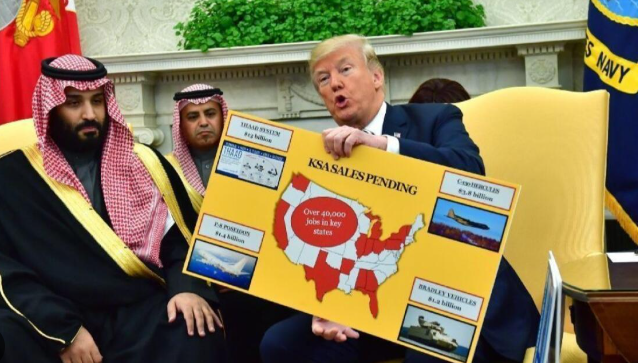
Washington has whitewashed all these minuses, including the alleged Saudi nationals’ role in 9/11, and restored the best relations with Riyadh, which has promised to invest USD 1 trillion in the USA, including imports worth over USD 500 billion. In return, the USA has agreed to make Saudi Arabia its key non-NATO ally in the Middle East, just like Turkey, and Israel.
To welcome MbS on his first post-Khashoggi visit to the US, President Trump invited the world’s wealthiest man Elon Musk, with whom he is cozy, again, and many others. On his part, the Crown Prince invited Portuguese footballer Cristiano Ronaldo.
According to media reports, the celebrity optics at the White House dinner on Tuesday was, however, eclipsed when President Trump formally designated Saudi Arabia as a Major non-NATO Ally (MNNA) after the Saudi prince committed to a nearly USD 1 trillion investment in America as the two leaders consecrated personal ties into greater strategic alignment.
Although 20 countries – including Pakistan, Kenya, Tunisia, and Brazil – have the MNNA status, Saudi Arabia’s designation marks a transformational US reset in the region, bringing Riyadh on par with Israel in terms of unlocking a suite of military and economic privileges.
Trump described the move as a leap forward in military cooperation, facilitating the sale of cutting-edge US arms like the F-35, and collaboration in areas ranging from civil nuclear technology to critical minerals to artificial intelligence.
Nvidia CEO Jensen Huang and Open AI President Greg Brockman were among those who attended the East Room dinner. Also, on the tech- and finance-heavy 140-people invitee list were Apple CEO Tim Cook, IBM CEO Arvind Krishna, Coinbase CEO Brian Armstrong, Dell CEO Michael Dell, Citigroup CEO Jane Fraser, Pershing Square Capital Management’s Bill Ackman, and Blackstone CEO Stephen Schwarzman.
A White House report cast the MNNA designation and the agreements that accompanied it as an “America First” strategy, that would fill US coffers and galvanize the economy. A raft of deals, including a sweeping Strategic Defense Agreement (SDA), also rehabilitated a country long viewed with suspicion in Washington for the role of its Saudi nationals in the 9/11 attack of 2001 on the U.S and its medieval outlook, both of which MbS has sought to overcome.
The defense agreement secures new burden-sharing funds from Saudi Arabia to offset America’s costs, while making it easier for US defense firms to operate inside the Sunni Kingdom.
Prince Salman responded to Trump’s repeatedly touchy-feely outreach that broke the royal protocol that the Prince is not to be touched, pledging a trillion-dollar investment that Trump lapped up even though the money will be spread over several years.
While sceptics questioned the numbers given that Saudi Arabia’s GDP itself is just USD 1.1 trillion, MAGA activists pointed to the riches of the Saudi’s Public Investment Fund (PIF), one of the largest Sovereign Wealth Funds in the world with more than USD 1 trillion in assets under management (AUM).
Still the USD 1 trillion commitment, up from USD 600 billion announced a few months ago, is expected to crimp other Saudi pledges across the world, including in India, where the Saudi PIF recently bumped up its commitment from USD 10 billion to USD 100 billion.
The US-Saudi deal is expected to cause geopolitical reverberations far beyond the Middle East going up to India and China which have both invested in ties with the Gulf monarchies in recent years. The Gulf region has been a key theatre for China’s Belt and Road Initiative (BRI) ambitions, and Washington wrapping its arms around Riyadh and Islamabad represents a partial dilution of Beijing’s influence, as the Saudis and their vassal state lean more heavily into the US defence ecosystem.