


Virendra Pandit
New Delhi: French writer Jean-Baptiste Alphonse Karr famously observed in 1849 that “the more things change, the more they stay the same.” Nothing epitomises this better than reactions of some of the invitees to US President Donald Trump’s “Board of Peace” in Gaza, where things are unlikely to change much, especially when America is seen as preparing to attack Iran anytime.
Few notables seem really interested in wearing this crown of thorns, prompting Trump to force them to join the peace effort, hours after, in a letter to Norway’s Prime Minister Jonas Gahr Stoere, he linked his drive to take control of Greenland to his failure to win the Nobel Peace Prize. He also said he no longer thought “purely of Peace” as the row over the island threatened to reignite a trade war with Europe.
In the same vein, Trump on Tuesday warned that he could impose tariffs as high as 200 percent on French wines and champagne. The threat came amid reports that French President Emmanuel Macron is unwilling to join Trump’s proposed “Board of Peace” focused on Gaza, the media reported.
Speaking to reporters in Miami, the US President dismissed Macron’s reported refusal and suggested trade penalties could force a change of mind. “Well, nobody wants him because he’s going to be out of office very soon. So, you know, that’s all right. What I’ll do is… I’ll put a 200 percent tariff on his wines and champagnes, and he’ll join. But he doesn’t have to join,” Trump said.
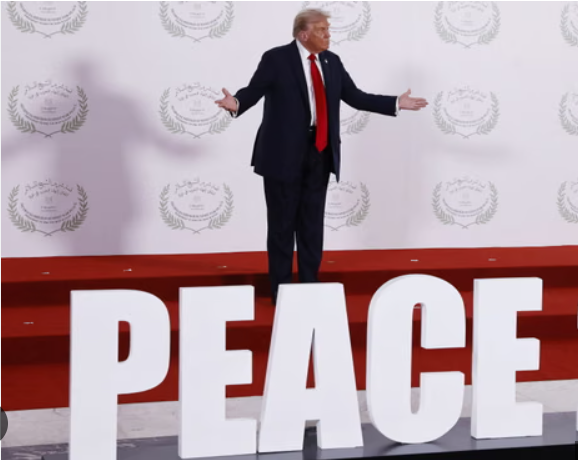
The “Board of Peace”
This is supposed to be a global body, which was endorsed by the United Nations Security Council (UNSC) in November 2025. It was created to monitor and oversee the ceasefire agreement between Israel and Hamas, the terrorist group still said to be ruling parts of the war-torn Gaza Strip.
The Trump administration has invited leaders of several nations—some reports said 60-odd—to be part of the board. These include Russian President Vladimir Putin, UK Prime Minister Keir Starmer, and Indian Prime Minister Narendra Modi.
According to a draft charter, the countries seeking a permanent seat on the board are expected to contribute at least USD 1 billion. Trump would serve as the board’s first chairman and would have the final say on membership decisions.
Apart from the US, those which confirmed participation included Albania, Argentina, Canada, Kazakhstan, Paraguay, Vietnam, and Uzbekistan.
The two countries that declined are Azerbaijan and France. Those still undecided include Australia, Belarus, Brazil, Cyprus, Egypt, Finland, Hungary, India, Jordan, Pakistan, Poland, Russia, Singapore, Thailand, Turkiye, the UK and the EU.
Trump has mostly packed his own men in this Board’s Executive Board. As well as the Gaza Executive Board who will really call the shots—a fact that has made several countries reluctant to join.
The White House has said the “Founding Executive Council” will be the top decision-making body, controlling both funding and strategy. President Trump will chair the council and retain veto powers.
The Executive Board will include: US Secretary of State Marco Rubio, US Special Envoy Steve Witkoff, Jared Kushner (Trump’s son-in-law), billionaire investor Marc Rowan, World Bank President Ajay Banga, Former UK Prime Minister Tony Blair, and Robert Gabriel Jr, Deputy National Security Adviser in the Trump administration.
Trump has also invited leaders from Egypt, Turkiye, and Jordan to help oversee Gaza’s post-war transition. Invitations have additionally been extended to Argentina’s President Javier Milei and Canadian Prime Minister Mark Carney. Several European countries have also been asked to join.
He also spoke about his long-standing interest in controlling Greenland, and suggested that European leaders would not strongly oppose the move. “We have to have it… They can’t protect it,” he said.
The US, he warned, could take control of Greenland, “whether they (European lawmakers) like it or not”, arguing that the move was necessary for “world security.”
Europe’s response
On Saturday last week, the US President warned of tariffs of up to 25 percent on goods imported from eight European nations, including the UK. He said that the measures would remain until the US gained control of Greenland.
While he has not ruled out using military force, Secretary of State Marco Rubio reportedly said on January 6 that the President would prefer to ‘buy’ the territory, even as Greenlanders have announced that their island is not for sale.
Responding to Trump’s statements, European governments are considering retaliatory tariffs and broader economic countermeasures worth of some USD 100 billion against the United States, the media reported.