


Virendra Pandit
New Delhi: Chief of Defence Staff (CDS) General Anil Chauhan on Friday said that India is taking policy initiatives for the development of equipment for space and cyber warfare, the new battlefields of technology-driven warfare.
Addressing the East Tech symposium in Ranchi, Jharkhand, he said that strategic selection of weapons was paramount and that research and development (R&D) needs to be reviewed to suit modern requirements, the media reported.
“There is a need to expand the defence manufacturing base, artificial intelligence (AI), and other modern techniques have to be explored,” he said.
Gen. Chauhan said that although the indigenisation of defence manufacturing started late in India but the country is on the right track.
He said the objectives of the Centre’s Act East policy, and self-reliance in defence production can be realised through the active participation of states such as Jharkhand and West Bengal.
“War is science and also an art. A warrior needs to be creative and innovative in the present context,” he added.
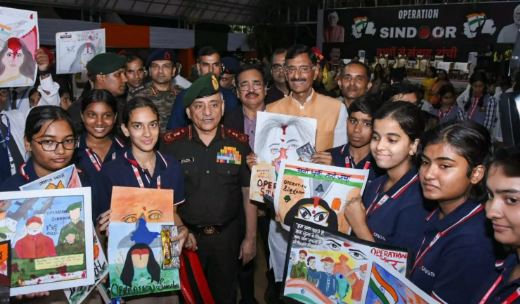
Earlier, during an interaction with children from 36 schools at the Raj Bhavan on Thursday in Ranchi, Gen. Chauhan said Operation Sindoor heralded a “new kind of warfare” in which India beat Pakistan decisively in every escalation during the strike.Union Minister of State for Defence Sanjay Seth was also present.
Unlike traditional warfare, this was fought on land, in air and sea, electromagnetic space and cyber domains, where the adversary was seen only with the help of satellites and electronic images or signal intelligence, he said.
The top military officer also said the first strikes during the operation were conducted at 1 a.m. to avoid civilian casualties across the border.
“It was a new kind of warfare… Till now, we have assumed victory in terms of capture of territory, the number of equipment destroyed, or the number of prisoners of war you have captured or soldiers you have killed…These were associated with traditional ways of fighting warfare.
“One of the matrices of victory over here is the sophistication of our attack, which was demonstrated there… Precision strikes for long-distance targets during the night required special efforts… We beat Pakistan decisively in every escalation during Operation Sindoor,” Gen. Chauhan asserted.
“The first strikes took place between 1-1.30 a.m. on May 7, 2025, on nine identified terrorist targets to prevent civilian casualties,” he said.
Operation Sindoor was launched in the aftermath of the Pahalgam terror attack, which claimed the lives of 26 people, mostly Hindu tourists, on April 22.
“Earlier, we did the Balakot operation, but we didn’t have satellite images or photos… But what we did at 1 a.m. now (Operation Sindoor), despite difficulty in collecting evidence in the darkness of night, was due to twin reasons — first, we had confidence in our capabilities that we could take imagery, and the second, we wanted to avoid civilian casualties.
“The best (option) would have been the time of 5.30 a.m. or 6 a.m…. But that time of the first Azan or Namaz… many civilian lives would have been lost. We wanted to avoid that completely,” Gen. Chauhan said.
He said that India was monitoring the neighbouring nation’s flying activities for some time and chose the strike on the night of May 7, as the weather was clear with no rain prediction.
Contrary to the general notion that the army was engaged at seven targets and the air force at two, the “navy was also involved in the strikes with S400 and S120, and deployment of navy commandos in Jammu and Kashmir and Punjab in addition to the Arabian Sea”, he said.
“During Uri and Balakot, we chose land and air medium, but in this operation, a surprise element was there as we adopted a new strategy, which was needed for success, and used drones, the capability of which we acquired,” Gen. Chauhan said.
He said the evolving character of warfare is now driven more by technology than the sheer number or territorial occupation.
“Modern warfare demands that we fight today’s conflicts with tomorrow’s technology. The battlespace is no longer limited to traditional domains of land, air, and sea and has expanded to include space, cyber, the electromagnetic spectrum, and even the cognitive domain. In recent operations, this shift was evident.
“India was able to strike deep into enemy territory with long-range precision weapons, guided by satellite imagery, electronic surveillance, and signal intelligence, often without direct visual contact with the adversary. These were non-contact, multi-domain operations where success was not measured by the ground captured, but by the level of dominance and sophistication displayed across all levels of escalation,” he emphasised.
Giving an example of the strike on Sarjal village in Pakistan’s Punjab, he said that though it appeared to be an unremarkable location comprising merely an old primary health centre, technical intelligence confirmed it had been a base for repeated terrorist infiltrations.
The precision strike neutralised a key node in the adversary’s network, reflecting the effectiveness of a technology-led approach, the CDS said.
This paradigm shift in warfare requires rethinking traditional metrics of victory. Success is no longer solely defined by body counts or territorial gains, he said.
Instead, it is measured through strategic deterrence, operational sophistication and information dominance.
The army, navy, and air force have learnt many lessons from Operation Sindoor to ensure higher levels of preparedness and integration, Gen. Chauhan said.
“As warfare continues to evolve, our armed forces are not just adapting; they are actively shaping the future battlespace. Victory today lies not only in decisive action, but in the ability to maintain superiority across all domains,” he said.
He also noted that ‘fauz’ (military) is the only place where there is no nepotism.
“Merit is rewarded, and there is recognition of work. You (children) should aspire to join the armed forces if you want to serve the nation, and explore the country and the world,” Gen. Chauhan said.
He added that the armed forces made maximum efforts this year to rescue citizens amid a high number of natural calamities.
“Step beyond mobile screens and the digital world and embark on an adventurous journey to places that no amount of money can ensure,” CDS Chauhan said, as he exhorted them to aspire to join the armed forces.
“Join the forces, not just to serve, but to see the world in ways no one else can. Embrace a life of purpose, discipline and unmatched adventure,” he said.
“Instead of being glued to your mobile screens, step beyond the digital world and experience the living, breathing geography, history and diversity of India — something no amount of money can buy,” Gen. Chauhan said.
Serving the nation becomes a journey of discovering it, he said.
The top army general said unique experiences await like Lungwa, a remote village in Nagaland where the mukhiya’s house sits partly in India and partly in Myanmar, to Dong in Arunachal Pradesh – the easternmost village where India sees its first sunrise.
India’s vastness comes alive through the eyes of a soldier, he said.
“These are the places where cultures converge, borders breathe, the real India unfolds,” said Gen. Chauhan.