


Virendra Pandit
New Delhi: Before he embarked on his return to India on Monday after the conclusion of the two-day Shanghai Cooperation Organization (SCO) Summit in China, a tough-sounding Prime Minister Narendra Modi ensured that the 10-member bloc unequivocally condemned the Pahalgam terror attack—in the presence of an embarrassed Prime Minister Shehbaz Sharif.
Although the SCO did not name Pakistan, it stressed that the perpetrators, organisers, and sponsors of such acts must be brought to justice as Sharif looked on.
“No double standards,” PM Modi declared, taking centrestage at the Summit, as he flagged “certain nations” for openly supporting terrorism, with President Xi Jinping in the chair, just about four months after Beijing supported Islamabad during Operation Sindoor in May.
India’s diplomatic push in the presence of top leaders from 9 countries, including hosts China, its ‘all-weather’ ally, Pakistan, and the latter’s friend Turkiye, is significant. Simultaneously, New Delhi also exposed Washington’s double standards, where Trump hosted Pakistan’s de facto dictator and self-decorated “Field Marshal” General Asim Munir twice in June and August, even after his humiliating defeat in Operation Sindoor.
In June, India’s Defence Minister Rajnath Singh had refused to sign a document during the SCO Defence Ministers’ meeting, also held in China, because it skipped the Pahalgam attack but cited militant activities in Baluchistan. This would have diluted India’s position on critical issues, particularly terrorism and regional security.
A lot has changed since and new a geopolitical, geostrategic, and geoeconomic world order is taking shape.
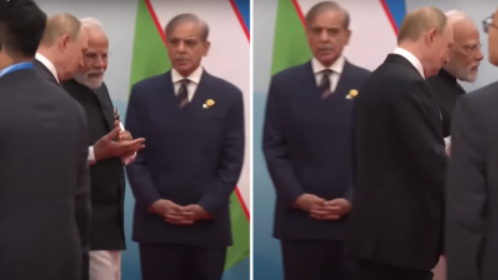
That’s why September 1, 2025, became different—with India repositioning and recalibrating its place. A week before the 80th United Nations General Assembly (UNGA), UNGA 2025, opens in New York City on September 9, the SCO leaders, in a joint declaration, “strongly condemned” the Pahalgam attack, but they steered clear of naming a SCO member-state, Pakistan, whose ignored and dejected Prime Minister Shehbaz Sharif was seen rushing to shake hands with Russian President Vladimir Putin just before the Summit—and got severely trolled at home and overseas.
The member-countries, including China and Turkiye, expressed “deepest sympathy and condolences” to the families of those killed in the April 22 attack at Pahalgam by Pakistan-based Islamist terrorists in Jammu and Kashmir where they massacred 26 Hindu-only tourists.
“The Member States, while reaffirming their firm commitment to the fight against terrorism, separatism, and extremism, stress the inadmissibility of attempts to use terrorist, separatist, and extremist groups for mercenary purposes. They recognize the leading role of sovereign States and their competent authorities in countering terrorist and extremist threats,” the declaration added.
In his remarks during the plenary session at the 25th Meeting of the Council of Heads of State of the SCO in China’s port city of Tianjin, PM Modi said that Pahalgam terror attack was an open challenge to every county who believes in humanity, and urged SCO members to stand united in their fight against terror.
“India has been bearing the brunt of the terrorism for the last four decades. Recently, we saw the worst side of terrorism in Pahalgam. I express my gratitude to the friendly country that stood with us in this hour of grief,” he said.
“This attack was an open challenge for every person, every county who believes in humanity. At this time, it is natural to question that whether open support of terrorism by some countries is acceptable to us. We have to speak in a united voice that no double standards on terrorism will be acceptable. We have to unanimously oppose terrorism in every form and colour. This is our duty towards humanity,” he added.
PM Modi urged for zero tolerance for cross-border terrorism and redefined the grouping’s focus, noting that its foundation rests on three key pillars — security, connectivity, and opportunity.
He also highlighted India’s initiative to fight against terrorism, calling it a “challenge for all of humanity.”
“Security, peace and stability are the basis of development of any country. But terrorism, separatism and extremism are big challenges in this path. Terrorism is not just a challenge to the security of a country but a common challenge for all of humanity. No country, no society, no citizen can consider itself safe from it.
Therefore, India has emphasised unity in the fight against terrorism. India took the initiative to fight Al Qaeda and the terrorist organisations associated with it by leading the Joint Information Operation…We raised our voice against terror financing. I express gratitude for your support in it,” PM Modi said.
The joint declaration condemned terror strikes inside Pakistan as well. “Member-States also strongly condemned the terrorist attacks on Jaffer Express on 11 March and in Khuzdar on 21 May 2025,” it noted.
After visiting Japan, PM Modi began his two-day visit to China on Sunday with a meeting with President Xi Jinping, holding wide-ranging talks aimed at repairing bilateral ties that had frayed during the four-year border standoff in Eastern Ladakh, which formally ended in October 2025.
“We have to say clearly and unanimously that no double standards are acceptable on terrorism. This attack (Pahalgam) was an open challenge to every country and person who believes in humanity. In such a situation, it is natural to raise the question of whether the open support of terrorism by some countries can be acceptable to us. We have to unanimously oppose terrorism in every form and colour. This is our duty towards humanity.”
After the April 22 massacre at Pahalgam, India conducted precision strikes on terror infrastructure in Pakistan and PoJK, repelled Pakistani aggression, and pounded its airbases.
Comprising of 10 members, the SCO includes Belarus, China, India, Iran, Kazakhstan, Kyrgyzstan, Pakistan, Russia, Tajikistan, and Uzbekistan. There are also several dialogue partners and observers. India has been a member of the SCO since 2017, having been an observer since 2005. India also held the chair of the SCO Council of Heads of Government in 2020 and of the SCO Council of Heads of State from 2022 to 2023.