


Virendra Pandit
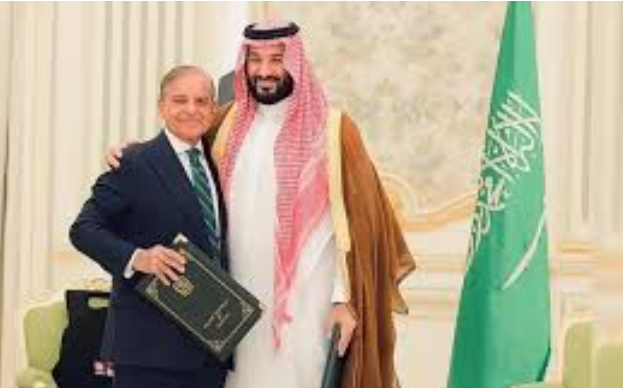
New Delhi: Saudi Arabia and self-styled nuclear-armed Pakistan, which just lost heavily against India in Operation Sindoor, have signed a mutual defense pact that defines any attack on either nation as an attack on both.
But the motive and target behind the pact remains unclear.
Some are seeing it as a key accord in the wake of Israel’s strike on Qatar last week to weed out the Hamas terrorists from that safe haven.
For Saudi Arabia, however, the “defense pact” with Pakistan seems more as a safety net against Iran, and a challenge to its Sunni rival Turkiye. For a nearly bankrupt Pakistan, now shunned even by China, this is a minor consolation prize which Prime Minister Shehbaz Sharif can now showcase as a feather in the cap to his failed country. He also hopes to win some brownie points against India.
As a fallout of this pact, however, Pakistan may lose a friend: Turkiye. Turkiye, close to Shia Iran, and Saudi Arabia lead the non-Arab and Arab factions within the Organization of Islamic Cooperation (OIC) where Ankara has for long been challenging Riyadh’s superiority.
In fact, Turkey, Pakistan, and Malasia even tried to create a short-lived non-Arab, Sunni bloc within the Muslim Brotherhood in 2020 to challenge the dominance of the Saudis, “Custodians of the Holy Places of Islam.” Incensed, the Saudis pulled the strings in Pakistan, forcing it to leave the bloc soon.
The Kingdom has long had close economic, religious and security ties to Pakistan, and may even have funded Islamabad’s nuclear weapons program, potentially against Iran. Unlike Pakistan, the Saudis have little to fear from Israel or India as their main enemy is Iran. After this pact, Pakistan may also antagonise Iran, with which it has had volatile neighbourly relations. A few months ago, they even attacked each other’s border areas to flush out “terrorists.”
The pact may also be a signal to Israel, long suspected to be the Middle East’s only nuclear-armed state, whose war in Gaza is underway since Hamas’ October 7, 2023, attack on Southern Israel. This conflict has been stretching across Iran, Lebanon, the Palestinian territories, Qatar, Syria and Yemen.
What the “defense pact” is all about?
While not specifically discussing the nuclear bomb issue, the pact states “any aggression against either country shall be considered an aggression against both,” according to statements issued by both Pakistan’s Foreign Affairs Ministry and the state-run Saudi Press Agency.
“This agreement … aims to develop aspects of defense cooperation between the two countries and strengthen joint deterrence against any aggression,” the statement said.
That is, if Iran attacks Saudi Arabia, Pakistan will have to attack Iran!
A senior Saudi official suggested that Pakistan’s nuclear protection was a part of the deal, saying it “will utilize all defensive and military means deemed necessary depending on the specific threat.”
Zalmay Khalilzad, a former US diplomat with long experience in Afghanistan and Pakistan, expressed concern over the deal, saying it comes in “dangerous times.”
“Pakistan has nuclear weapons and delivery systems that can hit targets across the Middle East, including Israel. It also is developing systems that can reach targets in the US,” Khalilzad wrote on X.
Pakistan and Saudi Arabia have a defense relationship stretching back decades, in part due to Islamabad’s willingness to defend the Islamic holy sites of Mecca and Medina in the Kingdom. Pakistani troops first travelled to Saudi Arabia in the late 1960s over concerns about Egypt’s war in Yemen at the time.
Those ties increased after Iran’s 1979 Islamic Revolution and the Kingdom’s fears of a confrontation with Tehran.
Pakistan developed its nuclear weapons program counter India’s nuclear assets. The two neighbours have fought multiple wars against each other and again came close to open warfare after a terror attack launched from Pakistani soil on Hindu-only tourists at Pahalgam, Jammu and Kashmir, on April 22. India is believed to have an estimated 172 nuclear warheads, while Pakistan has 170, according to the US-published Bulletin of Atomic Scientists.
On Thursday, India acknowledged the Saudi-Pakistan pact and said it “will study the implications of this development for our national security as well as for regional and global stability.” Saudi Arabia also maintains close ties with India.
Retired Pakistani Brigadier-General Feroz Hassan Khan, in his book on Pakistan’s nuclear weapons program called “Eating Grass: The Making of the Pakistani Bomb,” said Saudi Arabia provided “generous financial support to Pakistan that enabled the nuclear program to continue, especially when the country was under sanctions.”
Pakistan faced US sanctions for years over its pursuit of the nuclear bomb — and saw new ones imposed over its ballistic missile work at the end of the Biden administration.
Saudi Arabia has sought U.S. assistance to advance a civilian nuclear power program, in part with what had been a proposed diplomatic recognition deal with Israel prior to the 2023 Hamas attack that triggered the ongoing Gaza War.
While condemning the Israeli war in Gaza, Saudi Crown Prince Muhammed bin-Salman has also said the Kingdom would pursue a nuclear weapon if Iran had one.
Before the signing of the defense pact with Pakistan, Iran dispatched Ali Larijani, a senior political figure who now serves as the secretary of the country’s Supreme National Security Council, to visit Saudi Arabia.