


Virendra Pandit
New Delhi: Despite claims and counterclaims, the conflict in West Asia continued on Tuesday, the 25th day, as the US-Israel duo and Iran relentlessly struck each other’s targets, the media reported.
According to a news platform Semafor report, citing an unnamed American official, the US will continue striking on Iran, with the pause announced by President Donald Trump on Monday, following “productive talks,” applying only to attacks on Tehran’s energy sites.
He had postponed for five days a plan to hit Iran’s energy grid. Iran later denied that it had engaged in negotiations with the United States.
“The stop on attacks for five days is only on their energy sites,” the US official told Semafor.
“It is not on the military sites and the navy, and the ballistic missiles, and the defense industrial base. The initial initiatives of (Operation) Epic Fury will continue,” he told the news agency.
The Semafor report also disclosed that Jerusalem was not party to Washington’s talks with Tehran.
The Israel Defense Forces (IDF) on Tuesday said it has carried out more than 3,000 strikes across Iran since the start of Operation Roaring Lion. According to the IDF, recent operations targeted command centres of the Islamic Revolutionary Guard Corps (IRGC), along with weapons storage facilities and air defence systems.
The Israeli military said on Tuesday it carried out a wide-scale wave of strikes on multiple missile production sites in Iran, targeting key infrastructure as the conflict continues to escalate.
Overnight, the military said more than 50 additional sites were hit, including locations linked to ballistic missile storage and launch operations, as the campaign against Iranian military infrastructure continues.
IRGC has threatened to attack Israel “without restraint” if it targets civilians in Lebanon and Gaza, even as the IDF continued to bomb Beirut and other areas in Lebanon to flush out Hezbollah terrorists.
On Monday, Tehran threatened to deploy naval mines in the Persian Gulf and target power and water infrastructure across the region if its islands and coasts were attacked, raising fears of a deepening energy crisis.
News outlet Arab News cited Israeli publication Yedioth Ahronoth stating that Mojtaba was ready to negotiate with the Americans. Ahronoth cited a conversation between Iranian Foreign Minister Abbas Araghchi and US intermediary Steve Witkoff which was approved by the ‘highest level’ in Iran.
Earlier, the spokesman for Iran’s Foreign Ministry had dismissed President Trump’s claims of talks with Iran, saying Tehran has had no negotiations with Washington over the past 24 days of the unprovoked US-Israel war against the Islamic Republic.
The key development came after Trump on Monday said the Strait of Hormuz, a vital global shipping route, will be “open very soon” amid the ongoing conflict in West Asia and suggested that he envisions it being managed jointly by the US and Iran. Speaking to reporters in Florida, Trump said that the strait will be “open very soon” if ongoing negotiations with Tehran continue successfully.
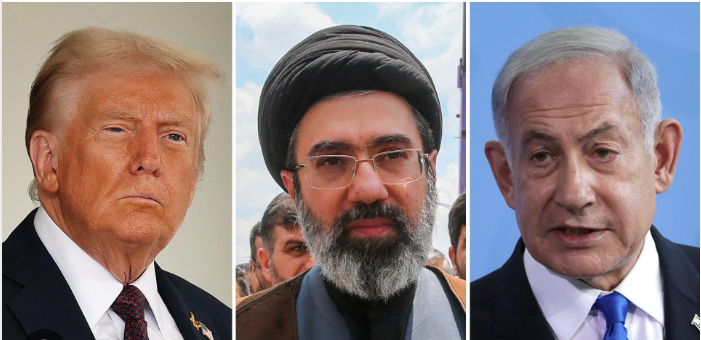
The US President added that he and Mojtaba Khamenei, will “jointly” control the critical shipping and global energy route. “It’ll be jointly controlled. Me and the Ayatollah, whoever the Ayatollah is, whoever the next Ayatollah is,” the US President added.
The Strait of Hormuz is a critical transit route that normally handles 15 million barrels per day of crude oil and 5 million barrels per day of oil products, representing roughly 25 percent of global seaborne oil trade.
However, due to the fierce conflict in the region, the narrow waterway has become high-risk for transit, choking the global energy supply. Trump also highlighted that the recent early strikes in the conflict had targeted much of Iran’s senior leadership, saying, “And there’ll also be a very serious form of regime change. There’s automatically a regime change,” and noted that talks over the weekend showed potential to reduce tensions.
Commenting on the individuals involved in negotiations, Trump said, “But we’re dealing with some people that I find to be very reasonable, very solid. The people within know who they are, they’re very respected, and maybe one of them will be exactly what we’re looking for.”
Earlier, he announced that he had instructed the US Department of War to delay any military action against Iranian power plants and energy sites for five days, citing ongoing diplomatic engagements with Tehran amid escalating tensions in West Asia.
In a post on Truth Social, Trump said the United States and Iran had held “very good and productive conversations” over the past two days aimed at resolving hostilities in the region. The decision to pause strikes was based on the “tenor and tone” of the discussions, which he described as “in-depth, detailed, and constructive.” They will continue through the week, he added.
The key development comes as the conflict between US-Israel and Iran has now entered into its fourth week–with ripple effects being felt beyond West Asia and the Gulf region as concerns intensify over global energy security, with supply bottlenecks and damaged infrastructure- civilian, military and energy.