


Virendra Pandit
New Delhi: With Israeli Defence Minister Israel Katz approving the plan to conquer the war-torn Gaza City and the Jewish nation calling an additional 60,000 reservists for a final assault on the world’s hottest spot, the Middle East is likely to enter one of its most decisive moments in the last two millennia.
When his ceasefire plans failed, US President Donald Trump, on July 25, had asked Israel to “finish the job” and “get rid of Hamas” at the earliest.
Katz’s move, to be put to the Security Cabinet this week, has piled pressure on Gaza’s terror group Hamas as mediators pushing for a ceasefire in the ongoing nearly two-year war, the media reported on Wednesday.
He also authorized the call-up of around 60,000 reservists to carry it out, his Ministry confirmed on Wednesday.
An Israeli military official said five divisions would be involved in the planned ground offensive to capture and occupy all of Gaza City.
A military official said the reservists would report for duty in September and that most of the troops mobilised for the offensive would be active-duty personnel.
Troops were already operating in the Zeitoun and Jabalia areas as part of the preparations for the plan, which Katz approved on Tuesday and will be put to the security cabinet later this week.
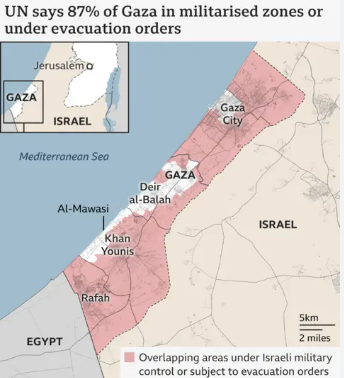
Hundreds of thousands of Palestinians in Gaza City are expected to be ordered to evacuate and head to shelters in southern Gaza.
Many of Israel’s allies have condemned the plan, while the UN and non-governmental organisations have warned that another offensive and further mass displacement will have a “horrific humanitarian impact” after 22 months of war.
Israel announced its intention to conquer the entire Gaza Strip after indirect talks with Hamas on a ceasefire and hostage release deal broke down in July.
Regional mediators are trying to secure an agreement before the Israeli offensive begins and have presented a new proposal for a 60-day truce and the release of around half of the 50 hostages still held in Gaza, which Hamas said it had accepted on Monday.
Israel has not yet submitted a formal response, but Israeli officials insisted on Tuesday that they would no longer accept a partial deal and demanded a comprehensive one that would see all the hostages released. Only 20 of the hostages are believed to be alive.
The Israel Defense Forces (IDF) said in a statement that orders calling up 60,000 reservists were issued on Wednesday as part of the preparations for “the next phase of Operation Gideon’s Chariots” – the offensive that it launched in May.
In addition, 20,000 reservists who had already been called up would receive a notice extending their current orders, it added.
An Israeli military official said senior commanders had approved the plan for a “gradual” and “precise” operation in and around Gaza City, and that the chief of staff, Lt. Gen. Eyal Zamir, was expected to finalise them in the coming days.
Five divisions may take part in the fresh offensive, the official said.
The Haaretz newspaper quoted Defence Minister Katz as saying on Tuesday: “Once the operation is completed, Gaza will change its face and will no longer look as it did in the past.”
He also approved a plan to “accommodate” Gaza City residents in the south of the territory, including the coastal al-Mawasi area, where the military has begun establishing additional food distribution points and field hospitals.
Prime Minister Benjamin Netanyahu has said the military’s objectives are to secure the release of all the hostages held by Hamas and “complete the defeat” of the Palestinian armed group.
The IDF also announced on Wednesday that the Givati Brigade had resumed operations in the northern town of Jabalia and on the outskirts of Gaza City, where it said they “are dismantling military infrastructures above and below ground, eliminating terrorists, and consolidating operational control.”
It said civilians were being told to move south for their safety “to mitigate the risk of harm.”
Meanwhile, UN agencies and NGOs have warned of the humanitarian impact of a new offensive.
“The Israeli plan to intensify military operations in Gaza City will have a horrific humanitarian impact on people already exhausted, malnourished, bereaved, displaced, and deprived of basics needed for survival,” they said in a joint statement on Monday.
“Forcing hundreds of thousands to move south is a recipe for further disaster and could amount to forcible transfer.”
They also said the areas of the south where displaced residents were expected to move were “overcrowded and ill-equipped to sustain human survival at scale.”
“Southern hospitals are operating at several times their capacity, and taking on patients from the north would have life-threatening consequences.”
The current crisis emerged after Israeli military launched a fierce campaign in Gaza responding to the Hamas-led invasion of Southern Israel on October 7, 2023, in which about 1,200 people were killed and 251 others were taken hostage.
At least 62,122 people have since been killed in Gaza, according to the territory’s Hamas-run health ministry.
Most of Gaza’s 2.3 million population has also been displaced multiple times; more than 90 percent of their homes are estimated to be damaged or destroyed; the healthcare, water, sanitation and hygiene systems have collapsed; and UN-backed global food security experts have warned that the “worst-case scenario of famine is currently playing out” due to food shortages.