


Virendra Pandit
New Delhi: Under pressure from his Republican supporters fearing political reverses ahead of the US Congress midterm elections this year, while President Donald Trump appeared to ‘wriggle out’ of it all to minimise losses by declaring the ongoing war in West Asia will “end soon,” Iran insisted that it will determine the end of the war, the media reported on Tuesday.
“It is we who will determine the end of the war,” Iran said as it rejected Trump’s claims of “short-term” conflict.
Tehran accused the US President of using “cunning and deceit” to manipulate public opinion following what Tehran described as “shameful defeats.”
According to media reports, Iran issued a defiant response to Trump’s claims regarding the conclusion of hostilities, asserting that it (Tehran) will be the sole authority to “determine” the end of military actions against American and Israeli targets. In a strongly worded statement, Iran’s Islamic Revolutionary Guard Corps (IRGC) rejected Washington’s timeline for the conflict.
The elite force maintained that the future of the region is now guided by Tehran’s military strategy rather than US intervention. “The equations and future status of the region are now in the hands of our armed forces; American forces will not end the war.”
Trump’s claims of safe passage for vessels in the region were false, Iran said, asserting that American ships and fighter jets have “fled the region more than 1,000 kilometres away” to escape Iranian strikes.
IRGC mocks the US
The statement specifically mocked the movement of the US Navy, claiming that “cowardly and timid soldiers” increased their distance after missiles were fired at the USS Abraham Lincoln. Tehran also dismissed reports of a weakened missile inventory, claiming that Iranian munitions are now “more powerful than in the early days of the war,” with some warheads weighing over one ton.
As the conflict continues to choke global energy supplies, the IRGC warned that it would not permit “the export of a single litre of oil” from the region to hostile nations until further notice. This stance directly challenges Trump’s recent threats to protect maritime trade. He had earlier suggested that the war against Iran would be a “short-term excursion to get rid of some evil.” However, he coupled this with a severe warning on social media regarding the strategic Strait of Hormuz.
“If Iran does anything that stops the flow of Oil within the Strait of Hormuz, they will be hit by the United States of America TWENTY TIMES HARDER than they have been hit thus far,” the US President posted.
Trump added that the US would target “easily destroyable targets” to ensure it is “virtually impossible for Iran to ever be built back, as a Nation, again.”
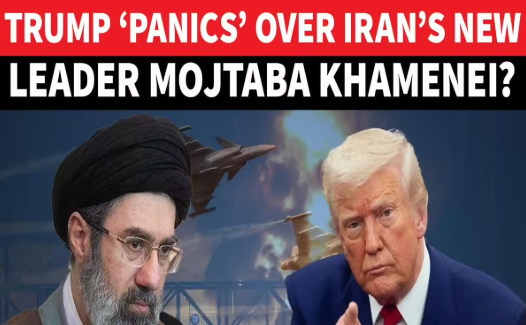
He characterised the protection of the waterway, Strait of Hormuz, as a “gift from the United States of America to China” and other nations dependent on the route. The escalation comes shortly after Ayatollah Mojtaba Khamenei was selected to succeed his late father as Iran’s Supreme Leader, a move that coincides with oil prices reaching their highest levels since 2022. In a bid for a diplomatic resolution, Russian President Vladimir Putin reportedly held a telephone call with Trump on Monday.
According to the Kremlin, Putin “voiced a few ideas regarding a quick political and diplomatic settlement” after consulting with regional leaders and Iranian President Masoud Pezeshkian.
Meanwhile, French President Emmanuel Macron confirmed that France and its allies are preparing a “purely defensive” mission to reopen the Strait of Hormuz. With nearly 20 percent of the world’s crude oil transiting the waterway, Macron emphasised the need to protect global economic interests from the ongoing volatility.