


Virendra Pandit
New Delhi: In just two days of massive anti-government demonstrations by leaderless Generation Z youths, the Communist-led government collapsed in Nepal, its ministers resigned, and so did its highly unpopular, pro-China Prime Minister KP Sharma Oli, who, reports suggested, might follow President Gotabaya Rajapaksa, who fled Sri Lanka in 2022 after a massive uprising against unemployment and inflation.
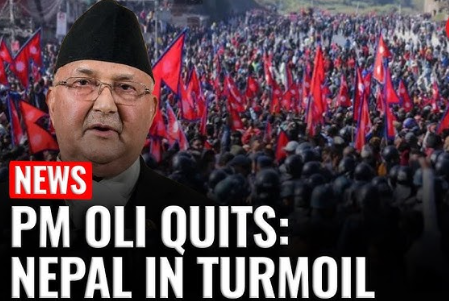
Media reported on Tuesday that Oli stepped down shortly after hundreds of demonstrators stormed his office, shouting anti-government slogans, and set ablaze his as well as President Ram Chandra Poudel’s private houses in the Himalayan country.
Hours before his resignation, the masked-and-helmeted demonstrators set on fire the Nepalese leaders’ private residence in Balkot, demanding accountability for Monday’s brutality. At least 22 people died in police firing and over 400 were wounded in the violence during an anti-government demonstration, triggered after the Oli regime banned 26 major social media platforms, except China’s TikTok.
The leaderless demonstrators had, on camera, feared that the government’s agents could provoke violence and then crush the peaceful movement.
Panicked at the unprecedented and massive protests, however, the government revoked the social media ban last night. However, that did not quell the fires, and the youths continued their agitation against the “corrupt” government, forcing ministers and Oli to resign.
Nepal’s Gen Z protests erupted on Monday after a nationwide social media ban imposed on September 3. It resulted in casualties, curfews, and a government rollback of the order. Ironically, Kathmandu could not even sense the build up to the uprising that would overthrow the Communist-led government entrenched on the poor country since the ouster of monarchy in 2008.
The world’s only former Hindu Kingdom has since been one of the most politically unstable countries. It has seen at least 14 governments come and go since 2008 when it became a republic. This frequent turnover of governments reflects the continued political instability and churning in Nepal, marked by coalition politics and shifting alliances among multiple parties and their breakaway factions. Some of its leaders have repeatedly become prime ministers in different permutations and combinations.
Amid mounting demands for a return of monarchy, thousands of Nepalese Gen Z youths hit the streets of Kathmandu and some other towns and cities on Monday. The government’s ill-advised and sweeping social media ban gave them a trigger-point to mount protests as many feared a loss of livelihood, networking, and freedom of expression through social media.
The unrest, which began with peaceful demonstrations, turned massive and violent after officials imposed curfews in Kathmandu and other cities. The protesters breached the Parliament premises and targeted the homes of politicians to vent their frustration against “Nepokids” and their luxurious lifestyles in Nepal and abroad.
On the second day of their agitation, videos emerged on social media showing demonstrators roaming through the President’s house and vandalising it, reminding the world of what happened in Sri Lanka in 2022. Houses of former Nepali Prime Ministers Pushpa Kamal Dahal alias Prachanda and Sher Bahadur Deuba, and Energy Minister Deepak Khadka were also damaged.
Protesters also breached the Nepali Parliament and set the building on fire. As the police did in Columbo in 2022, the Nepali Police also appeared not using any force, as the anger of demonstrators turned toward the government.
They carried placards while videos with hashtags like #NepoKid, #NepoBabies, and #PoliticiansNepoBabyNepal flooded social media.
Several widely used social networks, including Facebook, X and YouTube, were blocked in the Himalayan nation last week after they failed to comply with directives to register and submit to government oversight. Monday’s rallies against the ban swelled to tens of thousands of people in Kathmandu, and crowds surrounded the Parliament building before police opened fire at them.