


Virendra Pandit
New Delhi: Putting terror-nursery of Pakistan and terror-victim India on the same page, the Trump administration on Tuesday claimed that its relationship with both the South Asian countries “remains unchanged” and that American diplomats are “committed to both nations.”
Ironically, by openly pampering Pakistan, US President Donald Trump has only boosted Prime Minister Narendra Modi’s “Make in India” program, amid calls to boycott American products like McDonald’s and the two colas.
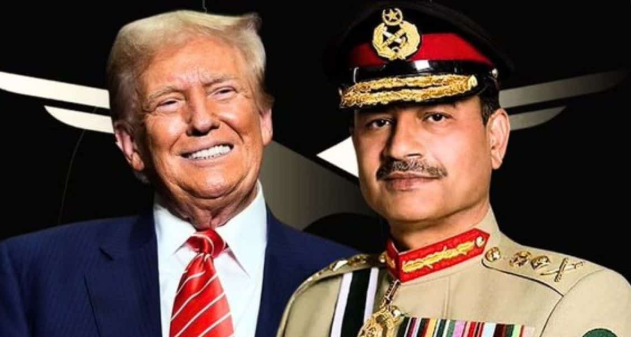
In May, Trump claimed that he mediated between India and Pakistan and stopped a potential nuclear war; he and his officials repeated it no less than 40 times since without giving any proof even as India officially denied multiple times. Then, twice in June and August, he hosted Pakistan’s de facto dictator, “Field Marshal” General Syed Asim Munir, who is now openly threatening, from the American soil, to take down not only India but also ‘half the world’ in a nuclear catastrophe.
This re-hyphenation of India and Pakistan, condemned by several former diplomats, economists, and experts in the US, came amid speculations that Prime Minister Narendra Modi may visit New York in September to participate in the United Nations General Assembly (UNGA)’s annual meeting.
While mollycoddling Islamabad, Washington even overlooked Mullah Munir’s fresh nuclear threats to India issued from Trump’s home state of Florida this week.
Speaking at the State Department briefing, its spokesperson Tammy Bruce reiterated President Trump’s claim of Washington’s ‘involvement’ in the India-Pakistan truce following their military conflict in May, saying it was a “very proud” moment for the US to have been “involved in stopping that potential catastrophe,” the media reported on Wednesday.
“We had an experience with Pakistan and India, when there was a conflict, that could have developed into something quite horrible. There was immediate concern and movement with President Donald Trump, Vice President J.D. Vance, and Secretary of State Marco Rubio in addressing the nature of what was happening,” she said.
“We described the nature of the phone calls and the work we did to stop the attacks, bringing the parties together to create something enduring. It’s a very proud moment that Secretary Rubio, Vice President Vance and the top leaders in this nation were involved in stopping that potential catastrophe,” Bruce added.
When asked if, after Munir’s recent meeting with Trump, the US would increase assistance and arms sales to Pakistan “at the expense of President Trump’s relationship with PM Modi,” Bruce noted that the US relationship with “both nations remain unchanged – good. The diplomats are committed to both nations.”
About the US-Pakistan counter-terrorism dialogue in Islamabad on Tuesday, she said, “The United States and Pakistan reaffirmed their shared commitment to combat terrorism in all its forms and manifestations during the latest rounds of talks in Islamabad. The US and Pakistan discussed ways to enhance cooperation to counter terrorist threats.”
“For the region and for the world, the US working with both those nations is good news and will promote a future that’s beneficial,” she added.
After failing to lord it over India, the US has been encouraging Pakistan to spew venum against India, something Islamabad has mastered since 1947. Munir is only the latest American front against India. Worried over how Trump has wasted 20 years of diplomatic efforts to build good relations with India, a former Pentagon official, Michael Rubin, even condemned Munir as “Osama bin-Laden clad in a suit.”
During the recent visit, Munir told a gathering of Pakistani-Americans in Florida, Trump’s home state, that Pakistan is a nuclear nation which will take “half the world down” if faced with an existential threat from India. His remarks drew a strong reaction from the Ministry of External Affairs (MEA) in New Delhi, but not from Washington.
“It is also regrettable that these remarks should have been made from the soil of a friendly third country,” the MEA said.
The statement signalled India’s subtle condemnation of the US for courting the Pakistani army chief who lost a war against India but claimed victory and promoted himself as “Field Marshal.”
In the US, he also warned that Islamabad would destroy Indian infrastructure if they hit the Indus water flow to Pakistan.
“We are a nuclear nation. If we think we are going down, we’ll take half the world down with us,” the media reports quoted him as saying.
“We will wait for India to build a dam, and when they do so, we will destroy it,” he added.
“Emboldened by reception and welcome by the US, his next step could possibly unfold in Pakistan as a coup in Pakistan so that the Field Marshal becomes the President,” an official was quoted as saying.
MEA spokesperson Randhir Jaiswal said India has already made it clear that “it will not give in to nuclear blackmail, and that “Nuclear sabre-rattling is Pakistan’s stock-in-trade.”
“The international community can draw its own conclusions on the irresponsibility inherent in such remarks, which also reinforce the well-held doubts about the integrity of nuclear command and control in a state where the military is hand-in-glove with terrorist groups,” he said.
Prime Minister Narendra Modi is likely to address the annual high-level session of the UNGA) in September. The 80th session of the world assembly will open on September 9. The high-level General Debate will run from September 23-29, with Brazil as the traditional first speaker of the session, followed by the US.
US President Donald Trump will address world leaders on September 23, his first address to the UN session in his second term in the White House.
In a joint statement issued after their meeting, PM Modi and President Trump had announced in February their plans to negotiate the first tranche of a mutually beneficial, multi-sector Bilateral Trade Agreement (BTA) by the fall of 2025.
Even as trade negotiations are still in progress, Trump imposed tariffs totalling 50 percent on India, including 25 percent for New Delhi’s purchases of Russian oil, that will come into effect from August 27.
Responding to the tariffs, India’s Ministry of External Affairs has said that the targeting of the country is unjustified and unreasonable.