


Virendra Pandit
New Delhi: Amid reports that Russian President Vladimir Putin has directed his officials to ‘match’ America’s nuclear arms preparedness, Poland and Romania are deploying a new weapons system to defend against Russian drones, lest the war theatre expand and they become the next Ukraine, the media reported on Thursday.
This follows a spate of Russian incursions into NATO airspace in recent months that exposed the alliance’s vulnerabilities and put Europe on edge.
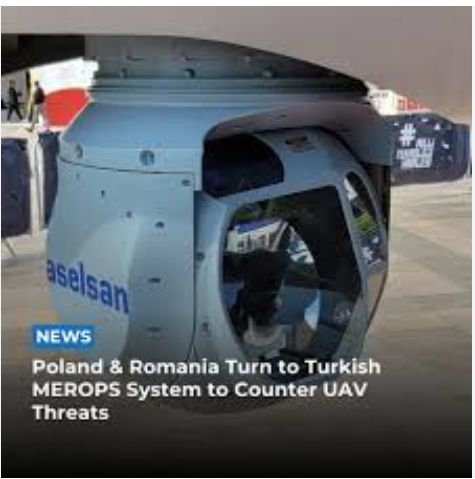
The two neighbours of Russia are using the Merops system, which can easily fit in the back of a mid-sized pickup truck, can identify drones and close in on them, using artificial intelligence (AI) to navigate when satellite and electronic communications are jammed.
Besides, Merops will also be used by Denmark to boost defences on NATO’s eastern flank, NATO military officials were quoted as saying.
The aim is to make NATO members’ borders with Russia so well-armed that Moscow’s forces will be deterred from ever contemplating crossing, from Norway in the north to Turkey in the south.
The need for such cutting-edge technology was felt after nearly 20 Russian drones barged into Polish airspace in early September. Expensive fighter jets were scrambled to respond to more affordable drones.
Romania later faced a drone incursion, while drones temporarily closed airports in Copenhagen, Munich, Berlin and Brussels. There were also drone sightings near military bases in Belgium and Denmark.
While the origin of the drones could not always be traced to Russia or linked to its war in Ukraine, the urgent need to bolster defences is clear. A protracted drone battle or full-scale war as in Ukraine would drain Western coffers and limited stocks of missiles.
Accurately detecting drones, the new system can take them down at a low cost. It’s a lot cheaper than flying an F-35 into the air to take them down with a missile.
Merops flies drones against drones, either directly at the hostile drone or can pass on its information from the system to ground or air forces so that they can shoot it down. It also gives commanders enough time to assess the threat and decide to shoot or not shoot. It can be used to protect both critical infrastructures, such as airports, and armed forces manoeuvring in a combat zone.
A protracted drone battle or full-scale war, as in Ukraine, would drain Western coffers and limited stocks of expensive missiles.
The drone incursions and the instability on NATO’s eastern flank stem from Russia’s ongoing war with Ukraine, since February 2022. The conflict has become a crucible for drone development, transforming the battlefield into a testing zone for new technology which now has applications elsewhere in Europe.
The Merops system has been used successfully in Ukraine. Drones are evolving rapidly, and each new type demands a different response. That requires extremely fast production cycles from development to battlefield within weeks.
Meanwhile, Russia is also mass-producing attack drones, equipping them with cameras, jet-propelled engines and advanced anti-jamming antennae. Putin admitted recently that Russia’s knowledge was simply non-existent in many a field but claimed Moscow could now field more advanced technology within a matter of days.
Ukraine, NATO and Russia are in a game of technological cat-and-mouse, the NATO officials suggested.
Meanwhile, President Putin has told top Kremlin officials to draft proposals for the possible resumption of nuclear weapons testing, as Moscow responds to US President Donald Trump’s order that the United States “immediately resume” its own testing after a 33-year-long hiatus.
Putin told his Security Council on Wednesday that should the US or any signatory to the Comprehensive Nuclear-Test-Ban Treaty (CTBT) conduct nuclear weapons tests, Russia would take “reciprocal measures.”
“In this regard, I instruct the Foreign Ministry, the Defence Ministry, the special services, and the corresponding civilian agencies to do everything possible to gather additional information on this matter, have it analysed by the Security Council, and submit coordinated proposals on the possible first steps focusing on preparations for nuclear weapons tests.”
Moscow has not carried out nuclear weapons tests since the collapse of the Soviet Union in 1991. But its tensions with Washington, which has the world’s largest nuclear arsenals, have spiked in recent weeks as Trump’s frustration with the Russian leader grows over Russia’s failure to end its war in Ukraine.
Trump also cancelled a planned summit with Putin in Hungary in October, before imposing sanctions on two major Russian oil firms a day later – the first such measures since Trump returned to the White House in January.
He said on October 30 that he had ordered the Department of Defense to “immediately resume” nuclear weapons testing on an “equal basis” with other nuclear-armed powers like Russia, China, Pakistan, and North Korea.
Trump’s decision came days after he criticised Moscow for testing its new Burevestnik missile, which is nuclear-powered and designed to carry a nuclear warhead.
State news agency TASS quoted Kremlin spokesman Dmitry Peskov as saying that Putin had set no specific deadline for officials to draft the requested proposals.
Russia and the US are by far the biggest nuclear powers globally in terms of the number of warheads they possess.
The Center for Arms Control and Non-Proliferation (CACNP) estimates that Moscow currently has 5,459 nuclear warheads, of which 1,600 are actively deployed.
The US has about 5,550 nuclear warheads, according to the CACNP, including 3,800 active. At its peak in the mid-1960s during the Cold War, the US stockpile consisted of more than 31,000 active and inactive nuclear warheads.
China currently lags far behind, but has rapidly expanded its nuclear warhead stockpile to about 600 in recent years, adding 100 per year since 2023, according to the Stockholm International Peace Research Institute (SIPRI).
France, Britain, India, Pakistan, Israel and North Korea comprise the remaining nuclear-armed countries.
The US last exploded a nuclear device in 1992, after former Republican President George HW Bush issued a moratorium on nuclear weapons testing following the collapse of the Soviet Union a year earlier.
Since 1996, the year the CTBT was opened for signatures, only three countries have detonated nuclear devices.
India and Pakistan conducted tests in 1998. North Korea has carried out five explosive tests since 2006 – most recently in 2017 – making it the only country to do so in the 21st century.