


Virendra Pandit
New Delhi: As India told the visiting Chinese Foreign Minister that differences must not become disputes, Beijing has agreed to address New Delhi’s requirements for rare earths, fertilizers, and tunnel-boring machines, the media reported on Tuesday.
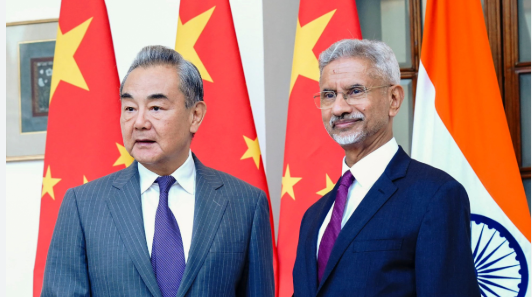
Minister for External Affairs S. Jaishankar, who led the Indian team to discuss various bilateral issues with China’s Foreign Minister Wang Yi on Monday, said the Chinese leader’s visit to India is an opportunity to review their ties, and an appropriate time to exchange views on the global situation and some issues of mutual interest, he said.
The fight against terrorism in all its forms and manifestations is another major priority, the EAM said.
According to reports, China has promised to address India’s three key concerns, namely rare earths, fertilisers, and tunnel-boring machines.
India’s automobile and electronics industries had repeatedly flagged shortages of rare earth magnets, and warned of production risks. Amid tensions with India, China had restricted supplies on what it called national security consideration. In April, however, it agreed to issue special export licences for seven rare earth elements and related magnets.
Reports said some Indian automakers had to cut production due to shortages of rare earth magnets. The Union Ministry of Heavy Industries is working on a Rs. 1,345 crore subsidy scheme to promote domestic manufacturing of rare earth magnets.
China’s curbs on fertilizer exports to India had also disrupted the supply of Di-Ammonium Phosphate (DA) during the 2024 Rabi season. Resuming this supply will benefit millions of Indian farmers.
Dr. Jaishankar said the bilateral talks covered “economic and trade issues, pilgrimages, people-to-people contacts, river data sharing, border trade, connectivity and bilateral exchanges.”
The EAM followed up on the concerns he had raised during his visit to China in July and underscored that as neighbouring nations and major economies in the world, there are various facets and dimensions of the India-China ties.
“It is also essential in this context that restrictive trade measures and roadblocks are avoided,” he said. “Stable and constructive ties between India and China are not only to our benefit, but that of the world as well. This is best done by handling relations on the basis of mutual respect, mutual interest and mutual sensitivity.”
Their bilateral ties had nosedived after hostile actions of the People’s Liberation Army (PLA) of China along the Line of Actual Control (LAC) in Eastern Ladakh in mid-2020 that led to a prolonged standoff. There was some easing of tensions due to agreements on the disengagement of troops from some friction points.
Ahead of the 2024 BRICS Summit, India and China reached an agreement on patrolling arrangements along the LAC, marking progress in easing tensions. They have in recent months taken steps to improve their ties. India has stressed the need of taking steps towards de-escalation along LAC.
Wang Yi’s two-day visit precedes Prime Minister Narendra Modi’s expected travel to China to attend the Shanghai Cooperation Organisation (SCO) Summit in Tianjin from August 31 to September 1.
On Monday. India and China also discussed economic and trade issues, including resumption of border trade and direct flights.
In his opening remarks, Dr. Jaishankar said that “the basis for any positive momentum” in India-China ties “is the ability to jointly maintain peace and tranquillity in the border areas.”
It is also essential that the de-escalation process moves forward, he said.
“Having seen a difficult period in our relationship,” Dr. Jaishankar told Wang, “Our two nations now seek to move ahead”. This requires a candid and constructive approach from both sides, he said.
Prime Minister Narendra Modi and Chinese President Xi Jinping’s meeting on October 23, 2024, in the Russian city of Kazan, on the sidelines of the BRICS Summit, paved the way for de-escalation in the border areas between the two countries after the friction in ties since the Galwan Valley clashes in 2020.
On Tuesday, Wang and India’s National Security Adviser Ajit Doval will discuss the boundary issues under the auspices of the 24th round of the Special Representatives mechanism.
Wang will also call on PM Modi on Tuesday evening.
At their meeting, the two sides also discussed the international situation.
“We seek a fair, balanced, and multi-polar world order, including a multi-polar Asia. Reformed multilateralism is also the call of the day,” Dr. Jaishankar said.
“In the current environment, there is clearly the imperative of maintaining and enhancing stability in the global economy as well,” he said.
Wang’s visit is the first by a Chinese minister since PM Modi and Xi’s Kazan meeting in October, Dr. Jaishankar noted.
“Overall, it is our expectation that our discussions would contribute to building a stable, cooperative and forward-looking relationship between India and China, one that serves both our interests and addresses our concerns,” he said, wishing China a successful SCO Summit that it is hosting next weekend.
In Beijing, China on Monday said Foreign Minister Wang Yi’s two-day visit to India was aimed at working with New Delhi to deliver on important understandings reached between the leaders of the two sides and decisions taken during the previous round of border talks.
Wang is slated to visit Pakistan as well later this week.