


Virendra Pandit
New Delhi: The recent China-Japan spat over Taiwan shows how rapidly the geopolitical situation changes and countries discover old enemies at the gates.
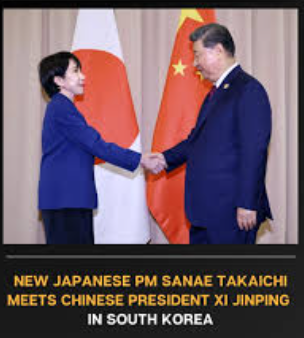
Only on October 31, 2025, Japan’s new Prime Minister Sanae Takaichi shook hands with Chinese President Xi Jinping, ahead of the Japan-China Summit on the sidelines of the Asia-Pacific Economic Cooperation (APEC) Summit in Gyeongju, South Korea.
Within a week, however, the two ancient enemies came at each other’s throats again.
It all started with the Japanese PM’s comment to help Taiwan in case China attacked it. It reopened old wounds between the two countries.
So much so that Beijing, on Friday last week, took its feud with Tokyo over Taikachi’s recent comments on Taiwan to the United Nations, as tensions between the East Asian neighbours deepened and ties plunged to their lowest since 2023, the media reported.
“If Japan dares to attempt an armed intervention in the cross-Strait situation, it would be an act of aggression,” China’s permanent representative to the UN, Fu Cong, wrote in a letter on Friday to UN Secretary-General Antonio Guterres, referring to the strait that separates mainland China from self-governing Taiwan, which Beijing insists is part of China. Beijing has not ruled out the possibility of forcibly taking Taiwan, and its warships and fighter aircraft routinely fly around Taiwan to threaten it.
The diplomatic spat began earlier in November when Taikachi, who took office only in October, remarked how Japan would respond to a hypothetical Chinese attack on Taiwan. Outraged, Beijing demanded retractions, although the Japanese PM has not made one.
The spat rapidly escalated into a trade war involving businesses on both sides, and deepened security tensions over a contested territory that has long been a flashpoint for the two countries.
What did she say?
Addressing the National Diet (Parliament) on November 7, Taikachi, a longtime Taiwan supporter, said a Chinese naval blockade or other action against Taiwan could prompt a Japanese military response. Unlike her predecessors, who merely expressed concern on the issue, she went several steps further.
“If it involves the use of warships and military actions, it could by all means become a survival-threatening situation,” she told lawmakers.
This immediately triggered protests from China’s foreign and defence ministries, which demanded retractions. A day later, China’s Consul-General in Osaka, Xue Jian, criticised the comments and even threatened a retaliation: “We have no choice but to cut off that dirty neck that has been lunged at us without hesitation. Are you ready?”
That post on X also angered many in Japan, and some officials demanded the diplomat’s expulsion. Japan’s Chief Cabinet Secretary Minoru Kihara protested to Beijing over Xue’s X message, saying it was “extremely inappropriate.” Japan’s Foreign Ministry also demanded the post be deleted. Chinese officials, meanwhile, defended the comments.
On November 14, China’s Foreign Ministry summoned the Japanese ambassador and warned of a “crushing defeat” if Japan interfered with Taiwan. The next day, Japan’s Foreign Ministry also summoned the Chinese ambassador to complain about the consul’s post.
Taikachi told parliament, three days later, that she would avoid talking about specific scenarios, but she refused to retract her comments.
Rising Tensions
The rising tension suddenly deteriorated into a trade war. On November 14, China issued a no-travel advisory for Japan, an apparent attempt to target the country’s tourism sector, which some 7.5 million Chinese tourists visited between January and September 2025. The next day, three Chinese airlines offered refunds or free changes for flights planned on Japan-bound routes.
The Chinese Education Ministry also warned Chinese students in Japan, or those planning to study in Japan, about recent ‘crimes’ against Chinese. Both China and Japan have recorded attacks against each other’s nationals in recent months that have prompted fears of xenophobia.
Tensions are also rising around territorial disputes. Last Sunday, the Chinese coastguard announced it was patrolling areas in the East China Sea, in the waters around a group of uninhabited islands that both countries claim. Japan calls the islands the Senkaku Islands, while Beijing calls them the Diaoyu Islands. In response, Japan condemned the brief “violation” of Japanese territorial waters by a fleet of four Chinese coastguard ships.
Over the last week, China suspended the screening of at least two Japanese films and banned Japanese seafood. On Thursday last, Beijing postponed a three-way meeting with culture ministers from Japan and South Korea that was scheduled to be held in late November.
On November 18, diplomats from both sides met in Beijing for talks where the grievances were aired.
Senior Chinese official Liu Jinsong even wore a five-buttoned collarless suit associated with the rebellion of Chinese students against Japanese imperialism in 1919.
Bilateral Trade
He Yongqian, a spokesperson for China’s commerce ministry, said that trade relations between the two countries had been “severely damaged” by PM Takaichi’s comments.
China is Japan’s second-largest export market after the US, with Tokyo selling mainly industrial equipment, semiconductors and automobiles to Beijing. In 2024, China bought about USD 125 billion worth of Japanese goods, according to the United Nations’ Comtrade database. South Korea, Japan’s third-largest export market, bought goods worth USD 46 billion in 2024.
China is also a major buyer of Japan’s sea cucumbers and its top scallop buyer. Japanese firms, particularly seafood exporters, are worried about the effects of the spat on their businesses.
Beijing is not as reliant on Japan’s economy, but Tokyo is China’s third-largest trading partner. China mainly exports electrical equipment, machinery, apparel and vehicles to Japan. Tokyo bought USD 152 billion worth of goods from China in 2024.
In 2023 also, China had imposed a ban on all Japanese food imports after Tokyo released allegedly radioactive water from the Fukushima nuclear plant into the Pacific. Beijing was against the move, although the UN atomic energy agency had deemed the discharge safe. That ban was lifted only on November 7, the day Taikachi made the controversial comments.
In 2010, China also halted the exports of rare earth minerals to Japan for seven weeks after a Chinese fishing captain was detained near the disputed Senkaku/Diaoyu islands.