


Virendra Pandit
New Delhi: The ongoing war between a dozen countries against Iran may have claimed lives of hundreds of people and soldiers, and wounded many more across the volatile Middle East, and showed no signs of an early ceasefire as US President Donald Trump declared the conflict may go on for three or four weeks until he achieves his ‘goals’, and Iran vowed a fight-to-finish.
As the situation worsened and conflicts widened, most countries have suspended their flights into and out of the war zone. Thousands of travellers were stranded at various airports, some of which also suffered attacks. Hundreds of Indians were also stuck at airports in the Middle East as India worked on an evacuation plan via the Arabian Sea.
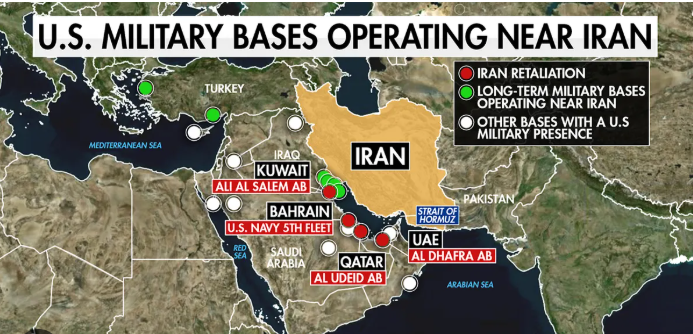
As Iran started the 40 days to mourn the death of nearly 50 top leaders in the theocratic-military-government establishment, led by the then Supreme Leader Ayatollah Syed Ali Khameini, 86, in the Saturday bombing by the US and Israel, Tehran both suffered aerial attacks and retaliated by showering hundreds of missiles and drones at Israel, multiple Arab countries, US assets, and several facilities across the Middle East to mount pressure on America to call a ceasefire.
However, reports suggested that France, Britain, and Germany, all NATO members, may also join the US and Israel to pressurize Iran to call off hostilities.
Meanwhile, Shia militia in Iraq, Lebanon, and Yemen also joined Tehran’s attacks by launching their own assaults on Iran’s enemies. While most of these attacks were repulsed, many, including soldiers, were reported dead or wounded in the three days of conflict which started on February 28 with joint aeries attacks by the US and Israel on Iran. Although casualties were seen as ‘low,’ destruction of properties and assets was vast across the region. Conflicting claims on each side made the situation murkier by the hour as few official confirmations were available.
In Pakistan, at least 12 demonstrators, who stormed and set afire the US Consulate in Karachi, were shot dead on Sunday by US Marine soldiers deployed at the facility. Islamists also tried to storm a US facility in Labore and gheraoed the US and US offices in Skardu, Islamabad, and other cities. The situation in Pakistan, which is concurrently fighting its own war against Afghanistan, remained uncertain as thousands of people, including militants of various hues, supporting ‘causes’ ranging from former Prime Minister Imran Khan’s release, to Baloch separatism, crowed roads in various cities.
Meanwhile, Prime Minister Narendra Modi, who held an emergency meeting of the Cabinet Committee on Security (CCS) on Sunday night, spoke with leaders of some of the affected countries, urging them to exercise restraint, and return to dialogue and diplomacy for enduring peace in the region.
India has a major stake in restoring stability in the war zone. Approximately 9 to 10 million Indians live and work in the Middle East (primarily in the Gulf Cooperation Council—GCC–countries), with the UAE hosting the largest population of about 4.3 million. These workers contribute significantly to India’s economy, sending over USD 35 billion to USD 50 billion annually in remittances. This accounts for nearly 38–65 percent of India’s total remittance inflows.
Reactions
The death of Iran’s Supreme Leader Ayatollah Ali Khamenei in US-Israel strikes over the weekend sparked intense political debate in India, with the opposition demanding a formal statement from the government. Carefully watching the situation unfold, PM Modi’s administration has observed a studied silence for now, opting instead for calls for restraint and de-escalation.
However, this stance mirrors the response of most major global powers as well.
PM Modi said the situation in the Middle East was a matter of grave concern. “India stands for peace and stability,” he said while addressing a joint press briefing with Canadian Prime Minister Mark Carney on Monday.
“India has always called for dialogue and diplomacy to find a solution to such disputes,” he said, underlining New Delhi’s longstanding position on peaceful resolution of conflicts.
A global survey of reactions reveals a similar stark pattern. No G-7 democracy has issued condolences for the Ayatollah’s death. President termed Khamenei as “one of the most-evil people” in history.”
Israeli Prime Minister Benjamin Netanyahu declared, “For 47 years, the regime chanted ‘Death to Israel.’ Justice has been served.”
Argentina’s Javier Milei labelled him “one of the most evil, violent, and cruel persons ever.”
A social media account of the Ukrainian government, which is fighting a four-year-long war of its own against Russia’s invasion, posted, “Nothing beats the death of a dictator,” indirectly pointing at Russian President Vladimir Putin.
UK Defence Secretary John Healey stated few would mourn the leader of an “evil regime.”
Australia’s Anthony Albanese cited Iran’s ballistic missiles and proxy support, while France’s government spokeswoman said they could “only be satisfied with his demise.”
Canada’s PM Mark Carney called Iran the “principal source of instability” in the Middle East.
The European Union’s Kaja Kallas remained neutral, viewing it as a “defining moment” for a potentially different Iran.
Saudi Arabia stayed mum as the Gulf Cooperation Council (GCC) held an emergency meeting against Iranian strikes. The UAE, under missile attack from Iran, closed its Tehran embassy and withdrew its ambassador. Japan and Germany expressed concerns over stability and escalation but issued no mourning statements.
Of the 57 Organisation of Islamic Cooperation (OIC) members, fewer than 10 condoled the Iranian leader’s death.
Iran’s allies were, however, vocal. Russian President Vladimir Putin called it a “cynical murder;” China Foreign Minister Wang Yi deemed the killing “unacceptable;” Shia-majority Iraq announced three days of mourning; Turkey’s President Recep Erdogan was saddened;” Pakistan PM Shehbaz Sharif called it a “violation of rules”.