


Virendra Pandit
New Delhi: The long-running dispute over the custody of a vast ancient Hindu Temple complex between Thailand and Cambodia, which triggered yet another armed clash between the two Southeast Asian nations this week, claimed the lives of at least 16 people, the media reported on Friday.
More than 138,000 people have been evacuated from Thailand’s border regions, its health ministry said, reporting 15 fatalities — 14 civilians and a soldier — with 46 wounded, including 15 troops.
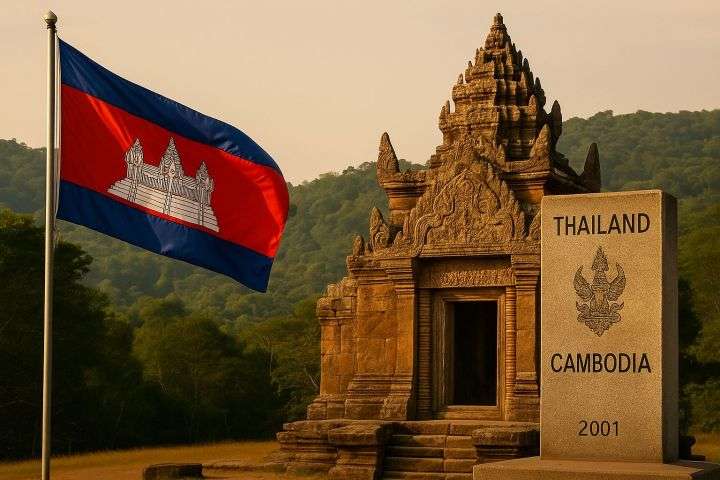
The Prasat Preah Vihear and Prasat Ta Muen Thom, both Khmer-era Hindu temples about 152 km (95 miles) apart on the bilateral border, are two of the key sites where tensions flared on Thursday.
Their border dispute intensified into fighting with use of jets, artillery, tanks and ground troops on Thursday near Prasat Ta Muen Thom, the ancient temple complex claimed by both nations.
According to multiple media reports, at least 15 people, including a Thai soldier, were killed in deadly clashes as none of the two countries showed signs of backing down on Friday. They even expelled each other’s ambassadors, clouding the prospects of a quick diplomatic resolution.
The UN Security Council will hold an emergency meeting on the crisis later on Friday as major powers called for a ceasefire and negotiations.
Thailand’s Acting Prime Minister Phumtham Wechayachai warned that cross-border clashes “could develop into war,” as the two countries traded deadly strikes for a second day. He said Cambodia launched attacks on multiple fronts and Thailand was defending its territory. “The current situation involves acts of intrusion and aggression that are causing harm to people’s lives. The situation has intensified and could escalate into a state of war. At present, it’s a confrontation involving heavy weapons,” he told reporters.
Thailand also accused Cambodia of using artillery and Russian-made BM-21 rocket systems to target areas that included schools and hospitals. “These barbaric acts have senselessly claimed lives and inflicted injuries upon numerous innocent civilians,” the Thai military said in a statement.
Footage showed the Royal Cambodian Army also used what appears to be an RM-70 Multiple-Launch Rocket System (MLRS) to attack Thailand.
The Thai military described Cambodia’s bombardment as “appalling attacks,” putting the blame squarely on the Phnom Penh government, which it said was being led by Hun Sen, the influential former premier of nearly four decades and father of the current Cambodian Prime Minister, Hun Manet.
“The deliberate targeting of civilians is a war crime, and those responsible must be brought to justice,” the Thai military added.
Both Thailand and Cambodia have blamed each other for starting the conflict, with Phuket accusing Phnom Penh of deliberately targeting civilians and Phnom Penh alleging Phuket was using cluster munitions, a controversial and widely condemned ordnance.
One Cambodian civilian has also been killed and five more wounded in cross-border strikes, said Meth Meas Pheakdey, the spokesperson for the border province of Oddar Meanchey.
On Friday, videos emerged showing an M758 Autonomous Truck-Mounted Gun (ATMG) with the Royal Thai Army firing 155mm shells towards positions of the Cambodian Army.
Soldiers with the Royal Cambodian Army attempted to take cover from incoming artillery fire near residential homes on the border with Thailand.
The Old Dispute
The long-running border dispute intensified into fighting with use of jets, artillery, tanks and ground troops on Thursday near Prasat Ta Muen Thom, an ancient temple claimed by both nations. It was the second armed confrontation since a Cambodian soldier was shot dead in May, and marks a dramatic escalation in an old dispute between the neighbours, both popular destinations for millions of foreign tourists, over their shared 800-km-long frontier.
Overnight, Thailand’s former prime minister Thaksin Shinawatra and Cambodia’s former Prime Minister Hun Sen– the two politicians who still wield massive influence in their countries– directly addressed each other on social media. Shinawatra wrote that Sen “needed to be taught a lesson” by the Thai military.
“Thaksin’s remarks further underscore Thailand’s military aggression toward Cambodia,” Sen responded.
Thaksin and Sen previously had close ties, and their children are serving as the prime ministers of their countries. But, the former Thai PM’s daughter, Paetongtarn Shinawatra, is currently suspended from office because of Sen.
In June, the former Cambodian premier leaked a private phone call with Shinawatra about the border tensions. Her deferential tone toward Sen during the call caused outrage in Thailand, with the Constitutional Court temporarily suspending her from office earlier this month while it reviewed a petition for her removal.
Emerald Triangle
The two neighbors have for long been locked in a bitter dispute over the Emerald Triangle, a border region where the two countries meet Laos. The area is home to several ancient temples, including the Prasat Ta Muen Thom temple, near which clashes broke out early Thursday.
The ancient Preah Vihear Temple in Cambodia has also been the site of some of the most violent conflicts between the countries.
Prasat Ta Muen Thom is reportedly on the Thai side of the border, and Prasat Preah Vihear is on the Cambodian side. Both countries claim ownership of these disputed sites.
Prasat Ta Muen Thom Temple, Thailand
The ancient Prasat Ta Muen Thom Temple stands along the border of Thailand’s Surin province and Cambodia’s Oddar Meanchey Province. It is among the contested sites in Thailand’s northeastern Surin province.
Prasat Ta Muen Thom archaeological site is located at Ban Nong Khanna, Tambon Ta Mueang, on the Thai-Cambodian border. It is a Khmer archaeological site of three buildings located near each other.
This temple is dedicated to Lord Shiva. In its sanctum sanctorum, it houses a Shivaling from a natural rock formation.
Prasat Ta Muen Thom is located about 800 metres to the south of Prasat Ta Muen Tot. It was assumed to have been built around the 12th century, which is older than its two companion temples, Prasat Ta Muen and Prasat Ta Muen Tot.
It is part of a larger temple complex on a strategic pass along the ancient Khmer highway that links Angkor in present‑day Cambodia with Phimai in Thailand.
Both sides have been fighting over the temple’s location. Accessible from both sides, it is in a poorly demarcated part of the border and is an important religious and cultural site for both Cambodians and Thais. Troops from both countries constantly patrol the temple’s area, leading to frequent skirmishes.
Cambodia claims the temple is based on historical Khmer Empire boundaries, which included modern-day Cambodia and parts of Thailand. But Thailand says it’s in its Surin province.
Earlier in February, a group of Cambodian soldiers had reportedly visited the temple area and began singing their national anthem, The Khmer Times, a Cambodian news outlet, reported. They were confronted by Thai soldiers.
The last time clashes between them turned deadly over the Prasat Ta Muen Thom temple were in 2011.
Preah Vihear Temple, Cambodia
The Preah Vihear temple is dedicated to Lord Shiva and is situated on the edge of a plateau that dominates the plain of Cambodia. It’s a UNESCO World Heritage site that has been at the centre of past disputes.
“It is an outstanding masterpiece of Khmer architecture, in terms of plan, decoration and relationship to the spectacular landscape environment,” UNSESCO says.
It recorded the temple as dating back to the first half of the 11th century AD. Nevertheless, its complex history can be traced to the 9th century, when the hermitage was founded.
This site is particularly well preserved, mainly due to its remote location.
Amid the violence at the border, the Thai air force said F-16 jets carried out two bombing runs on Cambodian positions. Cambodia claimed those bombs landed near the Preah Vihear temple.
The contesting claims stem largely from a 1907 map drawn under French colonial rule that was used to separate Cambodia from Thailand.
Cambodia has been using the map as a reference to claim territory, while Thailand has argued the map is inaccurate.
It complained that Thailand had occupied a piece of its territory surrounding the ruins of the Temple of Preah Vihear, and asked the International Court of Justice (ICJ) to declare that territorial sovereignty over the Temple belonged to it and that Thailand was under an obligation to withdraw the armed detachment stationed there since 1954.
In 1962, the ICJ awarded Cambodia sovereignty over the Preah Vihear temple area, which became a major irritant in bilateral relations.
It also held that Thailand was under an obligation to withdraw any military or police force stationed there and to restore to Cambodia any objects removed from the ruins since 1954.