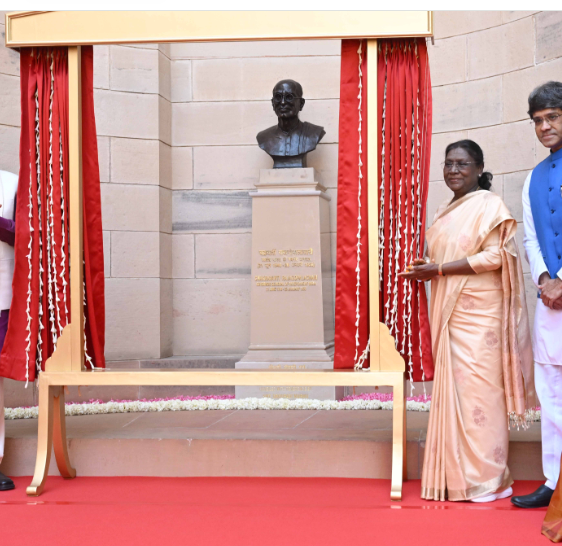






NEW DELHI, Feb 23: Within hours of the Prime Minister Narendra Modi announcing in his “Mann ki Baat” on Sunday, a bronze statue of Edwin Lutyens, the British architect who had designed many of Delhi iconic structures, was removed from its pedestal in the central courtyard of Rashtrapati Bhavan and was replaced by a bust of C Rajagopalachari, the first Indian Governor-General of independent India.
“Today, the country is leaving behind the symbols of slavery and has begun to value symbols related to Indian culture,” Modi told his listeners in his 131st episode of monthly radio programme. A new statue of Rajagopalachari or Rajaji, as he was affectionately known, was unveiled by President Droupadi Murmu on Monday as part of a newly coined “Rajaji Usav” with an accompanying exhibition running until March 1. The bust stands in an alcove on the grand open staircase inside Rashtrapati Bhavan.
The initiative is part of a series of steps being taken towards “shedding vestiges of colonial mindset,” the President’s secretariat said. Lutyens had personally designed the then Viceroy’s House, presently the Rashtrapati Bhavan. The grand capital project of New Delhi had also produced India Gate, North and South Block, the circular Connaught Place and the vast ceremonial axis then called Kingsway.
Edwin Lutyens was born on March 29, 1869, and named Edwin after a friend of his father, painter-sculptor Sir Edwin Landseer. Edwin Lutyens would go on to be knighted too, and become Sir. The family moved in artistic circles. His father, Captain Charles Augustus Henry Lutyens, was a soldier and a painter; mother Mary Theresa Gallwey was from Ireland and a homemaker.
Young Edwin, nicknamed Ned, was “so delicate as the result of rheumatic fever as a child that he was the only one of the boys not to go to public school or university,” according to his daughter’s account. The education was a patchwork of a shared governess’s lessons, some schooling from an older brother. His daughter says his education happened also in long solitary hours in the Surrey countryside watching buildings go up. His daughter writes: “(Edwin Lutyens) told Osbert Sitwell, ‘Any talent I may have was due to a long illness as a boy, which afforded me time to think, and subsequent ill-health, because I was not allowed to play games, and so had to teach myself, for my enjoyment, to use my eyes instead of my feet’.”
He dropped out of the South Kensington School, later joined the office of some architects as an apprentice, and set up his own practice in 1888 at the age of 19. He went on to be compared to Sir Christopher Wren, an architect renowned for rebuilding parts of London after the 1666 Great Fire, including the St Paul’s cathedral.
Lutyens built a formidable reputation designing English country houses, in a professional partnership with the garden designer and landscaper Gertrude Jekyll. But the New Delhi project was on a whole different scale. Following King George V’s announcement at the 1911 Delhi Durbar that British India’s capital would move from Calcutta (presently Kolkata) Lutyens was knighted in 1918. He died on New Year’s Day, 1944; his ashes rest in the crypt of St Paul’s Cathedral.
(Manas Dasgupta)