



Manas Dasgupta
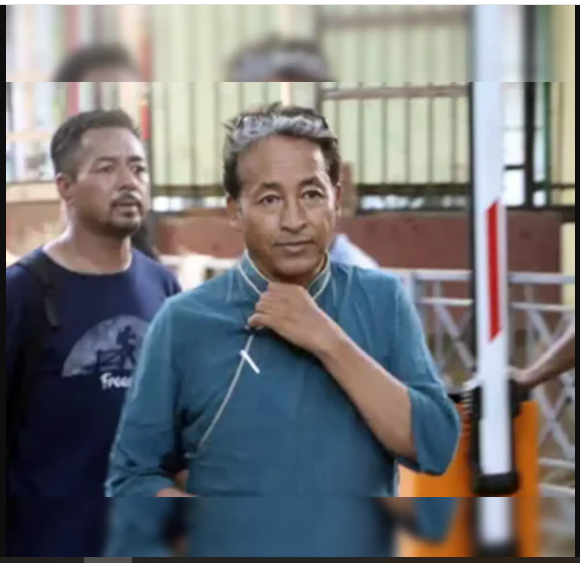
NEW DELHI, Sept 27: A Pakistan angle has emerged in the probe against Ladakh climate and statehood activist Sonam Wangchuk who was arrested on Friday under the stringent National Security Act (NSA) for allegedly instigating a mob that led to violence, with the police in Ladakh investigating his alleged links with Pakistan and foreign funding, UT police chief SD Singh Jamwal said on Saturday.
Addressing a press conference, Mr Jamwal questioned Mr Wangchuk’s Pakistan visits stating that the activist had attended an event hosted by a media house in Pakistan and accused him of trying to sabotage the statehood talks with the centre. He also informed about the arrest of a Pakistan Intelligence Operative (PIO) linked to Mr Wangchuk’s arrest and clues regarding the activist being in touch with Pakistani people.
“We also arrested a Pakistan PIO in the recent past who was in touch with him and was reporting back across. We have a record of this. He (Mr Wangchuk) had attended a Dawn event in Pakistan. He also visited Bangladesh. There is a big question mark on him,” said DGP Jamwal. He said, “We found somebody who was sending things across. We have put that person on surveillance.”
DGP Jamwal said Wangchuk had a “history of instigating,” while highlighting his mentions of the Arab Spring, Nepal and Bangladesh. “The investigation into his funding is going on for FCRA violation,” the DGP added.
Wangchuk was detained on Friday by the Ladakh police under the NSA two days after protests demanding Sixth Schedule inclusion for the union territory turned violent. Wangchuk, who was on a hunger strike, was leading a protest for full statehood of Ladakh and recognition of the UT under the Sixth Schedule. The protests for these demands turned violent on Wednesday, leading to the death of four people, while scores of others sustained injuries.
The Ladakh DGP added that provocative speeches were made by the “so-called environmental activist” in the lead up to the protests.
“This involved some so-called environmental activists; there is a question mark on their credibility as well,” Jamwal said, while specifically mentioning Wangchuk. “They tried to hijack the platform, and the prime name here is Sonam Wangchuk,” the DGP said adding that the activist had earlier tried to “derail” the talks with the Centre.
Sonam Wangchuk has been charged under the stringent National Security Act (NSA) that provides for long preventive detention without any scope for bail. Sources suggest he has been shifted to a facility in Jodhpur, Rajasthan. A curfew has been imposed in Leh, and internet services have been snapped to stop the alleged spread of misinformation.
For the first time since curfew was imposed three days ago in violence-hit Leh town of Ladakh, the restrictions were relaxed Saturday afternoon in a phased manner for a few hours, providing relief to residents who lined up outside shops selling essential commodities.
Police and paramilitary forces intensified patrolling and checking since early Saturday morning to maintain law and order and no untoward incident was reported from anywhere during the relaxation period. The curfew was clamped in the town on Wednesday evening after widespread violence resulted in the death of four persons and injuries to 90 others during a shutdown called by the Leh Apex Body (LAB) to advance talks with the Centre on the demands for statehood and extension of the Sixth Schedule to Ladakh.
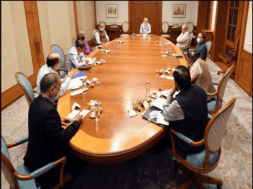
Lt Governor Kavinder Gupta chaired a high-level security review meeting at Raj Bhavan, after which the restrictions were eased. Officials said police parties on Saturday announced the relaxation in the curfew using the public address systems and, soon after, shops selling essential commodities were opened, witnessing a heavy rush. People were also seen queuing outside ATM kiosks in good numbers as the police and CRPF personnel kept a vigil, they said, adding the relaxation period passed off peacefully in the old city areas.
Mr Jamwal described Mr Wangchuk as the “main ring leader” behind Wednesday’s violence. In a statement issued late Friday night, the Lt Governor-led administration justified the detention of Mr Wangchuk, saying a series of alleged provocative speeches by him, with references to the Nepal agitation and the Arab Spring, resulted in Wednesday’s violence that left four persons dead and scores of others injured.
It said the detention of Mr Wangchuk was “important to restore normalcy” in the peace-loving Leh town and also to prevent him from further acting in a manner “prejudicial to maintenance of public order.” “There was no untoward incident reported from anywhere in Ladakh during the past 24 hours. The restrictions are in place to maintain law and order,” an official said.
The Directorate of Information of Ladakh in a statement late Friday night, said: “Time and again it has been observed that Mr Wangchuk has been indulging in activities prejudicial to the security of the state and detrimental to maintenance of peace and public order and services essential to the community.” It said despite clear communication from the government regarding the meeting of the High-Powered Committee (HPC) and the offer of prior meetings before the HPC, Mr Wangchuk, with his “ulterior motive,” continued his hunger strike in the town from 10 September.
“His series of provocative speeches, references to Nepal agitations, Arab Spring, etc, and misleading videos resulted in the violent protests of 24 September in Leh, where institutions, buildings and vehicles were burnt down, and, in the aftermath, police personnel were attacked, leading to the unfortunate death of four individuals.
“The entire episode could have been avoided if he could have risen above his personal and political ambitions by calling off the hunger strike when the dialogue with the government was resumed on the same agenda,” the statement alleged, referring to the demands for statehood and extension of the Sixth Schedule of the Constitution to the region. The statement said it was important to restore normalcy in the peace-loving Leh town of Ladakh.
The Shiv Sena (UBT) chief Uddhav Thackeray on Saturday questioned the Centre over the arrest of Mr Wangchuk saying the one who developed solar tent technology for our Army is being branded as anti-national, while cricket matches were allowed to be played against Pakistan.
Addressing a press conference in Mumbai, he also appealed to “patriots” to boycott the Asia Cup cricket final match in which India and Pakistan will face-off on Sunday. The former Maharashtra Chief Minister also urged companies not to advertise during the India-Pakistan match.
Talking about Mr Wangchuk’s arrest, Mr Thackeray said, “It is unfortunate. Sonam Wangchuk developed solar tent technology for the Indian Army in difficult terrain. The one who is working for our forces has been dubbed anti-national and arrested under the NSA and you are playing cricket with Pakistan which spreads terror in India. What kind of patriotism is this?” Opposition parties have been questioning the Centre for allowing the Indian cricket team to play against Pakistan in the Asia Cup, saying it was wrong to engage in a sporting activity against the country that sponsors terror.
Congress MP Digvijay Singh also criticised Mr Wangchuk’s detention while stating that the NSA had been imposed on a person who “follows Gandhian philosophy.” “Sonam Wangchuk has given an identity to Ladakh, its culture and its heritage. He served in every possible way, through education and through healthcare,” Singh said.
He pointed out that the Prime Minister Narendra Modi had lauded Wangchuk till 2019, and that this demand to make Ladakh a Union Territory had been accepted by the Centre. “The government promised statehood as well as the 6th schedule after the elections, but they did not keep their promise,” Singh said.
Official sources confirmed that weeks after the Union Territory of Ladakh was created in August 2019, three Ministries of the Union government had given a green light to the National Commission for Scheduled Tribes (NCST) to recommend Ladakh’s inclusion as a tribal area under the Sixth Schedule of the Constitution.
According to minutes of an NCST meeting held on September 11, 2019, the NCST had taken suo motu cognisance of the demand for the inclusion of Ladakh in the Sixth Schedule. In the meeting it had recommended “after careful consideration” that the “UT of Ladakh be brought under the Sixth Schedule of the Constitution.”
As per the minutes of this 119th meeting of the Commission, the panel had consulted the Ministries of Home, Tribal Affairs, and Law and Justice in a meeting on September 4, 2019, to discuss the issue. In this meeting, the Commission said after deliberations, the “Ministries were of the opinion that they have no objection in case the Commission recommends for granting Tribal area status to the UT of Ladakh in the Sixth Schedule of the Constitution.”
Accordingly, the Commission had recommended the UT’s inclusion in the Sixth Schedule, also noting that before the creation of Ladakh as a UT, the locals had certain agrarian rights and rights over land that restricted people from outside the region from purchasing or acquiring land in Ladakh. In its recommendation, the panel said it felt that Ladakh’s inclusion in the Sixth Schedule would protect these agrarian rights, including rights on land.
The Commission also said it believed Sixth Schedule status to Ladakh would help with “democratic devolution of powers,” “preserve and promote distinct culture of the region” and “enhance devolution of funds for speedy development of Ladakh region.” While the Ministry of Tribal Affairs issued a statement on this recommendation of the Commission at the time, this statement had left out the opinion of the Ministries.
The Home Ministry told Parliament in December 2019 that the Ladakh Autonomous Hill Development Council Act, 1997, already provided for the creation of autonomous hill development councils in the Ladakh region, the powers for which are “more or less in line with the Sixth Schedule of the Constitution of India.”
However, the following year, when the Hill Council of Leh went to polls in 2020, the BJP had promised constitutional safeguards for the region under the Sixth Schedule in its manifesto. Yet, in December 2022, responding to a Parliamentary panel’s suggestion to explore the possibility of Sixth Schedule status to Ladakh, the Home Ministry had said, “The main objective for inclusion of tribal population under Fifth/Sixth Schedule is to ensure their overall socio-economic development, which, the UT Administration has already been taking care of since its creation. Sufficient funds are being provided to Ladakh to meet its overall developmental requirements.”
Records of the NCST showed that the 2019 recommendation to include Ladakh in the Sixth Schedule came when the panel was under the chairmanship of BJP leader Nand Kumar Sai. The Commission had noted that a news clipping from August 2019 voicing Ladakhi leaders’ demand for Sixth Schedule status prompted it to take up the issue. It said that it discussed the issue in its meeting that month itself and had then decided to call for a special meeting with the three Ministries, following which the recommendation was finalised.