


Virendra Pandit
New Delhi: US President Donald Trump on Thursday slapped a 100 percent tariff on branded or patented drug imports from October 1, 2025, unless the manufacturer is building a plant in the USA, the media reported.
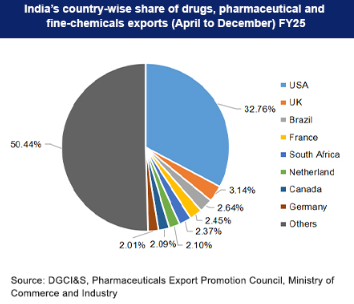
The US is India’s largest pharma market, accounting for over one-third of its USD 30.47 billion (USD 10 billion) exports in 2024-25. But Indian exports of branded or patented pharmaceuticals are negligible as the South Asian country majorly exports off-patented drugs or generics.
“The proposed 100 percent tariff on branded and patented pharmaceutical imports is unlikely to have an immediate impact on Indian exports, as the bulk of our contribution lies in simple generics and most large Indian companies already operate US manufacturing or repackaging units. They are also exploring further acquisitions,” Namit Joshi, Chairman, Pharmaceuticals Export Promotion Council (Pharmexcil) was quoted as saying.
Trump said in a post on X: “Is building will be defined as breaking ground or under construction. There will, therefore, be no tariff on these pharmaceutical products if construction has started.”
Reacting to the development, Indian pharmaceutical stocks opened in deep red on Friday, with the Nifty Pharma index falling 1.82 percent to 21,576.85 points.
The sector witnessed broad-based selling with 19 out of 20 stocks declining. Sun Pharma led the losers, dropping 2.76 percent to Rs. 1,582.50, while Biocon fell 3.24 percent to Rs. 344.40. Natco Pharma was the worst performer, declining 3.51 percent to Rs. 812.75. Only IPCA Labs managed to stay in positive territory with a marginal 0.10 percent gain. Gradually, however, prices stabilized.
“While the tariff primarily targets branded drugs, there is ambiguity over whether complex generics and specialty medicines might also be affected,” an expert noted.
The tariff announcement includes exemptions for companies that have already begun construction on US manufacturing facilities or have such facilities under development. This provides some relief for firms with existing American operations, though the broader sector remains vulnerable to the policy change that aims to boost domestic US manufacturing and reduce import dependence.