






Manas Dasgupta
NEW DELHI, Oct 29: Frustrated over failures to reach a ceasefire deal with Afghanistan as the border remained sealed for over two weeks, Pakistan has blamed India for the failed negotiations fuelling growing unrest on both sides.
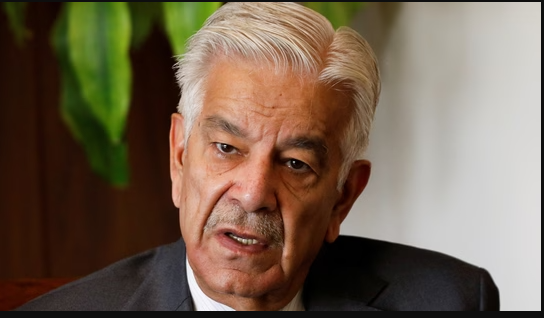
Pakistan’s Defence Minister Khawaja Asif has made wild allegations, accusing Kabul of acting as a tool for New Delhi to spread terror in his country. Asif also warned of a “50 times stronger” response if Kabul attacked Islamabad.
Cautioning Kabul that it would take only a fraction of its armed forces to “completely obliterate” Taliban in Afghanistan, Mr Asif slammed Afghan negotiators for taking a step back from the peace deal time and again. The remarks came after peace talks between Pakistan and Afghanistan in Istanbul dramatically collapsed.
“Whenever we got close to an agreement—either in the last four days or last week—when negotiators reported to Kabul, then there was intervention and the agreement was withdrawn,” Asif said. “I believe that the negotiations were sabotaged. We had an agreement, but then they called Kabul and back-pedaled from the deal” hinting at India. Kabul had earlier dismissed similar allegations by Islamabad as baseless.
The Pakistani minister nonetheless complimented the Afghan negotiators for being cooperative and trained his guns at the Kabul leadership. Deploying the classic Islamabad toolkit in an attempt to tweak the narrative, he alleged that Kabul was being controlled by New Delhi. “I would complement their delegation, but the people in Kabul pulling the strings and staging the puppet show are being controlled by Delhi,” he added.
“India is compensating for its defeat on their western border through Kabul. The junta there (in Afghanistan) has elements that have visited India and visited their temples,” Asif claimed. “India wants to engage in a low-intensity war with Pakistan. To achieve this, they are using Kabul.” On Afghanistan’s threats and a possible attack on Islamabad, Asif warned of a stronger response.
“If Afghanistan even looks at Islamabad, we will gouge their eyes out. They can employ the use of terrorists, and they already are. Over the past four years, they have been using terrorists,” he said. “There should be no doubt that Kabul is responsible for the terrorism in Pakistan. Kabul is a tool for Delhi. If they want to, God forbid, attack Islamabad, we will give a befitting response. A response 50 times stronger,” the Defence Minister added.
Afghanistan’s Defence Minister, Mohammad Yaqoob, had earlier called Pakistan’s accusations “unfounded and illogical” and stressed that it maintains relations with India as an independent nation. Pakistan and Afghanistan had started their second round of peace talks in Istanbul led by mediators from Qatar and Turkey on October 25 even as Asif warned Kabul of an open war in case the talks again failed.
According to Pakistani media reports, Asif said, “Let me assure them that Pakistan does not require to employ even a fraction of its full arsenal to completely obliterate the Taliban regime and push them back to the caves for hiding.”
When asked if Afghanistan was heading for a repeat of the 2001 Tora Bora offensive, the Pakistan minister replied in the affirmative. He added, “If they wish so, the repeat of the scenes of their rout at Tora Bora, with their tails between the legs, would surely be a spectacle to watch for the people of the region.”
Tora Bora was the last known hideout of al-Qaeda leader Osama bin Laden in Afghanistan, where he was sheltered by the Taliban after the 9/11 attacks on US. The 2001 battle there killed over 200 al-Qaeda fighters, though bin Laden successfully escaped into Pakistan.
While announcing the failure of ceasefire machinery between Islamabad and Kabul, Pakistan information minister Attaullah Tarar said on X, “Regrettably, the Afghan side gave no assurances, kept deviating from the core issue and resorted to blame game, deflection and ruses.” He added, “The dialogue thus failed to bring about any workable solution.” Afghanistan has not commented on the development as of now.
Earlier, Asif had cautioned that “any terrorist attack or any suicide bombing inside Pakistan shall give you the bitter taste of such misadventures.”
He said Pakistan had entered talks “to give peace a chance” at the request of “brotherly countries” approached by Kabul’s rulers. However, he accused the Taliban of revealing their “devious and splintered mindset” through “venomous statements.”
The October 9 blasts in Kabul, which coincided with Afghan foreign minister Amir Muttaqi’s visit to India, triggered a series of retaliatory attacks along the border. The Taliban launched an offensive, prompting Pakistani airstrikes in response.
A 48-hour ceasefire initially agreed upon collapsed soon after, though a second truce was briefly reached on October 19 following renewed mediation in Doha fuelling growing unrest on both sides.
The immediate trigger appears to have been Pakistan’s admission, for the first time publicly, that it has an agreement with the United States permitting drone operations from its territory. Pakistani officials reportedly insisted that this pact “cannot be broken”, a statement that provoked outrage from the Afghan side, which demanded assurances that Pakistan would not allow US drones to violate Afghan airspace.
Afghan sources have warned that any future Pakistani strikes will be met with “reciprocal action”, stating that if Afghan territory is bombed, “Islamabad will be targeted.”