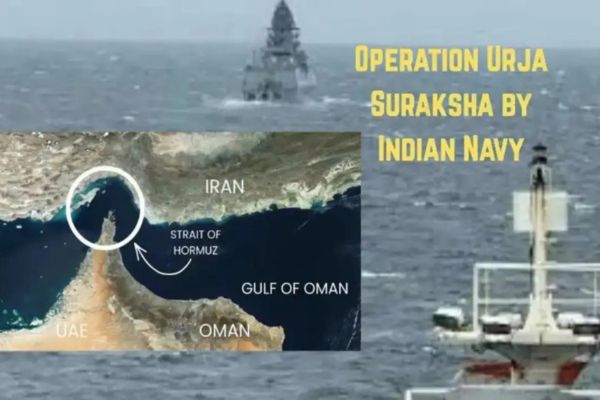
Operation Urja Suraksha: Securing India’s Energy Security Needs







By Harsh Pargat
In the current purview of the Iran-Israel War, the Indian Navy has launched Operation Urja Shakti to provide a safe and secure passage to Indian vessels transitioning from the Strait of Hormuz carrying energy supplies, which Iran has particularly blocked.
Comprehending Operation Urja Suraksha:
Operation Urja Suraksha is being executed with careful calibration to safeguard the uninterrupted movement of Indian-flagged vessels carrying vital energy supplies, according to officials. The initiative reflects a strategic effort to mitigate risks while maintaining operational discretion in a sensitive maritime environment.
Also read: Sri Lanka Thanks India for “Swift Supply” of Fuel to Tide over Shortage
Under this framework, all India-bound shipments transporting liquefied natural gas (LNG), liquefied petroleum gas (LPG), and crude oil have been systematically identified and prioritized for protected transit. The approach underscores a proactive commitment to energy security, ensuring that critical supply chains remain resilient amid evolving regional uncertainties.
Multiple Layers of Security: The Indian Navy’s priority is to ensure the safe transition of vessels from the Persian Gulf to the Arabian Sea. The navy, apart from deploying escorts has also used frigates and the deployment of warships.
Earlier this week, as per reports by the Hindu the Indian Navy had safely escorted LPG carriers Pine Gas and Jag Vasant, which are carrying a cumulative load of approximately 92,000 tonnes of cooking gas. The vessels are expected to reach Indian ports between March 26 and 27. Other ships escorted so far include LPG carriers Shivalik and Nanda Devi, along with crude oil tanker Jag Laadki.
Also read: Adani Defence delivers first batch of 2,000 ‘Prahar’ light machine guns to Army
Indian Navy destroyers and frigates are also extending their protective perimeter beyond the immediate confines of the Strait of Hormuz, reflecting a shift from reactive escort duties to a more proactive, layered maritime security architecture. Rather than limiting operations to chokepoints, Indian naval assets are now maintaining sustained presence across key transit corridors in the wider Gulf and adjoining Arabian Sea. This extended operational reach ensures that Indian-flagged vessels, particularly those carrying critical energy cargo, remain under surveillance and protection until they transition into relatively secure maritime zones. The deployment pattern indicates a calibrated blend of deterrence and reassurance—deterring potential threats such as piracy, state-backed interdiction, or asymmetric maritime attacks, while simultaneously reassuring commercial shipping operators of India’s commitment to safeguarding its sea lines of communication (SLOCs).
The concept of “layered maritime security” being operationalized here is particularly significant. It involves multiple concentric zones of monitoring and protection, beginning from high-risk chokepoints and extending outward through naval patrols, aerial reconnaissance, and real-time intelligence coordination. Indian warships, equipped with advanced radar systems, electronic warfare capabilities, and helicopter detachments, are functioning as both escorts and surveillance nodes. This multi-dimensional posture allows for early threat detection and rapid response, reducing vulnerabilities that merchant vessels typically face in contested waters. In effect, the Navy is not merely reacting to threats but shaping the maritime security environment through persistent presence and domain awareness.
Also read: West Bengal Assembly Elections Important for Country’s Security: Amit Shah
This operational expansion also aligns with India’s broader strategic doctrine of ensuring the security of the Indian Ocean Region (IOR), where energy flows constitute a critical national interest. A substantial proportion of India’s crude oil, liquefied natural gas (LNG), and liquefied petroleum gas (LPG) imports transit through the Gulf region, making these sea lanes indispensable to the country’s economic stability. Any disruption—whether due to geopolitical tensions, military escalation, or non-state threats—has the potential to trigger cascading effects on domestic energy markets and industrial output. By extending naval protection beyond traditional boundaries, India is effectively insulating its energy supply chains from such external shocks.
Conclusion:
In conclusion, it can be envisaged that this present Operation is a pragmatic attempt to ensure the availability of essential commodities in the background of the current war.
(The writer is a Research Analyst, International relations & Security Studies with a focus on West Asia)
Please share your views at harshpargat@gmail.com