

Manas Dasgupta
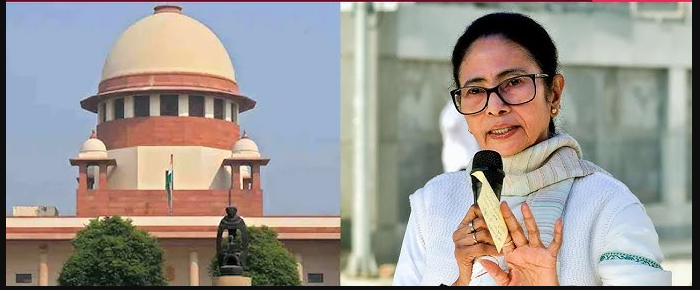
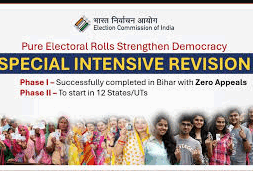
NEW DELHI, Feb 9: The Supreme Court on Monday delivered a strong message to all state governments that the process of the “Special Intensive Revision” of the electoral rolls would not be allowed to be obstructed even as it ordered an extension of the time for objections by a week from February 14 in the West Bengal SIR case.
“Whatever orders or clarification required, we will issue. But we will not allow any impediment to the SIR process. This must be understood by all states,” Supreme Court Bench comprising Chief Justice Surya Kant and Justices Joymalya Bagchi and N.V. Anjaria said during proceedings.
The observation came as the court heard the Election Commission’s (EC) response to a petition filed by West Bengal Chief Minister Mamata Banerjee challenging the SIR exercise in the state. The Bench also ordered the 8,505 officials from the West Bengal government to report to duty before the district electoral offices by 5 p.m. on Friday. The Election Commission has to utilise their services as EROs/AEROs if found suitable, the SC said. In addition, the apex court also asked West Bengal to respond to allegations of violence committed against EC officials.
In the previous hearing, on February 4, the top court issued notices and sought replies by February 9 from the Election Commission and the chief electoral officer of West Bengal on the petition filed by Ms Banerjee, who became the first serving Chief Minister to argue in the top court. She had urged the court to intervene in the ongoing SIR of electoral rolls to “save democracy,” alleging that West Bengal was being targeted and its people were being bulldozed.
Election Commission would be at liberty to remove the officials who are not complying with their official obligations under the SIR process, Chief Justice of India Surya Kant said. The Election Commission has to utilise their services of the 8,505 officials as EROs/AEROs if found suitable, SC adds. The remaining officials out of the 8,505 who are not selected as EROs/AEROs, may be assigned to assist the EROs in a role equivalent to micro-observers. The EROs will alone take the decision if a name has to be in the electoral roll or not, the Bench emphasizes.
The apex court tells Election Commission that considering the new developments, the time for objections could be extended by a week from February 14. EROs should consider all or any of the documents listed in the SIR notice plus documents mentioned in the SC order (admit card, Aadhaar, etc) during verification in the claim/objections phase, the Supreme Court order added. “Micro-observers cannot take decisions,” the CJI said.
Senior advocate Shyam Diwan, appearing for Mamata Banerjee, showed the court screenshots from the Election Commission website which says micro-observers agree/disagree with EROs. Mr Divan then read out instructions that names should be excluded even in case of production of Aadhaar, admit cards. “Even if person has two documents, it is exclusion. Idea appears to be mass exclusion. These are the “wholesale instructions” given,” Mr Diwan told the Bench.
At the heart of the dispute is the Election Commission’s special intensive revision of electoral rolls in West Bengal, an exercise that the state government has questioned. Mamata Banerjee has approached the court alleging irregularities in the process and questioning the deployment of thousands of micro-observers in the state.
The Election Commission, in turn, has defended its actions and accused the state government of failing to cooperate fully with its requests. During the hearing, the Chief Justice remarked that 8,500 officers have now been deployed in connection with the exercise. “If done earlier, it would probably get approved,” he said, in what appeared to be a reference to the timing of compliance by the state government.
The court questioned why there had been a delay in sending the names of more than 8,000 Group B officers to be used in place of micro-observers. “Why delay in sending names of more than 8,000 Group B officers to be used in place of micro-observers,” the Supreme Court asked the West Bengal government.
The Chief Justice also directly questioned the timing of the state’s communication. Addressing Mamata Banerjee, he asked: “Why you are sending names on 12 am on February 7 on mail when we gave directions on February 4?” A central point of contention in the case has been the deployment of micro-observers in West Bengal. The Election Commission told the court that it had written five letters to the West Bengal government specifying the officers it required.
“They have not given,” the poll body said, explaining why micro-observers were deployed. According to the poll body, particulars and details of officers sought were not shared by the state government. The Election Commission maintained that its actions were necessitated by the lack of response and that the deployment of micro-observers was within its constitutional authority to ensure the integrity of the revision process.
“On February 4, Ms Mamata Banerjee appeared along with her counsels. There was an objection raised on the deployment of micro observers by the ECI, and it was stated by ECI that despite repeated requests, adequate manpower was not provided by the state government. On this, Chief Minister Banerjee made a statement that she was willing to provide state government officers who are competent enough to perform these duties. We have been shown that on February 7, the AoR informed senior counsels of ECI at 11:57 am that the state is ready to provide 8,505 officers for the SIR exercise,” the court’s order read.
Appearing for the West Bengal government, senior advocate Abhishek Manu Singhvi disputed the Election Commission’s version. He told the court that the Election Commission had never requested Group-B officers nor made any such request to the state.
Shyam Diwan, appearing for Mamata Banerjee, countered the Commission’s claims by stating that names were ready and compiled and had been sent to the poll panel. The divergence in accounts reflects the broader friction between the state government and the Election Commission over both the manner and substance of the SIR exercise.