No Interim Relief for Voters Awaiting Tribunal Clearance, but SC Expresses Reservations over “Hurried SIR Exercise” in West Bengal






Manas Dasgupta
NEW DELHI, Apr 13: Even while refusing to grant interim voting rights to individuals whose names were removed during the voter roll clean-up process in West Bengal, the Supreme Court on Monday expressed certain reservations about the “Special Intensive Revision” of the voters’ list pointing out that the right to be on the electoral roll and to vote in one’s own country was not only constitutional right but also sentimental.
The apex court’s decision was applicable to those whose appeals are still pending before appellate tribunals. During the hearing, Trinamool Congress leader Kalyan Banerjee informed the court that around 1.6 million appeals have been filed and requested that these individuals be allowed to vote in the upcoming two-phase elections to the State Assembly to be held on April 23 and 29.
During the hearing, Chief Justice of India Surya Kant firmly rejected the demand, stating, “That is entirely out of the question.” He further cautioned against rushing the process, saying, “We cannot create a situation that the tribunals are bogged down and make errors and create another situation.”
The court emphasised that allowing such relief could disrupt the legal process and put undue pressure on appellate tribunals handling the cases.
Senior advocate Kalyan Banerjee informed the bench that over 34 lakh appeals have been filed against deletion of names from voter lists in West Bengal. He argued that genuine voters should not be denied their right to vote and told the court, “People of Bengal are only looking towards this court… 34 lakh persons are genuine voters, people want to exercise their right to vote.”
He also suggested issuing a supplementary voter list so affected individuals could participate in the upcoming polls. While the court acknowledged the importance of voting rights, it stressed the need to maintain the integrity of the electoral process. Justice JB Pardiwala observed, “We will try to create a via media between your right and the need for verification.”
The Supreme Court’s order came after a group of 13 people sought its intervention in the deletion of their names from the Bengal voter list. The court called the petition “premature” and told them to go to the appellate tribunals instead.
“Since the petitioners (Quaraisha Yeasmin and others) have already approached the appellate tribunals… in our considered view, the apprehensions expressed in the petition are premature. If the plea is allowed, then necessary consequences will follow,” the bench said in its order, adding that it has not expressed any views on the merits of the plea.
The Election Commission of India (ECI) has already frozen the Bengal voter list and no new name can be included before the election, unless the Supreme Court gives a specific direction on this count, which did not happen today. Nineteen appellate tribunals have been set up in the state bordering Bangladesh to decide the fate of 27 lakh cases that have been deleted in the judicial adjudication cases. The petition alleged that the Election Commission was summarily deleting names without following due process, and that appeals against these deletions were not being heard in a timely manner.
Even while rejecting the appeal, the Supreme Court strongly underlined the importance of voting rights, calling it both a legal and emotional issue. The bench observed, “Voters have a continuing right to remain on election rolls. The right to remain a voter… is not only a constitutional right, but also an emotional one. We need to protect it.”
However, it added that authorities “cannot get blinded by the dust and fury of impending elections.” The judges also expressed concern over the scale of the revision process. Justice Joymalya Bagchi pointed out that officials were handling a huge number of cases daily, which increases the chances of errors. He remarked, “If you go through 1,000 documents a day… the margin of error will be there, and we need a robust appellate forum.”
The court stressed that due process must be protected and that voters should not be caught between administrative and legal delays.
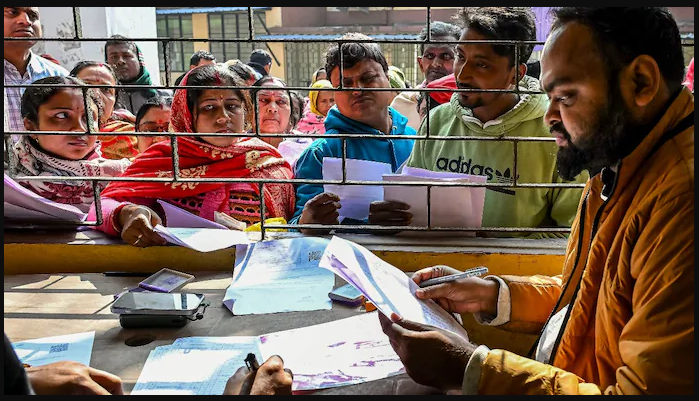
Referring to lakhs of voters excluded for “logical discrepancies” and lining up for appeal hearings in West Bengal, hardly 10 days ahead of the Assembly elections, following an “inquisitorial” Special Intensive Revision (SIR), the court said 34 lakh appeals by voters purged from the West Bengal electoral roll have already been filed for hearing before 19 Appellate Tribunals, over a lakh appeals pending before each of these tribunals.
After months of interventions to make the SIR more inclusive, the court made cutting remarks about the impact of an exercise the poll body said was necessary to “purify the electoral roll.” “The right to remain on the electoral roll, the right to vote in the country you are born in is something which is not only constitutional but sentimental. It is the biggest expression of nationality and patriotism that you are in a participatory process to elect a democratic government,” Justice Joymalya Bagchi said while addressing the Election Commission.
Senior advocate Dama Seshadri Naidu, for the poll body, said “statistics” proved West Bengal did not “stand out” and was “on par” with other States in the number of exclusions. “We are not bothered about West Bengal ‘standing out’. But no other State has a category called ‘logical discrepancy’. We have examined Bihar, we did not find a single person flagged for logical discrepancy… This is not a question of inflating or shrinking the EC, but of fairness,” Justice Bagchi said.
So far, the court had avoided any direct criticism of the SIR. The flurry of oral observations from Justice Bagchi indicated a judicial calling-out of the atmosphere of uncertainty and crisis which gripped the population during a hasty SIR process, especially in poll-bound West Bengal.
One of the petitioners Quaraisha Yeasmin said she was a mapped voter, and had an Indian passport and an Aadhaar. Yet, she said, she was excluded from the electoral roll. Ms Yasmin submitted that the judicial officer who verified her case did not give any reason for confirming her exclusion. She urged the apex court to ask the tribunal to hear her case in a time-bound manner so that she could vote in the Assembly election.
Justice Bagchi, who was part of the Bench headed by CJI Surya Kant, assured the petitioner that the “concern of the vigilant voter whose name was correctly or incorrectly excluded from the list” was also foremost in the mind of the court. The judge said the court had permitted the poll body to embark on an inquisitorial exercise mindful of the latter’s concern about “purifying the electoral roll.”
“The original SIR notification said voters in the 2002 electoral roll would not be touched. The 2002 roll would be the benchmark. But when you introduced ‘logical discrepancy,’ you infracted that rule,” Justice Bagchi told the poll body. Mr Naidu said voters who could prove their credentials were retained. Those with disparity in their names or other background details were asked to provide details, which were verified.
“A voter in the 2002 roll was not required to give anything… When the Bihar SIR was argued, and the Bihar SIR was a facsimile of the SIR we are dealing with today, the EC was unequivocal when it submitted that a person in the 2002 voter list does not have to prove anything. No uploading of documents was required… And then you deviated from your original arguments,” Justice Bagchi said.
The judge said the apex court wanted a robust appellate process in place for the excluded voters as the purging of names from the list by the EC was a “suo motu” and unilateral process. This was followed by a “verification” of identity documents during the objections phase of the SIR, and not exactly a hearing.
Justice Bagchi referred to how the exclusion of voters in the name of logical discrepancy came “so close” to the date of election in West Bengal that the apex court had to step in and deploy judicial officers to hear out the objections. This was all the more reason why the appeal process must not be hurried, the judge said.
“The appellate process must be robust… somewhere we are getting blinded by the dust and fury of an impending election… We need to protect the due process rights of the voters,” Justice Bagchi said.
The poll body said it was plagued by inadequate human resources due to a non-cooperative West Bengal government. “This is not a fight between the EC and the West Bengal government. This is not a blame-game. It is a question of voters being sandwiched between two constitutional authorities. Our adjudicatory process and interventions were meant to ensure fair elections. Justice Bagchi also said the tribunals manned by former judges cannot be overburdened by fixing the timelines for adjudications. “It is not the end justifying the means, but the means justifying the end,” Justice Bagchi said. “We need to protect due process rights. The voter should not be sandwiched between two constitutional authorities.”
The court directed Ms Yeasmin to make her case before the tribunal designated to hear her appeal.