


Virendra Pandit
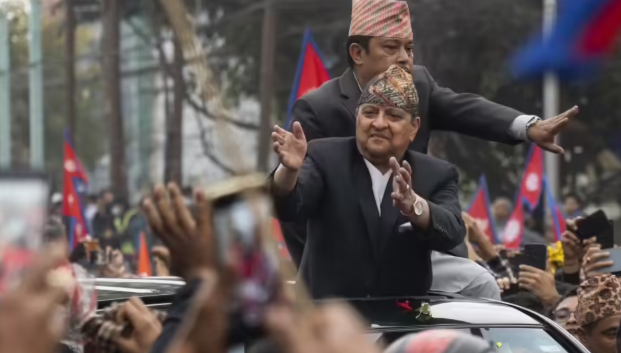
New Delhi: With thousands of his supporters chanting slogans for the restoration of monarchy, Nepal’s former King Gyanendra landed at the Kathmandu airport on Friday, ahead of the March 5 parliamentary election in the Himalayan country.
“We want King Gyanendra back to save our nation,” the loyalists chanted, carrying placards as the former monarch landed amid tight security.
The activists gathered at the airport despite the Kathmandu District Administration Office’s prohibitory orders banning gatherings of more than five people in and around the Tribhuvan International Airport area.
Nepal abolished monarchy in 2008, but pro-monarchy demonstrations resurfaced last year amid economic distress, political instability, and violence amid massive public demonstration that toppled the Communist-led coalition government.
Cadres of pro-monarchist Rastriya Prajatantra Party, led by senior leader Kamal Thapa, and various other loyalist groups led by Navaraj Subedi and medical professional Durga Prasai, had gathered at the airport area since Friday morning.
During a press meet in Kathmandu on Thursday, Prasai said that they want to restore the institution of monarchy before the March 5 general election.
He claimed that the election cannot be held without addressing their agenda of reinstalling a Hindu monarch in the country.
In September 2025, Nepal was rocked by a wave of violent protests led by its young population, Generation Z, with anger spilling onto the streets of Kathmandu and other towns after the government briefly banned social media platforms.
The violent demonstrations left at least 19 people dead and scores wounded, forcing Prime Minister KP Sharma Oli to resign. What began as outrage over restrictions on Facebook, X and YouTube quickly grew into something much deeper: A mass outpouring of frustration against corruption, entrenched political elites, and a lack of opportunities for the landlocked country’s youth.
Angry protesters torched parliament, government offices, and the homes of senior politicians, including that of former prime minister Sher Bahadur Deuba and his wife.
Even after Oli’s resignation, tens of thousands of young people remained on the streets, calling for a new leadership and systemic change.
Protesters say their struggle is not only against a social media ban but against decades of political failure.
The frustration of Nepal’s youth stemmed from years of political instability, corruption, and economic stagnation. Nearly 43 percent of the country’s population is aged 16–40, but with limited jobs at home.
For many, Oli’s dismissal of protesters as reckless “just by saying Gen Z,” encapsulated the ruling elite’s disconnection with the masses. That dismissal backfired spectacularly, as mobs set fire to parliament, media offices, and luxury car showrooms in defiance of curfews.
Then, President Ram Chandra Poudel appointed Sushila Karki, former Chief Justice of Nepal, as Interim Prime Minister until parliamentary elections were completed and a new government was sworn in.