


Virendra Pandit
New Delhi: Nearly five years after it toppled a democratically-elected government, China-supported Myanmar’s military junta, fighting a long civil war, on Monday announced the first phase of general elections to begin on December 28 which, however, critics have already derided as a sham, the media reported.
The National League for Democracy, led by Aung San Suu Kyi, which won landslides in the two elections prior to the coup, will not, however, be allowed to contest this one, the BBC reported.
State-controlled television, while announcing the polls, also outlined a roadmap for the first elections in a war-torn country divided against itself and facing a host of crises from within and without.
The dates for the subsequent phases of the elections, which officials plan to hold over December 2025 and January 2026 for security reasons, will be announced later, Myanmar’s Union Election Commission said, according to an announcement on MRTV.
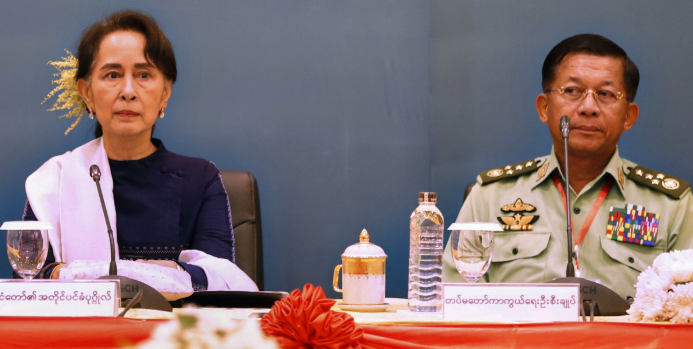
Myanmar has been plagued by violence since a 2021 bloody coup that unseated an elected civilian government led by Nobel Peace Laureate Aung San Suu Kyi, 80, currently in jail. The ruling generals, led by military chief Min Aung Hlaing, have faced fierce resistance from armed groups.
Altogether 55 political parties have been registered for the polls, of which nine plan to compete nationwide, according to state media.
“Six parties are under review for approval and registration,” The Global New Light of Myanmar newspaper reported early in August.
But with anti-junta opposition groups either barred from running or refusing to take part, the election has been dismissed by Western governments as a move to entrench the generals’ power and it is expected to be dominated by proxies of the military.
Officials said they plan to hold voting in more than 300 constituencies nationwide, including areas currently held by armed groups opposed to the military, according to the state-run newspaper.
In 2024, military-backed officials held a nationwide census to create voter rolls, but were only able to conduct on-ground surveys in 145 out of Myanmar’s 330 townships.
The military justified its February 2021 coup as a “necessary intervention” after what it claimed was “widespread fraud” in an election three months held earlier, that was won decisively by Suu Kyi’s now defunct ruling party, the National League for Democracy.
However, no evidence of the alleged fraud, which would have changed the outcome, was found by election monitors.
With large parts of Myanmar under opposition control and in a state of war, holding this election could become a formidable logistical exercise for the mountainous country’s military rulers.
But the junta’s leader Min Aung Hlaing, who led the catastrophic coup four and a half years ago, has said the vote must go ahead, and has threatened severe punishment for anyone who criticises or obstructs the election.
The planned election has been widely dismissed, but it has the support of Myanmar’s most powerful neighbour China, which views stability in the South East Asian nation as a vital strategic interest.
Critics believe the junta will use the polls to maintain its power through proxy political parties, as in Pakistan.
Tom Andrews, the United Nation’s special rapporteur on the human rights situation in Myanmar, had in June accused the military junta of designing a “mirage of an election exercise” to give itself a veneer of legitimacy.
He called on the international community to reject the elections to “not allow the military junta to… get away with this fraud.”
Thousands of people have been killed across Myanmar since the 2021 coup, which has destroyed the economy across much of the country and left a humanitarian vacuum.
Myanmar has also been hit by a devastating earthquake in March this year and international funding cuts, that have left vulnerable people in desperate and dangerous predicaments.
The junta would be “delusional” to think that an election held under the current circumstances will be considered “remotely credible,” Human Rights Watch told the BBC earlier this year.
“As a precursor to elections, they need to end the violence, release all those arbitrarily detained, and allow all political parties to register and participate instead of dissolving opposition parties,” the NGO said.
Veteran leader Aung San Suu Kyi—diplomat, author, human rights fighter, and political activis–was awarded the Nobel Peace Prize in 1991. She served as State Counsellor of Myanmar and Minister of Foreign Affairs from 2016 to 2021. Jailed on various charges, viewed as fabricated, her trials ended on December 30, 2022, with another conviction and an additional sentence of seven years’ imprisonment for alleged corruption. Her final sentence was of 33 years in prison, later reduced to 27 years.