


Dr Jagat Shah,
Founder of Global Network, an international trade advisory firm, Ahmedabad.
Key advantages (principal pros)
1) Scale plus signal value (a de-risking mega-corridor):
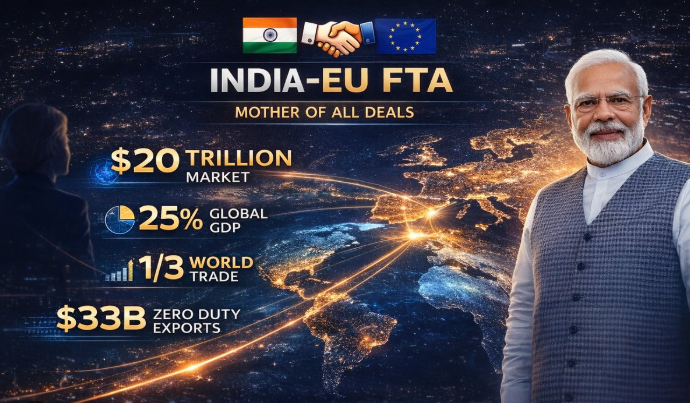
• It links two very large markets and sends a strong rules-based trade signal at a time when both sides are trying to reduce over-dependence on any single partner.
• Expect a confidence effect for investors and supply chains (EU firms looking at China+1, Indian exporters looking for stable demand plus predictable rules).
2) Better market access (tariffs plus non-tariff barriers):
• EU to India: India’s high tariff walls are the headline, especially in autos; reports indicate big phased tariff cuts for certain EU car imports (with some protections/time-phasing, including an EV carve-out early on).
• India to EU: India’s strengths are typically labour-intensive goods plus services; improved access can help textiles/apparel, leather, gems & jewellery, engineering goods, and some services segments (depending on the final schedules and recognition/standards chapters).
3) Investment plus technology spillovers:
• If the deal meaningfully improves certainty (IP rules, dispute settlement, customs facilitation, standards cooperation), it can pull more EU manufacturing and supplier ecosystems into India, especially where the EU has edge (advanced manufacturing, clean tech components, specialty chemicals, precision machinery), and,
4) Strategic cooperation beyond tariffs:
• Commentary around the deal highlights cooperation areas like clean technology, pharma, and semiconductors, important because the real gains often come from standards, procurement, and supply-chain integration, not just tariff lines.
Potential drawbacks (principal cons)
1) Adjustment pain and political backlash in sensitive sectors:
• India: tariff liberalisation can stress domestic players in autos/parts, wines & spirits, some medical devices, select industrial segments, especially SMEs, unless phased reductions and safeguards are well designed. (Autos are already politically and economically sensitive, hence the staged approach reported.)
• EU: agriculture/food sensitivities and fears of import competition can trigger pushback during ratification.
2) Compliance costs: EU standards can become the real barrier. Even if tariffs fall, exporters can struggle with:
• product standards/technical regulations,
• sustainability and traceability requirements,
• documentation and audit burden for smaller suppliers.
3) Climate-linked trade friction (CBAM/EUDR-type pressures):
• India’s carbon-intensive exports (steel, aluminium, cement, etc.) face additional cost/complexity from EU climate-linked measures; Indian policy circles often
view these as de facto trade barriers.
4) Ratification plus implementation risk:
• Negotiations may be concluded, but the deal still needs legal scrubbing and then political approvals, timelines discussed include months for legal review and further steps before full implementation. This creates uncertainty for businesses making near-term bets.
Main opportunities (where upside can concentrate)
For India:
• Export surge in labour-intensive sectors if rules of origin are workable and EU compliance support is strong (testing labs, certification, cluster-level traceability).
• Services plus skilled mobility (if Mode-4 / visas / professional recognition elements are meaningful in the final text).
• Value-chain upgrading: EU investment in machinery, quality systems, and supplier development can raise India’s manufacturing depth.
For the EU
• Access to a fast-growing consumer market plus public/private capex cycle.
• Autos & premium manufacturing (phased tariff cuts can materially change EU OEM economics).
• Diversified sourcing for pharmaceuticals/intermediates, engineering goods, and trusted supply chains.
For both
• Resilient supply chains (less single-country concentration),
• Clean transition collaboration (components, standards, financing models),
• Higher two-way investment as policy certainty improves.
Main risks (what can go wrong)
1. FTA on paper, friction in practice. Tariffs fall but exports don’t rise proportionately because standards, paperwork, or enforcement becomes the choke point.
2. Uneven gains leading to backlash If benefits concentrate in a few large firms/sectors while others feel hurt, political resistance can stall implementation or trigger safeguard actions.
3. Climate measures become the battleground If CBAM-style costs rise faster than firms can decarbonize, India–EU trade could see recurring disputes and lobbying cycles.
4. Geopolitical cross-pressure.
As India and the EU rebalance ties amid global tariff disputes, third-party reactions and shifting alliances can complicate follow-through.
Practical watch list (best indicators of real impact)
• Final tariff schedules (especially autos, spirits, medical devices) and safeguard clauses.
• Rules of origin simplicity (too complex will mean low utilization).
• Market access for services/mobility (language will matter).
• How CBAM/traceability compliance support is operationalized for SMEs.
• Ratification milestones and the stated go-live timeline.