


Manas Dasgupta
NEW DELHI, July 18: The Prime Minister Narendra Modi on Friday slammed the Trinamool Congress government in West Bengal for “hindering” the development of the state and defended the on-going “Special Intensive Revision” (SIR) in Bihar stating that anyone who has entered the country illegally would face legal action in accordance with the Constitution of India. ital.
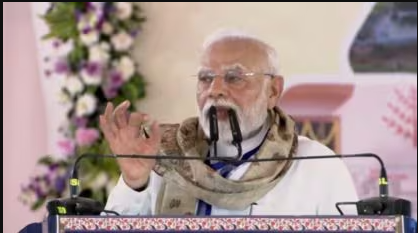
Addressing a rally at West Bengal’s industrial town of Durgapur, Mr Modi claimed the TMC was “acting like a wall in path of Bengal’s development” and vowed to change the scenario if the BJP was voted to power in the state in the coming Assembly elections.
“BJP is trying to make Bengal a developed state. Bengal was once a centre of development but the situation is completely different today. Youths now have to leave Bengal to look for jobs in other states. Industries are shutting down and there is no development in Bengal; we have to change this scenario,” said PM Modi.
“If the BJP forms a government in Bengal, it will turn the State into the top industrial region in the country. Once TMC is ousted, real change will take place in Bengal. Why will investors come to Bengal where riots take place and police are biased?” he asked. “TMC’s ‘goonda tax’ stops investment in West Bengal,” alleged PM Modi.
Before addressing the rally, Mr Modi launched a slew of development projects worth Rs 5,400 crore in West Bengal, unveiling major initiatives across the oil and gas, power, rail, and road sectors to boost infrastructure, connectivity, and clean energy in the region.
As part of the events, he laid the foundation stone for Bharat Petroleum Corporation Limited’s ₹1,950-crore City Gas Distribution project in Bankura and Purulia districts. The project is aimed at providing piped natural gas (PNG) to homes and industries, compressed natural gas (CNG) at fuel outlets, and generating employment opportunities locally.
Mr Modi also dedicated to the nation the ₹1,190-crore Durgapur–Kolkata section of the Durgapur–Haldia Natural Gas Pipeline, a 132-km stretch built under the Pradhan Mantri Urja Ganga (PMUG) scheme. This pipeline passes through Purba Bardhaman, Hooghly, and Nadia districts, and is expected to provide lakhs of people with a reliable and eco-friendly supply of natural gas.
Continuing the Centre’s thrust on clean energy, PM Modi dedicated Flue Gas Desulphurisation (FGD) systems retrofitted at the Durgapur Steel and Raghunathpur Thermal Power Stations of Damodar Valley Corporation (DVC). Built at a combined cost of over ₹1,457 crore, the systems aim to curb industrial emissions and improve air quality in the region. In the rail sector, the Prime Minister inaugurated the doubling of the 36-km Purulia–Kotshila rail line, completed at a cost of over ₹390 crore.
With the Election Commission of India having indicated that West Bengal was the likely state where the “SIR” exercise would be initiated before the Assembly elections in view of large scale complaints of infiltration by Bangladeshis, Mr Modi said anyone who was not a citizen of India and has entered the country illegally would have to legal action in accordance with the Constitution and would be eliminated from the voters’ list.
During his speech, the Prime Minister referred to Dr Shyama Prasad Mukherjee’s vision of “One Nation, One Constitution,” saying that it had become a core commitment of the BJP and stated that the BJP had not only adopted this vision but had also fulfilled it, reflecting the party’s resolve to uphold national unity and constitutional values.
“For the BJP, the Bengali language is a symbol of inspiration, tradition, and identity. Bengali pride is paramount for the BJP,” he noted. He noted that Bengali pride was of great importance to the party, and stressed that in every BJP-ruled state, both the Bengali language and the people of West Bengal were treated with the highest respect.
Accusing the TMS of endangering the state’s identity, he said “But what is happening here in West Bengal? TMC, driven by its selfish interests, has put the identity of West Bengal at stake,” he added.
He said the world today was discussing India’s resolve to become a developed nation, and the ongoing transformation of the country’s infrastructure was a key pillar of that vision. “Today, the entire world is discussing the resolve for a developed India. Behind this, there are changes visible in India, on which the edifice of a developed India is being built. A major aspect of these changes is India’s infrastructure,” the Prime Minister said.