





Manas Dasgupta
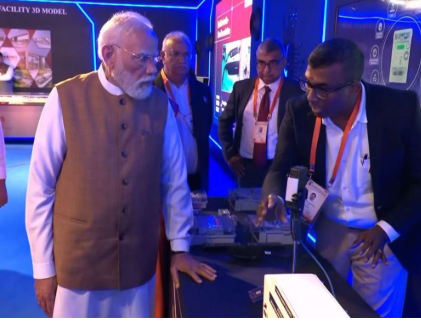
NEW DELHI, Mar 31: The Prime Minister Narendra Modi on Tuesday inaugurated Kaynes Semicon’s outsourced semiconductor assembly and test facility at Sanand in Gujarat on Tuesday and hailed the pace of Indian semiconductor ecosystem’s growth.
Addressing the gathering, Mr Modi said India was strengthening its role as a reliable semiconductor supplier in the global market. He noted he was in Sanand on the last day of February for the start of Micron Technology’s production and returned on the last day of March for Kaynes facility. “This is not a coincidence. This is proof of the pace at which India’s semiconductor ecosystem is growing,” he said.
Stating that the project would strengthen India’s push towards self-reliance, which marks a landmark step in building a robust semiconductor ecosystem, he said India’s decision to join the Pax Silica initiative aims to strengthen the supply of critical minerals.
Calling the development a moment of pride as an Indian company has joined the global semiconductor supply chain, Mr Modi said this was not just the time of economic competition but a time to shape the future tech landscape.
“With the commencement of production in this project, India is further strengthening its role as a reliable semiconductor supplier in the global market. In a sense, a new bridge has emerged today between Sanand and Silicon Valley; the plant in Sanand is now supplying Intelligent Power Modules to a company based in California,” the Prime Minister added.
The Kaynes facility will manufacture Intelligent Power Modules used in electric vehicles and industrial applications, with a significant share of output expected to be exported. Officials said the project is already integrated with global supply chains, linking domestic production with international markets.
Mr Modi said India launched the Semiconductor Mission in 2021, which was not just an industrial policy but a declaration of India’s confidence. “India launched Semiconductor Mission 2 in the last budget to make the country self-reliant in every sector of production,” he added.
Mr Modi had inaugurated Micron’s assembly, test, and packaging facility on February 28, making it the first American semiconductor company to manufacture in India. Kaynes Technology is an Indian electronics manufacturing company. Its Sanand facility will focus on semiconductor packaging and the production of intelligent power modules for global markets.
Modi said the modules manufactured in Sanand will reach American companies and from there power the entire world. “The success of the mantra Make in India, Make for the World will echo in every corner of the world,” Modi said. He added that products manufactured at the facility have been booked for export, making it commercially operational from day one.
“A new bridge has been built between Sanand and Silicon Valley,” Modi said. “In the days ahead, many Indian companies, through global collaboration, will provide a resilient semiconductor supply to the world. Today is a day for Make in India, Make for the World.”
Citing industry estimates, the Prime Minister noted that India’s semiconductor market, currently valued at around $50 billion, is projected to cross $100 billion by the end of the decade. He also referred to the next phase of the semiconductor mission, which aims to develop domestic capabilities in equipment and materials, alongside efforts to secure critical raw material supply chains through initiatives such as the National Critical Minerals Mission.
On the technology front, he cited the development of the indigenous ‘Dhruv 64’ microprocessor as part of efforts to strengthen design and manufacturing capabilities across the value chain.
Mr Modi said India’s semiconductor ambitions have moved from policy to production. He added that the decision to make India self-reliant in semiconductors was taken during the Covid-19 pandemic. Under the India Semiconductor Mission (ISM), launched in 2021, 10 projects worth ₹1.6 lakh crore are underway across six states.
The Kaynes facility has been built with a production capacity of 6.33 million units daily, with an investment of about ₹3,300 crore under the ISM.
Modi said the government has moved to the next phase with the launch of India Semiconductor Mission 2.0, which was included in this year’s Union Budget. He said the goal was to build a full-fledged Indian semiconductor ecosystem that could play a major role in both domestic and global supply chains.
Modi said India was actively promoting industry-led research and training centres to build a future-ready workforce. “The government is on track to surpass its target of training over 85,000 semiconductor design professionals. Under the Chips to Startup programme, around 400 universities and startups have been given access to modern design tools, resulting in the design and development of more than 55 chips to date.”
He cited industry estimates placing India’s current semiconductor market at approximately $50 billion, or ₹4.5 lakh crore. Modi projected it could cross $100 billion by the end of this decade. “This shows how enormous the potential is in this sector in India.”
Modi referred to India’s inclusion in Pax Silica, a US-led initiative to secure the global silicon supply chain among nations, including Japan, South Korea, the UK, and Israel, in February. He spoke about the National Critical Minerals Mission and a ₹1,500 crore recycling scheme.
Modi said a rare earth corridor connecting Odisha, Andhra Pradesh, Tamil Nadu, and Kerala, announced in this year’s Budget, will integrate mining, refining, and manufacturing into a single national network. He said that self-reliance in semiconductors would strengthen India’s position across AI, electric vehicles, clean energy, defence, and electronics.
Modi cited progress in quantum computing, the opening of the space sector to private players, and steps taken to increase nuclear energy’s share in India’s energy mix as part of the country’s long-term technology and energy security strategy. “India’s mantra is that this era of the 21st century is not merely a time of economic competition; it is a time to shape the future technology landscape.”
The Prime Minister said the growth of the semiconductor sector would support industries such as electric vehicles, clean energy and electronics, and contribute to India’s long-term technology ambitions.