Modi Government Questioned for Allowing Exclusion of Female Journalists at Muttaqi’s Presser




Manas Dasgupta
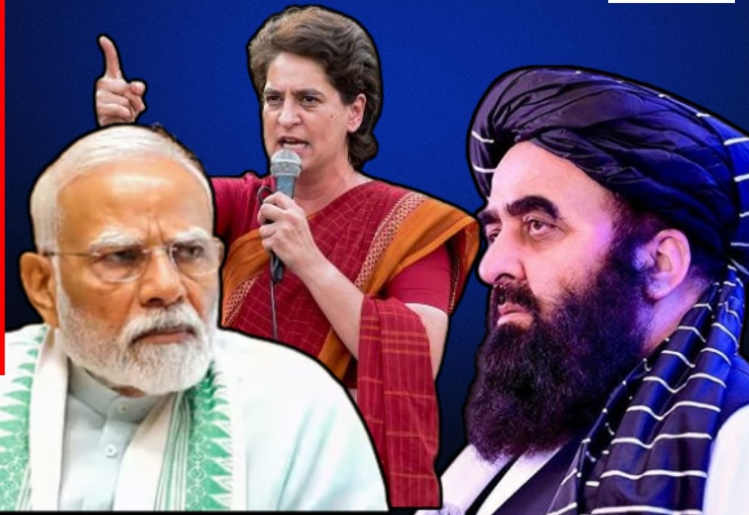
NEW DELHI, Oct 11: In the face of heavy opposition criticism of the Narendra Modi government over exclusion of female journalists from a press conference addressed in Delhi by the visiting Afghanistan foreign minister Amir Khan Muttaqi, India on Saturday insisted that it had “no role to Play” in organising the press meet and keeping the women journalists out of it.
According to the Ministry of External Affairs (MEA), the invites for the press meet went to select journalists from Afghanistan’s Consul General in Mumbai who were stationed in Delhi for the Afghan minister’s visit. The Afghan Embassy territory does not come under the jurisdiction of the Indian government, it pointed out. “MEA had no involvement in the press interaction held yesterday by the Afghan FM in Delhi,” the Ministry said on Saturday.
Women were missing at the press conference held on Friday at the Afghanistan Embassy. Some female journalists were also allegedly stopped from entering the meet. Shortly after the press meet, many journalists expressed their anger on social media and also pointed out that all women reporters had respected the dress code.
The opposition parties had strongly criticised the Modi government over the issue questioning whether it amounted to the Centre’s tacit approval to the practice of discrimination against women.
“Mr Modi, when you allow the exclusion of women journalists from a public forum, you are telling every woman in India that you are too weak to stand up for them. In our country, women have the right to equal participation in every space. Your silence in the face of such discrimination exposes the emptiness of your slogans on Nari Shakti,” Leader of the Opposition in the Lok Sabha Rahul Gandhi said in a post on social media platform X.
Demanding Mr Modi to clarify the government’s stand on the exclusion of female journalists, the Congress general secretary Priyanka Gandhi Vadra questioned whether the Prime Minister’s recognition of women’s rights was “just convenient posturing from one election to another,” and wanted to know how such an “insult to some of India’s most competent women” could have been permitted.
“Prime Minister @narendramodi ji, please clarify your position on the removal of female journalists from the press conference of the representative of the Taliban on his visit to India,” she said on X.
The press conference, addressed by Mr Muttaqi, was restricted to a limited group of male journalists, with women reporters conspicuously absent. Mr Muttaqi held the interaction at the Afghan Embassy in New Delhi, hours after holding wide-ranging talks with External Affairs Minister S. Jaishankar.
While there has been no official comment from the Government of India, it is learnt that the decision on media invitations was taken by Taliban officials accompanying the visiting minister. Sources said the Indian side had suggested to the Afghan delegation that women journalists be included among the invitees.
“(Tali)ban on female journalists in India. Shocking and unacceptable that the Govt of India agreed to it – and that too in New Delhi on the eve of the International Day of the Girl Child,” Congress communication chief Jairam Ramesh said in a post on X. Former Finance Minister P. Chidambaram, expressing his personal view, said, “The men journalists should have walked out when they found that their women colleagues were excluded (or not invited).”
Communist Party of India general secretary D. Raja, tagging External Affairs Minister S. Jaishankar in his X post, asked, “Was it just Taliban misogyny or a tacit endorsement of it on Indian soil? The Republic of India is built on equality. We are the nation which gave women voting rights from day one, when many Western countries lagged behind. To allow such exclusion here is blasphemy to our constitutional spirit.”
Mr Raja urged the Ministry of External Affairs to explain how it agreed to “permit this discriminatory spectacle”. “This is not diplomatic nuance. This is nourishment to patriarchal ideology that wants to erase half the world from public life. We must call it out, without hesitation,” he added.
The press conference had been organised at the Afghanistan Embassy in New Delhi following bilateral talks between External Affairs Minister S. Jaishankar and Mr Muttaqi. No joint press briefing was held after the official meeting between the two ministers and the Afghan side alone conducted a separate media interaction at its embassy premises.
The Taliban regime in Kabul has faced severe criticism from various countries as well as global bodies like the United Nations for restricting the rights of women in Afghanistan. On Friday, Muttaqi side-stepped a direct question on the plight of women in Afghanistan, but said every country has its own customs, laws and principles, and there should be respect for them.
The Taliban government in Afghanistan is known for the restrictions it imposes on women, especially barring them from working. Recently, it even banned books authored by women in Afghan universities and dropped 18 courses, including Gender and Development, Women’s Sociology, Human Rights, Afghan Constitutional Law, and Globalisation and Development.
Muttaqi arrived in India on Thursday and held talks with External Affairs Minister S Jaishankar a day later. The meeting was seen as a big reset of ties, with India announcing that the technical mission in Kabul would be upgraded to an embassy – which was welcomed by the Afghanistan foreign minister.
Jaishankar, during the announcement, said, “India is fully committed to the sovereignty, territorial integrity, and independence of Afghanistan. I am pleased to announce the upgrading of India’s Technical Mission to the status of Embassy.” He also spoke about a “deep interest” in Afghanistan’s development and progress, pointing to many existing India-backed projects in that country, and committed to six more.
But the selective exclusion of female journalists at a press conference on the Indian soil has once again renewed discussions about the Taliban’s views on women and highlighted the ongoing challenges faced by Afghan women under the return of the militant group to power after the US withdrawal in 2021.
Since the Taliban regained control of Afghanistan in August 2021, they have systematically restricted women’s rights across various domains, including education, employment, healthcare, and public life.
Girls have been banned from attending schools beyond sixth grade making Afghanistan the only country in the world with such a ban.
Taliban’s higher education minister, Neda Mohammed Nadim, justified the ban by stating it was necessary to prevent the mixing of genders and because he believed some subjects being taught violated the principles of Islam.
This policy has left over 1.5 million young girls and women without access to secondary and higher education. Women also face severe restrictions in the workforce, with government positions closed to them and private sector participation heavily curtailed. Public spaces such as parks, gyms, and salons are largely inaccessible to women, and long-distance travel is forbidden without a male relative.
They are also required to stay fully covered from head to toe whenever they leave home, and the very sound of a woman’s voice in public has been effectively silenced.
These restrictions have economically marginalised women and confined them to domestic roles, erasing their presence from public life.
The Taliban have dismantled legal and institutional frameworks that previously protected women’s rights. They have dismissed female judges and replaced them with unqualified male appointees, effectively eliminating women’s access to justice.
The legal system has been weaponised to target women and girls, with reports of arbitrary detentions and physical violence for those who defy dress codes or attempt to assert their rights. Activists, educators, and ordinary citizens alike face severe risks when asserting their basic rights.
Over the past three years, women’s faces have been removed from advertisements on billboards, painted over on school murals, and scratched off posters lining city streets. Even the heads of female mannequins, dressed in full black abayas, have been covered with tinfoil, symbolizing the systematic erasure of women from public life.
The restrictions imposed by the Taliban have also had detrimental effects on women’s health and well-being.
Access to healthcare has become increasingly difficult, with many female healthcare workers barred from practicing and women facing obstacles in seeking medical treatment.
The lack of access to education and employment has led to increased poverty and dependency, while the confinement to domestic spaces has contributed to mental health issues, including depression and anxiety.
International organisations have condemned the Taliban’s policies as violations of human rights.
The United Nations has described the situation as gender apartheid, highlighting the systematic nature of the discrimination faced by women and girls in Afghanistan. Human rights groups have documented numerous cases of abuse and have called for accountability and international intervention to protect the rights of Afghan women.
Despite these oppressive conditions, Afghan women continue to resist in remarkable ways. Many organise underground schools for girls, engage in covert activism, and use digital platforms to raise awareness of their plight.
Protests and advocacy campaigns, although often met with threats or violence, reflect the resilience and determination of women to claim their rights. International human rights organisations continue to document these struggles, emphasising the need for sustained global attention and support.