


Virendra Pandit
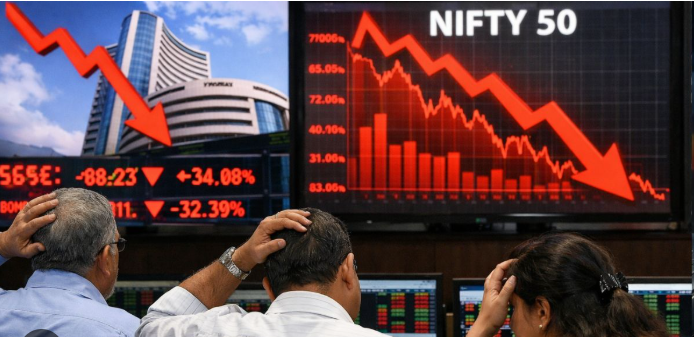
New Delhi: With the ongoing war in the Middle East involving a dozen countries escalating by the hour—US President Donald Trump said it could go on for three to four weeks!—and crude oil prices going up due to potential supply crises, India’s equity markets tumbled over 1.2 percent on Monday.
While benchmark Sensex slipped 1.29 percent (1,048.34 points) to close at 80,238.85), Nifty50 lost 1.24 percent (312.95 points) to close at 24,865.70.
Equities slumped sharply on Monday as escalating tensions in the volatile Middle East pushed crude oil prices higher and triggered a shift toward safe-haven assets, dampening investor sentiment. The sell-off was broad-based, with benchmark indices under heavy pressure and sharp declines across sectors.
The weakness extended to the broader market, with both midcap and smallcap indices falling over 2 per cent as the markets opened. All sectoral indices traded in the red, led by consumer durables and auto stocks, which declined over 3 percent. Realty, media and oil & gas indices slipped more than 2 percent.
According to media reports, crude oil prices could exceed USD 100 per barrel if tanker traffic through the Strait of Hormuz, closed by Iran, is not swiftly restored, as the waterway’s closure threatens to disrupt 15 percent of global oil supply and 20 percent of LNG supply.
After the US and Israeli attacks began on Saturday last week on Iranian government’s offices and assets, top clerical and security leadership, military and nuclear facilities, Iran has attacked nearly a dozen countries, and warned shipping away from the strait and insurers withdrew coverage, effectively halting tanker movements.
The disruption, experts said, could create a dual supply shock. Current exports through the strait remain suspended, while additional OPEC+ volumes and most of OPEC’s spare capacity – typically used to balance the global oil market – are inaccessible as long as the key waterway remains closed.
Global oil prices rose after at least three ships were attacked near the Strait of Hormuz. Brent crude was up more than 8 percent at USD 78.72 a barrel, while US-traded oil was up by around 7.6 percent at USD 72.20. Experts said the Indian economy may be impacted if the oil prices cross the USD 86 per barrel redline.
India imports 88 percent of its crude oil needs and any rise in prices will swell its import bill as well as fuel inflation.
OPEC+
Eight OPEC+ countries responsible for voluntary production cuts – Saudi Arabia, Russia, Iraq, UAE, Kuwait, Kazakhstan, Algeria and Oman – agreed on March 1, 2026, to resume unwinding their April 2023 cut of 1.65 million barrels per day. Output will rise by 206,000 bpd in April, with a further review scheduled for April 5.
Strategic stock releases by International Energy Agency members could offer limited relief, but those countries account for less than half of global oil demand.
Gas markets
A halt in LNG flows through the Strait of Hormuz would also roil global gas markets. Around 81 million tonnes (110 billion cubic meters) of LNG transited the strait in 2025, primarily from Qatar, representing nearly 20 percent of global supply.
European storage levels are below seasonal norms and about 10 percent lower than a year earlier following a severe cold spell in January.
About 1.5 million tonnes (2.2 bcm) of LNG exports are at risk for each week that flows are halted. Asian and European buyers would need to draw more heavily on storage and step up summer restocking, tightening market conditions beyond the eventual reopening of the strait.
Additional pressure could stem from precautionary closures of Israel’s Leviathan and Karish gas fields, which supplied more than 10 bcm to Egypt last year, prompting Cairo to boost LNG imports. Potential disruptions to Iranian pipeline exports to Turkey, which exceeded 7 bcm in 2025, could further strain supply.
A prolonged LNG halt would be comparable in scale to the curtailment of Russian gas supplies to Europe, which drove prices to nearly USD 100 per million British thermal units (Btu) at their peak and averaged USD 40 per mmbtu in 2022. However, reaction may be less extreme if the Hormuz disruption is seen as temporary.
Experts said the closest historical analogue is the 1970s Middle East oil embargo, which lifted prices by 300 percent to around USD 12 per barrel in 1974, or roughly USD 90 a barrel in 2026 terms.
While the global economy is less oil-intensive than five decades ago, oil prices would need to exceed USD 200 per barrel to deliver a worldwide shock comparable to that of the 1970s embargo.