


Virendra Pandit
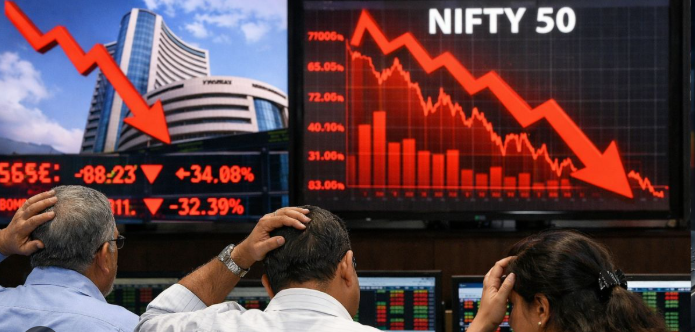
New Delhi: Equity benchmark indices Sensex and Nifty nosedived 1.7 percent on Monday as soaring crude oil prices and weak global trends due to the worsening situation in West Asia triggered a sharp sell-off in the stock market, the media reported.
The BSE Sensex tanked 1,352.74 points, or 1.71 percent, to settle at 77,566.16, registering its second day of decline. During the day, the benchmark crashed 2,494.35 points, or 3.16 percent, to 76,424.55.
NSE Nifty also dropped 422.40 points, or 1.73 percent, to end at 24,028.05. Intra-day, it tumbled 752.65 points, or 3.07 percent, to 23,697.80.
The Indian Rupee fell 53 paise to close at all-time low of 92.35 against the US Dollar.
UltraTech Cement was the biggest loser in the Sensex pack, tumbling 5.23 percent followed by Maruti, Mahindra & Mahindra, State Bank of India, InterGlobe Aviation, and Adani Ports.
In contrast, Reliance Industries, Sun Pharma, Infosys, Tech Mahindra and HCL Tech were the gainers.
Brent crude, the global oil benchmark, jumped 12.34 percent to USD 104.1 per barrel.
Russian oil
Meanwhile, the US said it has urged India to buy Russian oil already floating at sea and redirect it to Indian refineries to “tamp down” fears of supply shortages and price spikes amid the ongoing West Asia conflict, US Energy Secretary Chris Wright clarified.
However, the move, he said, is a short-term, pragmatic effort to stabilise the market and did not signal any change in Washington’s policy towards Moscow.
In an interview with CNN on Sunday, Wright said he, along with Treasury Secretary Scott Bessent, had spoken to Indian authorities about buying Russian crude cargoes currently waiting to be unloaded at Chinese refineries.
“India has been a great partner through this. I did call up the Indians, as did Treasury Secretary (Scott) Bessent, and said there’s a whole bunch of oil floating, waiting to unload at Chinese refineries.
“Instead of having it wait six weeks to unload there, let’s just pull that oil forward, have it land in Indian refineries and tamp this fear of shortage of oil, tamp the price spikes and the concerns we see in the marketplace,” he said.
However, the US policy towards Russia has not changed at all, Wright said, adding that “India is very clear on that.”
Group of Seven
The Group of Seven (G7) nations are expected to meet on Monday to discuss a joint release of petroleum from strategic reserves, coordinated by the International Energy Agency (IEA), as the West Asia conflict pushes up global crude prices, the Financial Times reported.
It stated that the United States and two other member nations have expressed support for such a release. G7 members include Britain, Canada, France, Germany, Italy, Japan, and the US.
Oil reserves
About 1.2 billion barrels of oil are held in strategic reserves by the 32 members of the IEA under a collective emergency mechanism meant to respond to oil price shocks. Of this, the US and Japan account for about 700 million barrels. According to the Financial Times, some US officials believe a coordinated release of 300–400 million barrels could be appropriate to tackle the supply crunch and control the prices.
This comes after oil prices across the globe soared to USD 116.71 a barrel on Monday before falling back a little after the news of the G7 meeting surfaced. Monday’s meeting comes after the IEA held an emergency meeting last week and said that it is “ready to act to support the stability of oil markets,” the report added. The organisation also said that the stock could last nearly a month of total oil demand in IEA countries and over 140 days of net imports.
The trigger
Oil prices surged after the US and Israel launched airstrikes on Iran on February 28, triggering retaliatory attacks by Tehran on Israeli territory and US military bases across oil-rich countries of West Asia. The escalation has disrupted oil shipments from the region and raised fears of a broader supply shock.
The G7 meeting comes as US President Donald Trump faces pressure from American leaders and allies to control prices. It also comes after his administration last week said that a release from the strategic petroleum reserves would not be needed to stabilise markets.
India is not a permanent member of the G7. However, it participated in the ‘Outreach Session’ of the G7 Summit in Canada in 2025. It is also not a full member of the IEA, and holds the status of an associate country.
However, it is one of the largest importers of crude oil in the world, along with countries such as China, South Korea, Japan, Germany, Italy and Spain.