


Virendra Pandit
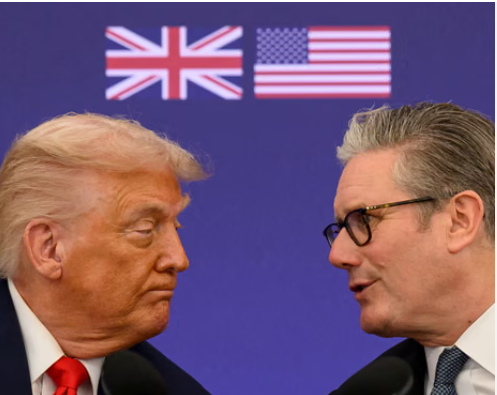
New Delhi: US President Donald Trump has accused British Prime Minister Keir Starmer’s decision to initially keep the UK away from the ongoing war in Iran may be an attempt at “Muslim appeasement,” the media reported on Tuesday.
In a telephonic interview with the British newspaper The Sun on Monday, Trump expressed his disappointment over the United Kingdom’s decision not to join the US in strikes against Iran. He alleged that PM Starmer’s decision was aimed at appeasing voters of Islamic faith in the country.
According to him, PM Starmer is pandering to Muslim voters by not backing the American strikes in Iran. Britain is “not such a recognisable country” anymore.
Referring to Starmer, Trump was quoted as saying, “He has not been helpful. I never thought I’d see that from the UK. We love the UK.”
According to The Sun, when asked about accusations that Starmer was pandering to Muslim voters for political reasons, the President said “it could be.”
“London is a very different place, with a terrible Mayor (Sadiq Khan). You have a terrible Mayor there, some terrible people. But it’s a very different place.”
The transatlantic fallout comes after Prime Minister Keir Starmer told the House of Commons on Monday that the United Kingdom was not involved in the initial US and Israeli strikes on Iran. “That decision was deliberate,” he said.
However, latest reports said London hurried to pacify Washington to contain the fallout. “The UK is still working closely with the US, a cabinet minister insisted, after President Donald Trump said the US-UK relationship was “obviously not what it was.”
Darren Jones, Chief Secretary to PM Starmer, said he understood Trump was dissatisfied that the UK was not involved in the initial joint US-Israeli strikes on Iran.
PM Starmer explained that the UK believes the best path for the region is through a negotiated settlement, one in which Iran agrees to abandon its aspiration to develop a nuclear weapon and ceases its destabilising activities across West Asia. That has been the longstanding position of successive British governments.
“President Trump has expressed his disagreement with our decision not to join the initial strikes. But it is my duty to judge what is in Britain’s national interest, and that is the judgement I made. I stand by it.”
Starmer criticised Iran’s actions, calling it a threat to the UK’s partners, interests and allies.
He also told the House that the US had requested permission to use British bases. He affirmed that the bases are limited to defensive purposes and that the UK had not joined American offensive operations.
“The United States requested permission to use British bases for that specific, limited defensive purpose. They have the capabilities required to prevent Iranian missiles from killing civilians, British nationals, or our allies in countries that played no part in the initial strike. To be clear: the use of British bases is strictly limited to agreed defensive purposes.
“The UK has not joined US offensive operations. Our action is rooted in the principle of collective self-defence of longstanding friends and in the protection of British lives. We have published a summary of our legal position, which sets this out clearly. We will keep this decision under review.”
The rapid developments come as a full-scale conflict is ongoing in West Asia involving the United States, Israel, and Iran, following a major “military offensive” launched on February 28. In a coordinated operation known as Operation Epic Fury/Roaring Lion, the US and Israeli forces carried out large-scale air and missile strikes across Iran, targeting key military sites, nuclear-related infrastructure, and leadership compounds.
In response, Iran retaliated by launching ballistic missiles and drones at US assets and allies across the region, including Israel, Bahrain, Kuwait, Qatar, the United Arab Emirates, Saudi Arabia, and Jordan. This has further widened the conflict and heightened risks for civilians and expatriates alike.
World leaders and international bodies are currently urging de-escalation as the risk of a wider regional conflict grows, though fighting continues without a clear end in sight.