


Virendra Pandit
New Delhi: Pakistan, which had signed a bilateral defence pact with Saudi Arabia in September 2025 and was now trying to broker peace between Iran and the US, was shocked on Wednesday when Tehran turned back a Karachi-bound ship at the Strait of Hormuz, saying it had “no approvals.”
With Turkiye and Egypt, Pakistan offered to broker peace between the US and Iran by organizing a conference in Islamabad, the media reported on Wednesday.
China, the so-called “all-weather friend” of Pakistan, has been virtually cut off from the happenings in West Asia, except issuing statements and watching Pakistan from the sidelines, slipping back into the arms of America.
The Strategic Mutual Defence Agreement (SMDA), signed between Pakistan and Saudi Arabia on September 17, 2025, is a major security pact declaring that any aggression against either country will be considered aggression against both. Signed by Crown Prince Mohammed Bin Salman and Prime Minister Shehbaz Sharif, it provided Saudi Arabia with a potential Pakistani security umbrella, and offered Pakistan economic and energy support.
Interestingly, while Riyadh pressed Islamabad to join its war against Tehran, Pakistan tried to divert attention by attacking Afghanistan! While its masses were on the roads supporting Iran in its ongoing war against the US and Israel, the Shehbaz-Munir duo attempted to humour Washington, which is bombing Tehran on a daily basis.
Meanwhile, US President Donald Trump, who telephoned Prime Minister Narendra Modi on Tuesday, shared on X an official statement from PM Shehbaz Sharif, sparking diplomatic speculation over a potential mediating role for Pakistan in the Washington-Tehran standoff.
Sharif expressed Islamabad’s eagerness to facilitate a diplomatic resolution to the West Asian crisis. Pakistan was “ready and honoured” to moderate “meaningful and conclusive talks” between the United States and Iran, provided there is a mutual agreement from both parties.
On Tuesday, PM Sharif said Islamabad fully supports dialogue efforts and is ready to host talks for a comprehensive settlement, subject to agreement by both Washington and Tehran.
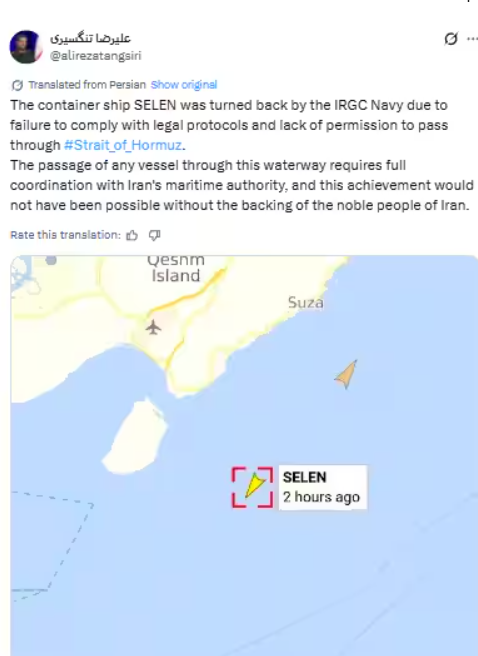
A day later, however, Iran shocked Pakistan, when asserting that it has “not approved”, it turned back a Karachi-bound container vessel at the Strait of Hormuz.
According to reports, the vessel, which departed Sharjah Anchorage late on March 23, was sailing on a standard route toward Pakistan before abruptly reversing course near the Hormuz approach and returning to the Persian Gulf.
Iran’s powerful Islamic Revolutionary Guard Corps (IRGC) Navy later confirmed it had intervened.
Rear Admiral Alireza Tangsiri said the ship was turned back for failing to comply with ‘legal protocols’ and not obtaining permission to pass through the strait. The vessels must now coordinate transit with Iranian maritime authorities.
The vessel, SELEN (IMO: 9208459), is a small feeder containership flagged in St. Kitts and Nevis and managed by Dubai-based Exceed Oceanic Trading LLC.
Despite diplomatic efforts, Iran has publicly announced that no peace or ceasefire negotiations are underway and has reiterated its intent to continue the conflict.
Iran’s action against a Karachi-bound vessel highlights a broader shift in how Tehran is handling traffic through the Strait of Hormuz, once an open international transit shipping route. Tehran is asserting that the waterway be treated as a permission-based corridor, with Iran asserting oversight over vessel movements amid the ongoing conflict.
This shift is affecting shipping behaviour, with some vessels delaying or rerouting voyages as uncertainty over access, costs, and security rises.
The Strait of Hormuz is among the world’s most critical energy arteries, carrying roughly a fifth of global oil and gas supplies.
For Pakistan, the incident is particularly worrisome. Even as it repositions itself as a potential diplomatic bridge between Tehran and Washington, a vessel bound for its own Karachi port has been stopped at the region’s most strategic chokepoint, highlighting the gap between Islamabad’s diplomatic intent and operational realities on the ground.