


Virendra Pandit
New Delhi: With Prime Ministers Narendra Modi and Mark Carney deciding to resume negotiations on the bilateral free trade agreement (FTA), India and Canada are set to restart trade talks after a two-year rift, the media reported on Monday.
The two PMs also decided to nearly double bilateral trade by 2030, Union Commerce and Industry Minister Piyush Goyal said.
In 2024, India was Canada’s seventh-largest goods and services trading partner, with two-way trade worth USD 30.9 billion. The two PMs have now set the target to increase bilateral trade to over USD 50 billion by 2030.
Meanwhile, Canadian Prime Minister Mark Carney said he will visit India in early 2026.
Ottawa had suspended trade talks after September 2023 when the then Canadian PM, Justine Trudeau, accused India of alleged involvement in the murder of a Khalistani activist on Canadian soil. Their bilateral diplomatic relations nosedived thereafter until a change of regime in Ottawa early this year.
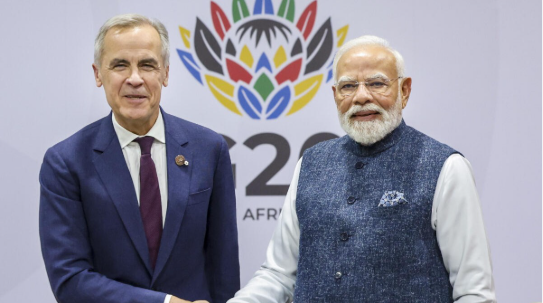
“The recent meetings that Prime Minister (Narendra) Modi and Prime Minister Mark Carney (of Canada) have had, including the one very recently at the G-20 Summit in South Africa, clearly gave a direction for the future of the Canadian-India relationship. They have agreed to begin negotiations for a comprehensive economic partnership agreement (CEPA), and double the trade between the two nations by 2030,” Goyal said on Monday.
Addressing an event organised by the Indo-Canadian Business Chamber, the minister said the focus areas for the partnership must include critical minerals, clean energy, which holds tremendous potential, aerospace, and also defence capabilities, which is an area to be looked at seriously.
About other areas of high potential, Goyal cited nuclear technology, particularly on Uranium supplies. “We can also focus on technologies like AI, data centres, quantum computing and machine learning…all new age technologies where India has very strategic benefits to offer to investors wanting to leverage on AI and emerging technology… India has the highest number of STEM (Science, Technology, Engineering, and Mathematics) graduates coming out annually, at 2.4 million,” he said.
Earlier this month, Goyal and Canadian Minister of International Trade Maninder Sidhu co-chaired the Seventh India–Canada Ministerial Dialogue on Trade and Investment (MDTI) signalling a thaw in relations between the two sides after a two-year diplomatic standoff following Canada’s accusation that Indian officials were involved in the killing of a Sikh separatist leader, who was a Canadian citizen.
“At the Seventh Ministerial dialogue, that we concluded earlier this month, we decided to reinvigorate our business-to-business contact and possibly have business delegations visiting each other’s countries. We are seriously looking at elevating this relationship to the next level,” Goyal said.
Meanwhile, Carney will visit India early next year. He accepted PM Modi’s invitation to visit India following bilateral talks between the two leaders on the sidelines of the G-20 Leaders’ Summit, that just ended in Johannesburg, South Africa.
“Prime Minister Carney accepted Prime Minister Modi’s invitation to visit India in early 2026,” said a statement issued by the Canadian Prime Minister’s office on Sunday.
The two leaders, who held a bilateral meeting, agreed to unlock the potential for deeper cooperation in defence and space sectors, besides advancing ties in areas such as trade, investment, technology and energy during the talks.
“The leaders agreed to formally launch negotiations for an ambitious Comprehensive Economic Partnership Agreement (CEPA) encompassing goods, services, investment, agriculture and agri-food, digital trade, mobility, and sustainable development,” it said.
They also agreed on the importance of regular reciprocal high-level visits, including by ministers and members of the business community, it added.
Carney welcomed the progress being made in the law enforcement dialogue between the two countries.
The two sides have taken several steps in recent months to normalise their relations. They have also agreed to revive several mechanisms to advance relations in a range of areas.