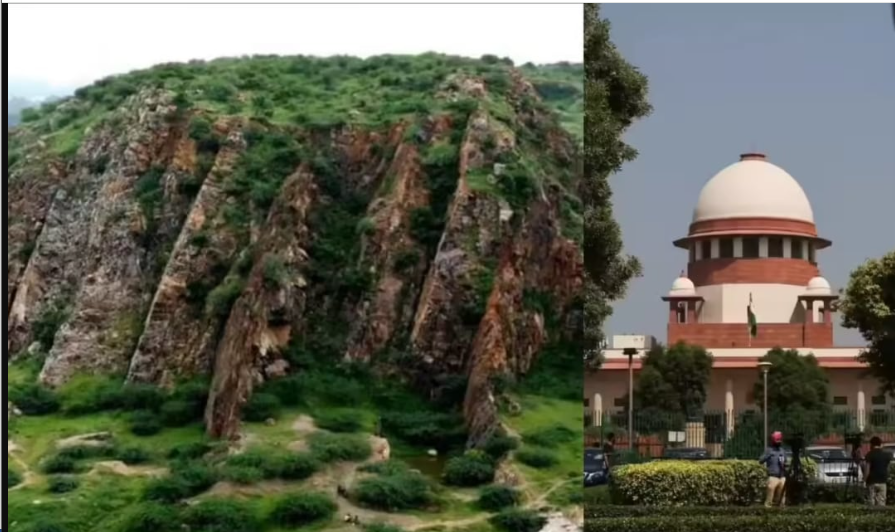









NEW DELHI, Dec 29: The Supreme Court on Monday kept in abeyance its November 20 order upholding the restricting definition by a government expert panel on the Aravalli Range to hills sporting an elevation of 100 metres or above, and hill clusters, slopes and hillocks located within 500 metres of each other.
The restrictive definition had sparked a public furore across the four Aravalli States of Rajasthan, Uttar Pradesh, Haryana, and Delhi, with environmentalists and activists voicing concerns that the shrinking of protection of the world’s oldest surviving mountain range would open the doors wide for unbridled mining in the hill ranges, which act as a green barrier against the eastward expansion of the Thar desert, and would worsen pollution in cities, including Delhi.
A three-judge Bench headed by the Chief Justice of India Surya Kant, which assembled during the court’s ongoing winter vacation, took suo motu cognisance of public apprehensions, especially that only 1,048 Aravalli hills out of a total 12,081 in Rajasthan alone would meet the 100 metre elevation threshold and, consequently, the lower ranges would be “stripped off” the environmental protection due to them. The court said pertinent factors like these have to be ascertained scientifically.
The Bench made it clear that it would form a high-powered committee to re-look the earlier government panel’s report in order to find out if its assessments suffered from a “significant regulatory lacuna.” The court called for a “multi-temporal evaluation of the short-term and long-term environmental impacts of the recommendations” of the government panel.
The court indicated that the definition of the Aravalli hill range must be arrived at only after exhaustive scientific and geological estimations, and precise measurements of all the hills and hillocks. The definition, the court underscored, must be more nuanced and maintain the “ecological integrity of the entire range.”
The court’s acceptance of the recommendations of a committee of the Union Ministry of Environment, Forest and Climate Change has led to “misconceptions and misrepresentations” about the court and the government in the public domain, the government, represented by Solicitor General Tushar Mehta, said.
The judgment had directed the preparation of a ‘Management Plan for Sustainable Mining’ by the Environment Ministry through the Indian Council of Forestry Research and Education, which would have had to get the nod of the apex court, Mr Mehta stated. The judgment had stopped the granting of fresh mining leases in the interregnum.
“But some more clarifications are required. Independent expert opinions must be obtained and considered after consulting with all the stakeholders. There is a need to resolve ambiguities and provide definitive guidance,” Chief Justice Kant responded to Mr Mehta.
A definition restricting the Aravalli Range to clusters within 500 m of each other may introduce a “structural paradox,” the court said. The court explained whether clusters with larger gaps but contiguous to the Aravalli terrain would be then opened to unregulated mining and other “disruptive activities,” thereby causing and spreading extensive damage to even the protected areas.
The court asked whether a cluster of the Aravalli hills, 100 metres or higher but with a gap of over 500 metres among them, would come within the definition of the protected area. The Bench highlighted the urgent need for laying down specific and special parameters to define the extent of Aravalli hills without compromising ecological requirements. The court listed the next hearing of the case on January 21.
(Manas Dasgupta)