

Manas Dasgupta
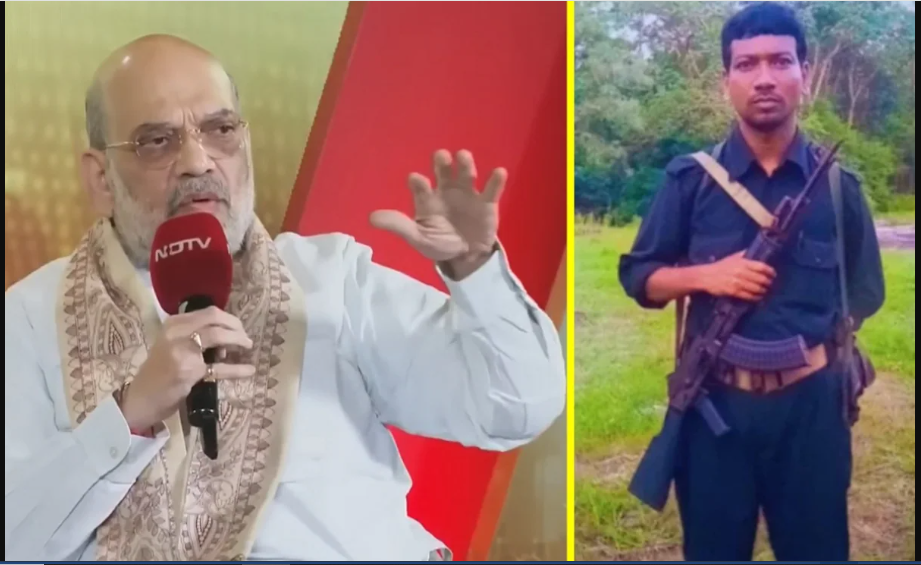
NEW DELHI, Nov 18: The killing of Madvi Hidma alias Santosh, a Central Committee member and formidable head of People’s Liberation Guerrilla Army (PLGA) Battalion No. 1, is a severe operational and ideological blow to the banned Communist Party of India (Maoist) and indicative that the deadline set by Union Home Minister Amit Shah to end left-wing terrorism by March, 2026, in the country is nearing reality.
A special party team of the Alluri Sitharama Raju (ASR) district police on Tuesday morning gunned down the elusive Maoist leader Madvi Hidma, his wife Madakam Raje alias Rajakka, and four others in an encounter near Nellooru village in Maredumilli Mandal, ASR district in Andhra Pradesh.
The encounter reportedly took place between 6 a.m. and 7 a.m., and combing operations are still ongoing, Andhra Pradesh DGP Harish Kumar Gupta said. The killing of Hidma is considered a major blow to the already dwindling Maoist movement, as Hidma had not only eluded security forces for a long time but was also regarded as a military strategist and a fierce fighter.
He headed the Central Military Commission (CMC), the main fighting force of the banned CPI (Maoist), and was known for his ability to lead and motivate his fighters with his tactical and combat skills. Born in 1981 in Sukma, Chhattisgarh (then part of undivided Madhya Pradesh), Hidma was the youngest member of the Central Committee (CC) and the only tribal from the Bastar region to be inducted into the CC, the party’s main think tank and decision-making body, in recent years.
His fighting prowess at a young age attracted the attention of Nambala Keshava Rao, alias Basavaraju, the former General Secretary of the party, who was killed in an encounter in the Abujhmad forest area of Chhattisgarh on May 21, this year, and Hidma quickly rose to lead a battalion of the People’s Liberation Guerrilla Army (PLGA), the Maoist party’s main strike force.
He carried a reward of Rs. 50 lakh and was known to have participated in at least 26 major deadly attacks, including the 2010 attack on the CRPF camp in Dantewada, Chhattisgarh, in which 76 CRPF personnel were killed, and the 2013 Jhiram Ghati ambush, in which several Congress leaders, including Mahendra Karma, Chhattisgarh Congress chief Nand Kumar Patel, and former union minister Vidya Charan Shukla, were killed.
The Maoist party, once considered the single largest terrorist threat to the country by the Union Government, now appears to be a dying movement. The Union Government, including Minister for Home Affairs Amit Shah, has set a deadline to end the movement by March 2026. In line with this, the government has launched Operation Kagar in Chhattisgarh, the Maoist stronghold, in coordination with other Left-Wing Extremist (LWE)-affected states such as Andhra Pradesh, Maharashtra, Jharkhand, Odisha, and West Bengal.
The CPI (Maoist), which once had about 42 CC members in 2004, now has only about 12. This year alone, five CC members, including the party’s General Secretary Basavaraju, were killed, while key members like Mallojula Venugopal Rao, alias Bhupathi, have surrendered. Hidma was one of the leaders on whom the CC had placed its hopes to revive its military movement. With his killing, it now seems that the endgame is drawing near.
Hidma’s killing along with other recent eliminations and surrenders of top leaders in 2025, has significantly weakened the Maoist leadership. Based on recent security intelligence reports, the remaining high-ranking leadership is severely thinned. It is primarily composed of older members of Telugu origin. The current key politburo members are Thippiri Tirupathi, known as Devuji/Devji, who was appointed as the new General Secretary and heads the Central Regional Bureau (CRB), and Misir Besra alias Sagar or Sunirmal, who heads the Eastern Regional Bureau (ERB).
Significantly, Additional Director General of Police (ADGP) (Intelligence) of Andhra Pradesh, Mahesh Chandra Laddha, has said nine of the 31 Maoists arrested from nearby districts of the state formed Devuji’s security detail. Also on the list of politburo members is Mupalla Laxman Rao, known by the name Ganapathy, the former General Secretary, who is believed to be elderly and inactive, but remains a nominal politburo member.
The reported internal friction between Devuji, who reportedly favours peace talks in his region and Besra, who has condemned surrenders and ceasefires, further compounds the party’s internal instability. “The ideological differences within the leadership are out in the open and have clearly weakened the party,” Pillari Prasad Rao, Central Committee member for 17 years, popularly known as Chandranna, who recently joined the mainstream before the Telangana police chief, said..
The Central Committee is the second-highest decision-making body. Hidma was the last tribal member from the Bastar region on this committee, which gave him unique influence over the local tribal cadres. “Hidma was influential and almost a cult figure among tribal youth who would get inspired by his talk. So his elimination is important on that count too,” Mr Gupta said.
The notable surviving CC members, excluding politburo members, include Paka Hanumanthu alias Ganesh Uike, Pathiram Manjhi alias Anal Da or Marandi, Malla Raja Reddy, known also as Sangram or Murli, and Ramdev, also known as Majidev. The consistent elimination of Central Committee members in 2025, such as Katta Ramachandra Reddy and Kadari Satyanarayana Reddy in September, shows a sustained degradation of this crucial body.
Hidma’s most significant role was as the de facto head and chief military strategist of the PLGA Battalion No. 1, the most formidable fighting unit, where he provided military leadership. His elimination creates a massive vacuum in the organisation’s military and tactical command structure. He was an expert in guerrilla warfare and had intimate knowledge of the Bastar forest terrain, which will be nearly impossible for an external or non-tribal leader to replicate.