


Virendra Pandit
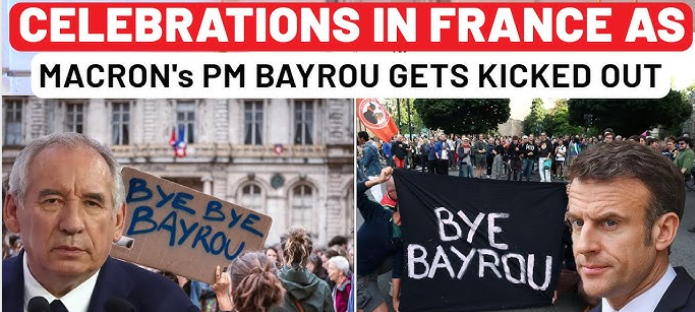
New Delhi: European Union’s largest country, France, has done it again. On Monday, the government of its fourth Prime Minister in a year collapsed after François Bayrou lost a parliamentary confidence vote, defeated by 364 to 194 in the National Assembly, plunging the country into political paralysis.
Bayrou, the 74-year-old centrist, was appointed as the PM less than nine months ago.
The result has forced Macron to search for yet another leader to steer Europe’s second-largest economy. He is likely to appoint the next PM in the “next few days.”. Bayrou was Macron’s fourth PM in a year and the sixth since his election in 2017.
With this baggage, Macron, elected in May 2017 and re-elected in April 2022, will face the next presidential poll in 2027. He holds executive power and appoints the PM but his centrist coalition lacks a parliamentary majority, forcing reliance on unstable alliances to pass key policies, the media reported.
Bayrou’s downfall stemmed from a political gamble that backfired. He proposed 44 billion euros in spending cuts and tax hikes. The measures included proposals as drastic as eliminating two public holidays to reduce costs. He argued that urgent fiscal consolidation was needed to rein in France’s public debt, which has risen to 3.35 trillion euros. He called for a vote of confidence tied to this controversial budget plan. Lawmakers instead ousted him.
Prolonged political paralysis and a revolving door of the PMs have stalled President Macron’s domestic agenda and undermined investor confidence at a time when France’s public debt has reached 114 percent of GDP. The budget deficit hit 5.8 percent of GDP in 2024, well above the EU’s 3 percent ceiling, and Bayrou’s austerity programme was intended to narrow the gap to 4.6 percent by 2026.
The country’s internal turmoil has also weakened Macron’s position as a global leader. While he is a powerful figure on the international stage, these issues threaten the country’s ability to participate in European affairs, especially as the EU needs to present a united stance in the face of the war in Ukraine and global trade disruptions.
Macron has, however, vowed to serve out his second term until 2027 and has rejected calls for his resignation.
His 2022 win against far-right leader Marine Le Pen gave him a broad mandate to pursue pro-European reforms and economic modernisation. However, his decision in June 2024 to dissolve the National Assembly and call snap legislative elections proved disastrous. Instead of consolidating power, the elections produced a splintered National Assembly with no clear bloc in control.
Since then, his governments have lurched from crisis to crisis, as they are dependent on the alliances of opposition groups, who lack the numbers to govern themselves but can combine to topple Macron’s PMs.
Marine Le Pen, leader of the far-right National Rally, has demanded that Macron dissolve parliament again and call fresh elections, calculating that her party could secure a majority this time. “A big country like France cannot live with a paper government,” she said after the vote.
On the left, socialist leader Olivier Faure has argued that it is time for his camp to lead the government and break with Macron’s pro-business agenda.
Moreover, far-left leader Jean-Luc Mélenchon and conservative Republicans such as Bruno Retailleau have already ruled out supporting a socialist-led cabinet.
Whoever Macron names as the next PM will face the same structural challenges: a fragmented Assembly, a growing opposition, and the pressing need for an acceptable budget.
Emmanuel Macron’s second term, which began on May 14, 2022, is scheduled to end on May 13, 2027. The first round of the next presidential election is scheduled to be held in April 2027.