


Virendra Pandit
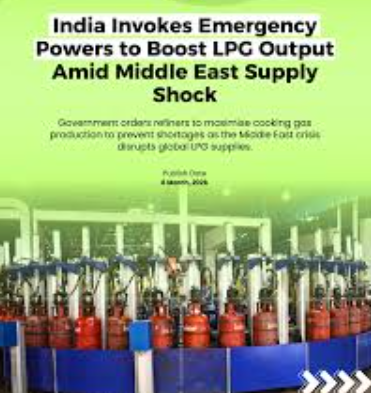
New Delhi: Invoking emergency powers amid uncertainties in energy supplies because of the raging multinational war in the global energy hub of West Asia, the government has ordered state-run oil marketing companies in India to boost liquefied petroleum gas production to meet the country’s demands, and announced rules for smooth gas supplies, the media reported on Tuesday.
These companies—Indian Oil Corporation Ltd (IOCL), Bharat Petroleum Corporation Ltd (BPCL), and Hindustan Petroleum Corporation Ltd (HPCL)—on Tuesday said they have taken steps to boost LPG production and prioritise its availability for domestic consumers and essential non-domestic sectors.
“Requests from other non-domestic sectors will be reviewed by a committee of executive directors from OMCs and prioritised based on merit, necessity, and product availability,” a joint statement by the OMCs said.
This comes a day after the Centre ordered all refineries to use their propane, butane, propylene, and butene output entirely for LPG production. It also directed domestic companies to supply all the LPG produced to IOCL, BPCL, and HPCL. These OMCs collectively supply more than 99 percent of India’s domestic LPG, multiple media reports said.
The Centre also warned that violating the order would lead to action under the Essential Commodities Act, 1955, and the Petroleum Products (Maintenance of Production, Storage and Supply) Order, 1999.
The move comes amid the disruption of oil and gas supply due to the ongoing West Asian conflict since February 28, involving the US, Israel, Iran, and other regional oil producing nations.
The continuing military strikes from both sides have strained shipping through the crucial water way of Strait of Hormuz, a narrow passage between Iran and Oman, that handles a fifth of global oil and gas trade.
India is dependent on imports for around 60 percent of its domestic LPG requirements. Of this, 85-90 percent of its total LPG imports are from West Asia, which uses the Strait of Hormuz to ship cargoes to Asia.
As part of its broader measures to meet demand during uncertainty, the OMCs have also extended the period for making fresh LPG cylinder bookings from the last delivery to 25 days, up from 21 days, to prevent hoarding. Last week, the price of domestic LPG was increased by Rs. 60 per cylinder, while commercial LPG rose by Rs.114.50 per cylinder nationwide.
ESMA
Meanwhile, the government has invoked the Essential Services Maintenance Act (ESMA), 1968/1981, to regulate the supply of natural gas, prioritising the critical commodity for households and CNG vehicles, as well as for the production of LPG for shipment.
The ESMA empowers the government to prohibit strikes and work stoppages in services critical to public life, such as transport, health, and energy supply. It is invoked during emergencies to ensure the continuity of essential services, with violations punishable by fines or imprisonment.
In an order, the Ministry of Petroleum & Natural Gas (MoPNG) prioritised the supply of natural gas to the Domestic Piped Natural Gas (D-PNG) supply, Compressed Natural Gas (CNG) for transport, LPG production, pipeline compressor fuel, and other essential pipeline operational requirements.
These sectors “shall be treated as priority allocation and shall be maintained subject to operational availability to hundred percent of their average past six- month average gas consumption.”
Fertiliser sector
The government’s second priority is to ensure that the supply of natural gas to the fertiliser plants is 70 percent of their past six months’ average gas consumption, subject to operational availability.
“The gas marketing entities shall ensure that gas supply to tea industries, manufacturing and other industrial consumers supplied through the national gas grid is maintained at 80 percent. of their past six-month average gas consumption subject to operational availability.”
CGD supplies
All City Gas Distribution (CGD) entities shall ensure that industrial and commercial consumers supplied through their networks receive eighty percent of their average gas consumption over the past six months, subject to operational availability, the gazette notification added.
Refineries gas curbs
The oil refining companies shall absorb the impact of LNG supply disruption to the extent feasible by reducing gas allocation to refineries to approximately 65 percent of the past six months’ gas consumption, subject to operational feasibility.
Gas allocation mechanism
The government also fixed the gas allocation mechanism. State-run Gas Authority of India Ltd (GAIL), in coordination with the Petroleum Planning and Analysis Cell (PPAC), shall manage the supplies of natural gas to implement the above directions, for which it shall submit the invoice price of every diverted volume of natural gas to the PPAC.
Pooled gas pricing
A pooled price shall be notified by the PPAC for the natural gas diverted from non-priority sectors to priority sectors, it added.
“The entities from priority sector to whom the pooled gas is supplied shall give an undertaking that the pooled price is acceptable to them and they shall not make the force majeure mitigation supply, subject to any litigation as this may be at variance with their existing contracts,” the notification said.
Mandatory supply data
Every producer, importer, transporter, marketer, or distributor of natural gas, including LNG and regassified LNG, shall furnish information relating to production, imports, stocks, allocation, supply, and consumption to the Central Government or to any officer authorised by it.