


Virendra Pandit
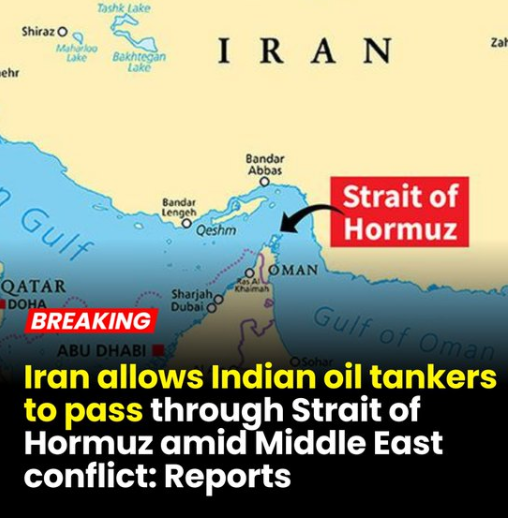
New Delhi: Amid escalating war in West Asia and uncertainties in energy supply chains, Iran may allow a safe passage for Indian-flagged crude oil tankers to pass through the Strait of Hormuz even as Tehran tightened restrictions on vessels of Israel, Europe, the US, and some other countries, the media reported on Thursday.
External Affairs Minister S. Jaishankar has held talks with his Iranian counterpart Abbas Araghchi thrice in recent days.
Reacting to media reports about Iran allowing Indian ships, Ministry of External Affairs spokesman Randheer Jaiswal said it was “premature” to say so.
India said 28 of its flagged vessels are currently operating in the Persian Gulf, and their safety is being closely monitored.
With the West Asia conflict putting stress on fuel supply routes that use the Strait of Hormuz, Iran decided to allow India-flagged ships to pass safely through the Strait, where maritime traffic has all but halted since the United States and Israel attacked Iran on February 28.
Iran’s warning
Earlier, the commander of Iran’s Islamic Revolutionary Guards Corps (IRGC) Naval Force said that vessels seeking to sail through the strategically critical Strait of Hormuz must obtain Iran’s approval; otherwise, they could become targets of Iranian attacks.
Rear Admiral Alireza Tangsiri said that two ships that had ignored Iran’s warnings were targeted in the Strait on Wednesday.
“Were the ships assured of safe passage through the Strait of Hormuz? This should be asked of the crews of the vessels Express Rome and Mayuree Naree, who today, trusting in empty promises, ignored the warnings and intended to cross the Strait, but were caught. Any vessel intending to pass must obtain permission from Iran,” the Iranian general said in a post on X.
According to Iranian state media, Iran intensified its restrictions on the passage of ships through the Strait of Hormuz. Tehran said that vessels not serving the interests of the United States and Israel can sail through safely through the strait.
More than 20 million barrels of crude oil passes daily through the narrow channel separating the Iranian coast from Oman. That volume represents roughly a fifth of all global oil consumption and nearly a quarter of seaborne oil trade. A significant share of the world’s liquefied natural gas (LNG) also moves through the same passage. When that flow falters even briefly, the consequences cascade across financial markets, supply chains, and household budgets around the world.
India monitors situation
Meanwhile, India’s Ministry of Shipping on Wednesday said that at present, 28 Indian-flagged vessels are operating in the Persian Gulf region. Of these, 24 vessels are located west of the Strait of Hormuz carrying 677 Indian seafarers, while four vessels are east of the Strait with 101 Indian seafarers onboard. The Ministry said that their safety and security are being actively monitored.
A 24-hour control room has been operational in the ministry and the Directorate- General of Shipping since February 28, 2026, to monitor developments and coordinate assistance. Authorities, ship managers and recruitment agencies are coordinating closely with Indian embassies and local authorities to ensure safety and provide assistance to Indian seafarers wherever required.
The ministry said it is closely monitoring the evolving maritime situation in the Persian Gulf region with a focus on the safety of Indian seafarers and Indian-flagged vessels. The government remains committed to ensuring the safety and welfare of Indian seafarers and protecting India’s maritime interests.
The External Affairs Ministry’s comments on Dr. Jaishankar’s conversation with Araghchi came shortly after a Liberia-flagged tanker carrying crude oil from Saudi Arabia docked at Mumbai, to become the first vessel to navigate the Hormuz and reach India since the war began.
The ministry also confirmed that some Indian nationals in Iran had returned safely, while dozens more had been shifted from within Tehran to safer locations within the war-torn country.
“We have some 9,000 Indians in Iran… these comprise students, seafarers, business people, and pilgrims. We issued an advisory some time back and, following the advisories, several – a lot of them students – left the country and reached home.”
“We also shifted several Tehran-based Indian nationals to other safer locations… and are assisting others with land-border crossings through Azerbaijan and Armenia. From there they can take commercial flights to return to India,” the ministry explained.
On Monday Dr. Jaishankar told Parliament that dialogue and diplomacy are the only means of resolving the conflict in the strife-torn Middle East, and said New Delhi is “closely monitoring developments” in a region which is home to millions of Indians. “We are concerned about their safety and wellbeing,” he said.
The Middle East, he also noted, is critical to India’s energy security and is also an important trade partner – with trade worth an estimated USD 200 billion taking place annually.
So far two Indians have died in the fighting in Iran and the wider Middle East region. Both were seamen; Captain Ashish Kumar from Bihar and Dalip Singh, from Rajasthan, died last week when Palau-flagged oil tanker Skylight came under attack off Oman’s northern coast. A third, Dixit Solanki from Mumbai, was reported missing.
Over 1,300 people have been killed in Iran alone due to the fighting, which has also impacted the world’s oil supply. The Strait of Hormuz, over which Iran has geographical control and has imposed a military blockade, ships a fifth of that supply, resulting in Brent crude price spikes.
India has played down concerns of an energy supply crisis in the country, insisting it has sufficient petroleum and gas stocks to ride out this crisis.