


Virendra Pandit
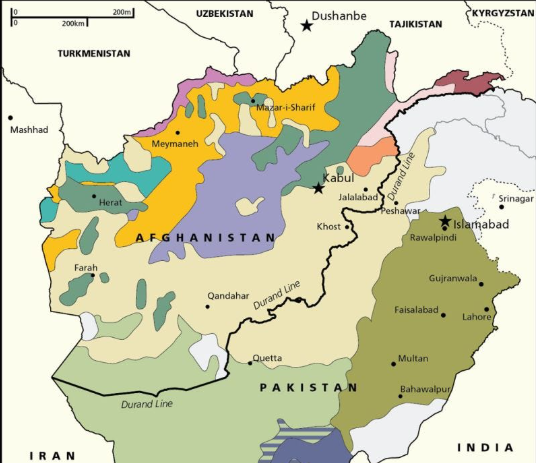
New Delhi: Afghanistan’s Taliban rulers on Saturday blamed an “irresponsible” Pakistan for a lack of results after talks mediated by Qatar and Turkiye in Istanbul, but insisted a previously agreed ceasefire will hold despite recent clashes between the two neighbours across their disputed Durand Line, which is heating up now and has become the real bilateral issue with the Taliban trying to unite Pakhtunistan on both sides of the border.
The third round of ‘peace talks’ between the two neighbours, whose intermittent clashes have claimed dozens of lives of civilians, military, and terrorists, ended on Friday without any resolution after the Taliban said several Afghan civilians were killed and others were wounded in ongoing clashes along the border, the media reported on Saturday.
Two days of talks were conducted in good faith, with the Taliban expecting Islamabad to “present realistic and implementable demands to reach a fundamental solution”, Taliban government spokesman Zabihullah Mujahid said in a statement on social media on Saturday.
“During the talks, the Pakistani side attempted to refer all responsibilities regarding its security to the Afghan government, while at the same time it did not demonstrate any willingness to assume responsibility for either Afghanistan’s security or its own.”
Mujahid claimed that Pakistan exhibited “irresponsible and non-cooperative attitude,” which meant that there was “no outcome” from the talks.
He also stressed that the ceasefire has not been violated by the Taliban, and will continue to be observed.
Pakistan on Friday also confirmed that the talks had reached a deadlock and no real progress was made as a ceasefire brokered by Qatar remained intact.
Pakistan’s Information Minister Attaullah Tarar said Islamabad “will not support any steps by the Taliban government that are not in the interest of the Afghan people or neighbouring countries”.
Pakistan maintains that Taliban failed to honour pledges made with the international community under a 2021 Doha peace accord to combat “terrorism.”
“Peace talks between Pakistan and Afghanistan’s Taliban ended without any agreement to tackle the thorny issues of cross-border terrorism as the deadlock persisted,” top officials said.
The third round of talks began on Thursday but got no written commitment from Kabul to take action against TTP terrorists, accused of launching attacks against Pakistan from the Afghan soil.
Pakistan’s Defence Minister Khawaja Asif told a private TV channel on Friday that the negotiations were suspended, with “no programme for the fourth round of talks.”
“There is a complete deadlock. The negotiations have entered an indefinite phase,” he told Geo TV, as he thanked Turkiye and Qatar for their “sincere efforts” to mediate.
“They support our stance. Even the Afghan delegation agreed with us; however, they were not ready to sign a written agreement,” he said, adding that Pakistan would accept only a formal, written accord.
“They wanted verbal assurances to be accepted, which is not possible in international negotiations,” he noted, and added the mediators had done their best but eventually lost hope.
“If they had even a little optimism, they would have asked us to stay. Our return empty-handedness shows that even they have given up on Kabul,” he said.
He reiterated that Pakistan’s position remained firm and clear. “Our only demand is that Afghanistan must ensure its soil is not used for attacks on Pakistan,” he said.
He warned that Pakistan would respond if provoked. “If there is any attack from Afghan soil, we will respond accordingly,” he said, adding that as long as there is no aggression, the ceasefire will remain intact.
Separately, Tarar said on X on Saturday that the onus lies on Afghan Taliban to fulfil its long-standing international, regional, and bilateral pledges, regarding control of terrorism, in which they have failed so far.
“Pakistan does not harbour any ill-will against the Afghan people. However, it shall never support the Afghan Taliban regime’s measures detrimental to the interests of the Afghan people as well as the neighbouring countries,” Tarar said, adding that Pakistan will continue to safeguard its citizens and sovereignty.
The peace talks began on October 29 in Doha with Qatar and Turkiye mediating between the two sides following their armed clashes between October 11 and 15, which caused human losses on both sides.
The first round of negotiations ended without any tangible progress, but the two sides agreed to have another round on October 25 in Istanbul, which also remained fruitless. The third and latest round also met the same fate.