


Virendra Pandit
New Delhi: Proving the hopefuls wrong, who read too much in the so-called ‘bonhomie’ between China and India during the Shanghai Cooperation Organization (SCO) Summit a week ago, Beijing and Islamabad have announced a USD 7 billion consortium for a railway project under the ongoing USD 60 billion China-Pakistan Economic Corridor (CPEC).
India has consistently been opposing the controversial CPEC, linking Xinjiang in China and the Gwadar port in Pakistan’s Baluchistan, as it passes through the illegal Pakistan-occupied Kashmir (PoK).
According to reports, Pakistan and China agreed to form a consortium of bilateral and multilateral partners to finance a USD 7 billion railway project, along with a four-year action plan (2025-29) for the second phase of the CPEC initiative. The two countries recently launched the second phase of the controversial CPEC project.
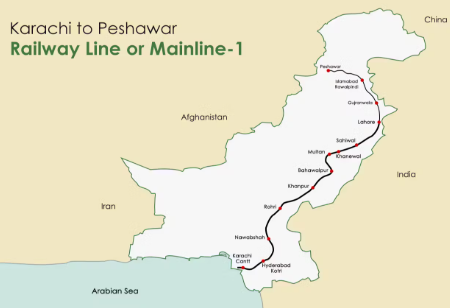
Speaking at a news conference, Planning and Development Minister Ahsan Iqbal said that during Prime Minister Shehbaz Sharif’s recent visit to China, the two sides had agreed to constitute a consortium of financiers, including the Asian Development Bank (ADB), Asian Infrastructure Investment Bank (AIIB), China and Pakistan, for the 1,700-km Karachi-Peshawar railway line, the Dawn newspaper reported on Tuesday.
He said China had assured financing not only for the rail project but also for the Karakoram Highway (KKH), which passes through PoK. It serves as a vital link connecting China with northern Pakistan, passing through hazardous terrain and connecting Gilgit-Baltistan to China’s Xinjiang region.
Negotiations with multiple financiers would be concluded within a month, Iqbal said.
Pakistan and China have agreed to develop and implement a four-year action plan to build, between 2025 and 2029, a China-Pakistan community with a shared future with stronger political trust, closer trade ties, deeper security cooperation and stronger people-to-people links.
The plan includes aligning the Belt and Road Initiative (BRI) with Pakistan’s 5Es Framework, implementing both large-scale landmark projects and small and beautiful livelihood projects, while ensuring both high-quality development and robust security, the Dawn reported.